Production Job Description — Clothing & Apparel
The factory-floor work of making garments — cutting, sewing, finishing and packing clothing at scale
Production, in clothing and apparel, means the making itself: the connected work that turns fabric into finished garments in a factory. It begins with fabric inspection and cutting, runs through the sewing lines where garments are assembled operation by operation, and ends with finishing, pressing, inspection and packing. Millions of people worldwide do this work as cutters, sewing machinists, finishers, pressers and packers, coordinated by the supervisors and managers whose office-side roles appear elsewhere in this category. This page describes production as the factory floor lives it — the stages, the skills and the standards that decide whether clothing is made well.
More Production Job Descriptions by Letter:
From Fabric to Cut Work
Production starts before any sewing. Incoming fabric is inspected for shade variation, weaving faults and damage, relaxed so it will not shrink after cutting, and recorded by roll against the orders it will serve. In the cutting room, layers of fabric are spread into a lay — dozens of plies aligned by edge and tension — a marker lays out the pattern pieces to use the cloth economically, and cutters separate the pieces by hand knife, band knife or computer-controlled cutter. Accuracy here is absolute: a mis-cut bundle cannot be un-cut, and every later stage inherits the cutting room's precision or its mistakes.
Cut pieces are ticketed, bundled and fused where interlinings are needed, then issued to the sewing floor in work order. The bundle system is production's bookkeeping made physical: each bundle carries its style, size, quantity and operation record, so work in progress can be counted, machinists can be paid by the operations they complete, and a fault found at inspection can be traced to the stage — sometimes the hands — that produced it.
The Sewing Line and Finishing
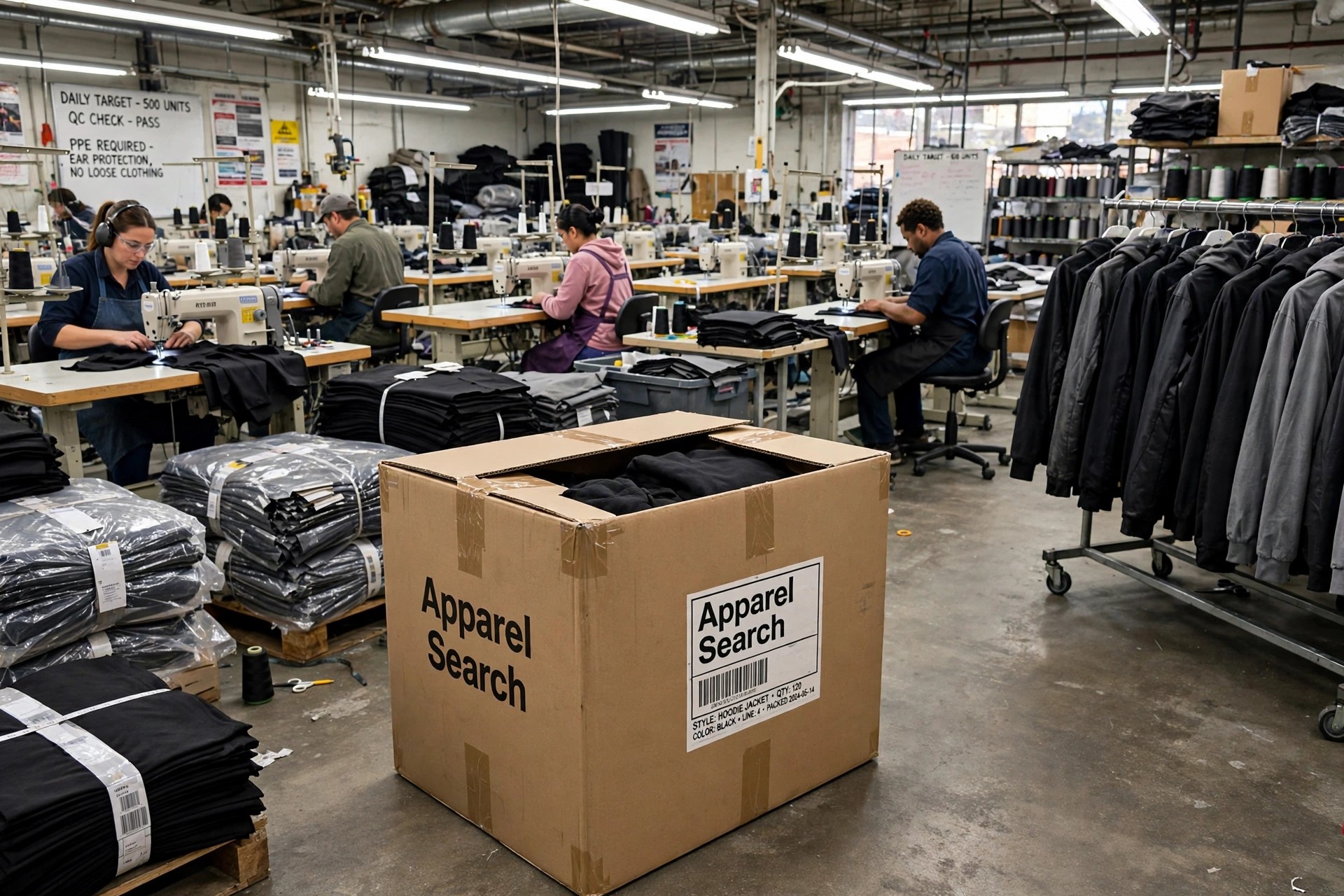
In the sewing room a garment is not made by one person but by a line. Each machinist performs a small set of operations — one sets sleeves, another closes side seams, another attaches collars — and the garment travels bundle by bundle until it is whole. Line supervisors balance the work so no operation starves or floods, trainers bring new machinists up to standard and speed, and mechanics keep hundreds of machines adjusted to their fabrics. Skill on a production line is specialised and real: an experienced machinist's seam is straighter, faster and more consistent than a beginner's on the five-hundredth repetition, not just the first.
After sewing, garments are trimmed of loose threads, finished with buttons, buttonholes and labels, pressed into their final shape and inspected against the order's quality standard. Faults are repaired where repair is honest, rejected where it is not, and passed garments are folded, tagged, polybagged and packed to the customer's specification — size ratios, carton markings and all. The packed carton, not the sewn garment, is what the customer actually ordered, and finishing is where production either protects or squanders everything the earlier stages achieved.
Quality, Pace and Working Conditions
Factory production is paced work. Lines run to output targets derived from the garment's standard time, and the day's rhythm — bundles issued, operations counted, hourly output checked — is set by the delivery dates the office has promised. Quality systems run inside the pace, not instead of it: inline checks catch a drifting operation before it produces a hundred faults, end-of-line inspection measures the whole, and acceptable quality levels decide whether a batch ships or is re-screened. The production worker's craft is holding quality at speed, which is harder than either alone.
Conditions vary widely across the world's garment industry, and responsible buyers audit factories on safety, hours and treatment as conditions of their orders. The physical reality everywhere is similar: seated or standing machine work, repetitive movements that training and rotation must manage, noise, fabric dust, and heat from pressing and finishing equipment. Good factories treat ergonomics, machine guarding and needle safety as production issues, because injured and exhausted workers make faults — welfare and quality are the same conversation on a well-run floor.
Skills, Qualifications and Career Paths
Production operatives are hired mainly on demonstrated skill: a sewing test at the machine, a cutter's trial, a finisher's sample pressing. Formal qualifications matter less than dexterity, eyesight for detail, stamina and the concentration to repeat an operation to standard all day — though garment technology courses give supervisors and technicians their theory. Training is typically at the machine, beside an experienced operative, with speed built only after accuracy is reliable.
The floor has its own ladder. Skilled machinists become trainers, line leaders and supervisors; cutters progress to cutting room supervision; quality checkers move into quality control and audit roles; and the supervisors who run whole lines are the natural candidates for the production supervisor and factory management posts described elsewhere in this category. Office-side production careers — coordination, management, direction — all draw on this floor, and the coordinators and managers who have stood on it carry an authority with factories that no spreadsheet confers.
Common Questions
What does production mean in clothing and apparel?
The manufacturing process itself: inspecting and cutting fabric, sewing garments on production lines, then finishing, pressing, inspecting and packing them to a customer's order. It is the factory-floor work that the office production roles coordinate.
What jobs make up garment production?
Cutters and spreading and marker staff in the cutting room; sewing machinists, line supervisors, trainers and mechanics on the sewing floor; and finishers, pressers, quality checkers and packers at the end of the line.
How do you get into clothing production work?
Usually by applying to a factory and passing a practical skills test — sewing, cutting or finishing — then training at the machine. Advancement runs through trainer, supervisor and quality roles toward factory and production management.
More to Explore
Garment Production Resources
References & Further Reading
More Job Description Categories
- Buying Job Descriptions
- Design Job Descriptions
- Marketing & PR Job Descriptions
- Miscellaneous Job Descriptions
- Planning & Allocation Job Descriptions
- Production & Sourcing Job Descriptions (current)
- Sales & Selling Job Descriptions
- Transportation & Warehouse Job Descriptions