Sewing Operator / Sewer Job Description
Operating industrial sewing machines to join, reinforce and decorate garments — the production line machinist’s craft
Sewing operators — also called sewers or machinists — operate or tend sewing machines to join, reinforce, decorate, or perform related sewing operations in the manufacture of garment or non-garment products. They are the largest workforce in clothing manufacturing: the line of machinists whose combined operations turn bundles of cut pieces into finished garments. Where a seamstress finishes whole garments by hand craft, the sewing operator masters machine operations at production speed, one operation performed to standard hundreds of times a day.
More Production Job Descriptions by Letter:
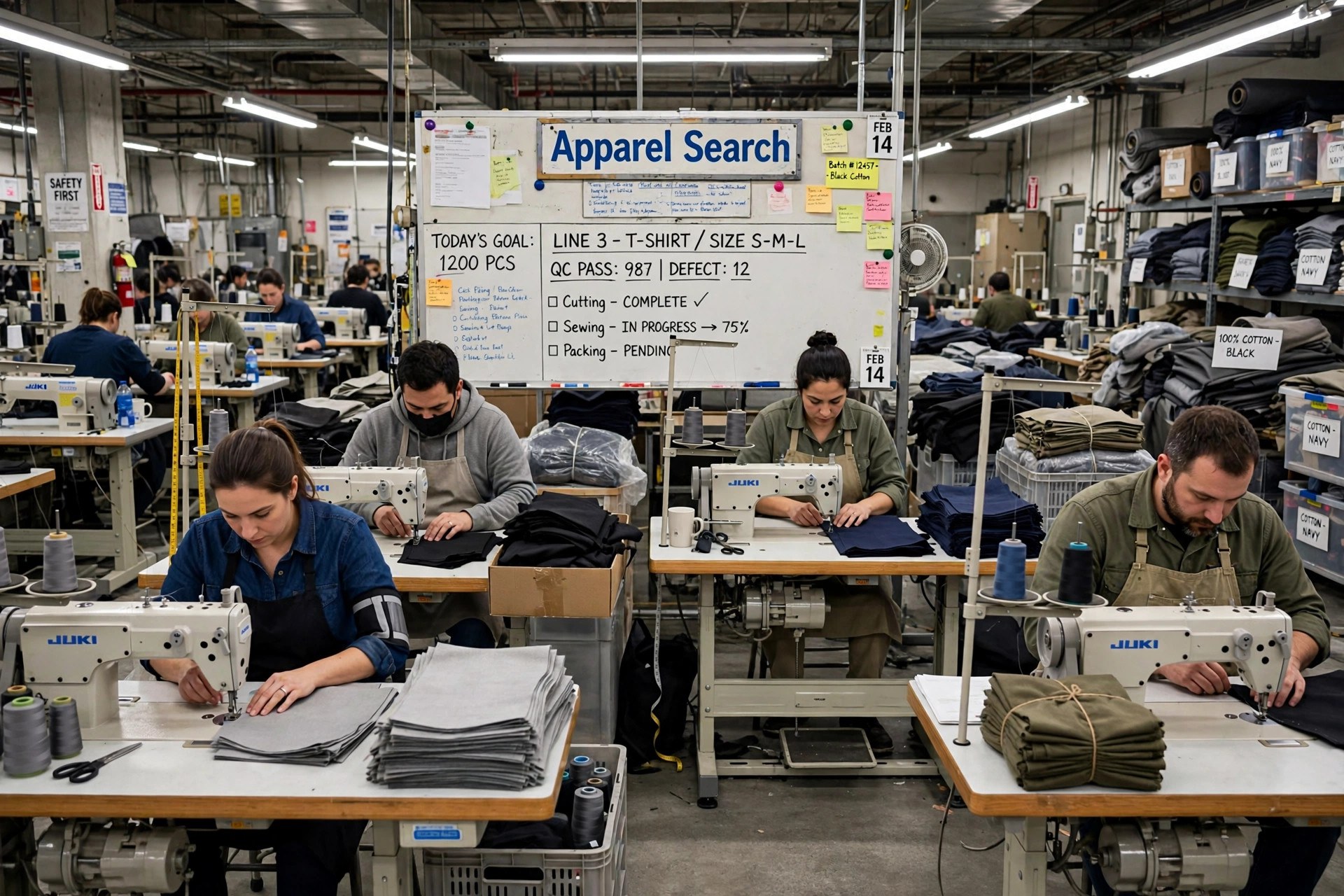
Machine Operations on the Production Line
Production sewing is divided into operations, and an operator is typically assigned one or a few: closing seams on a lockstitch machine, overlocking raw edges, attaching pockets, setting sleeves or waistbands, bartacking stress points, buttonholing, button sewing, hemming on a blindstitch or coverstitch machine, or decorative work such as topstitching and embroidery-machine tending. Each operation has a specified seam type, stitch density, seam allowance and quality standard, shown on the operation breakdown and the approved sample the line works to.
The working rhythm is the bundle system: cut pieces arrive in bundles with tickets, the operator sews the operation on every piece in the bundle, reties it and passes it on, recording the bundle for piece-rate or line accounting. Skilled operators manage their own pace against the line balance — fast enough that the next operation never starves, controlled enough that seams sit correctly first time, because every repair is unpaid time and every fault found at end-of-line inspection traces back to an operation.
Machines, Setup and Quality at the Machine
Operators are responsible for their machine’s daily readiness: threading and rethreading, winding and changing bobbins, fitting the correct needle for the fabric and changing it on schedule or at the first burr, setting stitch length and thread tension, and using the right presser foot, folder, guide or attachment for the operation. First pieces of every bundle are checked against the sample — seam allowance, stitch quality, skipped stitches, puckering, oil marks — and a fault is fixed at the machine, by adjustment or a mechanic’s call, before the bundle proceeds.
Fabric behaviour is the operator’s constant variable. Jersey stretches under the foot, chiffon creeps, denim demands needle and feed strength, slippery linings wander; experienced machinists adjust handling, speed and tension instinctively, easing or holding the fabric so seams land true. That feel for material under a needle, built over thousands of garments, is what factories mean by a skilled operator, and it transfers across products from shirts to upholstery and footwear uppers.
Pay, Pace, Safety and the Working Environment
Sewing operators work seated at machines in production lines, usually on day shifts with overtime at peak order periods. Pay is commonly by piece rate — earnings follow verified output — or hourly with production bonuses, varying by country, factory and product. The work is repetitive by design, so good factories manage it actively: operation rotation for multi-skilled operators, correct chair and table heights, needle guards and eye protection, machine maintenance that keeps treadles and motors safe, and honest pacing that skilled operators can sustain across a career.
Health discipline matters in this trade: posture, wrist and shoulder strain, eye strain and needle injuries are the known risks, and operators protect themselves and each other by reporting faults, using guards, and keeping hands clear of the needle path — the experienced operator’s speed never comes from defeating a safety device. Union and works-council representation has a long history in garment sewing, and terms vary widely between factories and countries.
Skills, Training and Career Path
Most operators are trained in the factory: new machinists start on simple straight operations under a trainer or line supervisor, build speed and accuracy, and qualify operation by operation until they hold a personal skill matrix. Prior home or school sewing helps a beginner but production machining — industrial machine speed, bundle discipline, quality standards — is its own skill learned on the line. Employers test practically: a timed sewing exercise on their machines says more than any certificate.
Advancement follows skill breadth. Multi-operation operators earn more and are kept through quiet periods; from the line, paths lead to sample machinist work, training and line supervision, quality inspection, mechanics’ assistance and production roles. Some operators move across to the hand-craft side as alteration and finishing specialists. In an industry that regularly reshores and rebuilds sewing capacity, a proven operator’s machine skills are portable between factories and products worldwide.
Common Questions
What does a sewing operator actually do all day?
Operates an industrial sewing machine performing assigned operations — closing seams, overlocking, attaching pockets, hemming, buttonholing and similar — on bundle after bundle of cut pieces, checking first pieces against the sample and recording output for piece-rate or line accounting.
How is a sewing operator paid?
Commonly by piece rate, where earnings follow verified output, or hourly with production bonuses. Skilled, multi-operation machinists earn more because they can cover several operations and hold quality at speed.
Do you need experience to become a sewing operator?
Usually not to start: factories train new machinists on simple operations and qualify them operation by operation. Home sewing helps, but industrial machine work is learned on the line, and hiring is normally by a practical sewing test.
More to Explore
Sewing Production Resources
References & Further Reading
More Job Description Categories
- Buying Job Descriptions
- Design Job Descriptions
- Marketing & PR Job Descriptions
- Miscellaneous Job Descriptions
- Planning & Allocation Job Descriptions
- Production & Sourcing Job Descriptions (current)
- Sales & Selling Job Descriptions
- Transportation & Warehouse Job Descriptions