Trim Developer Job Description
Developing the components that finish a garment — buttons, zips, labels, elastic and every notion on the bill of materials
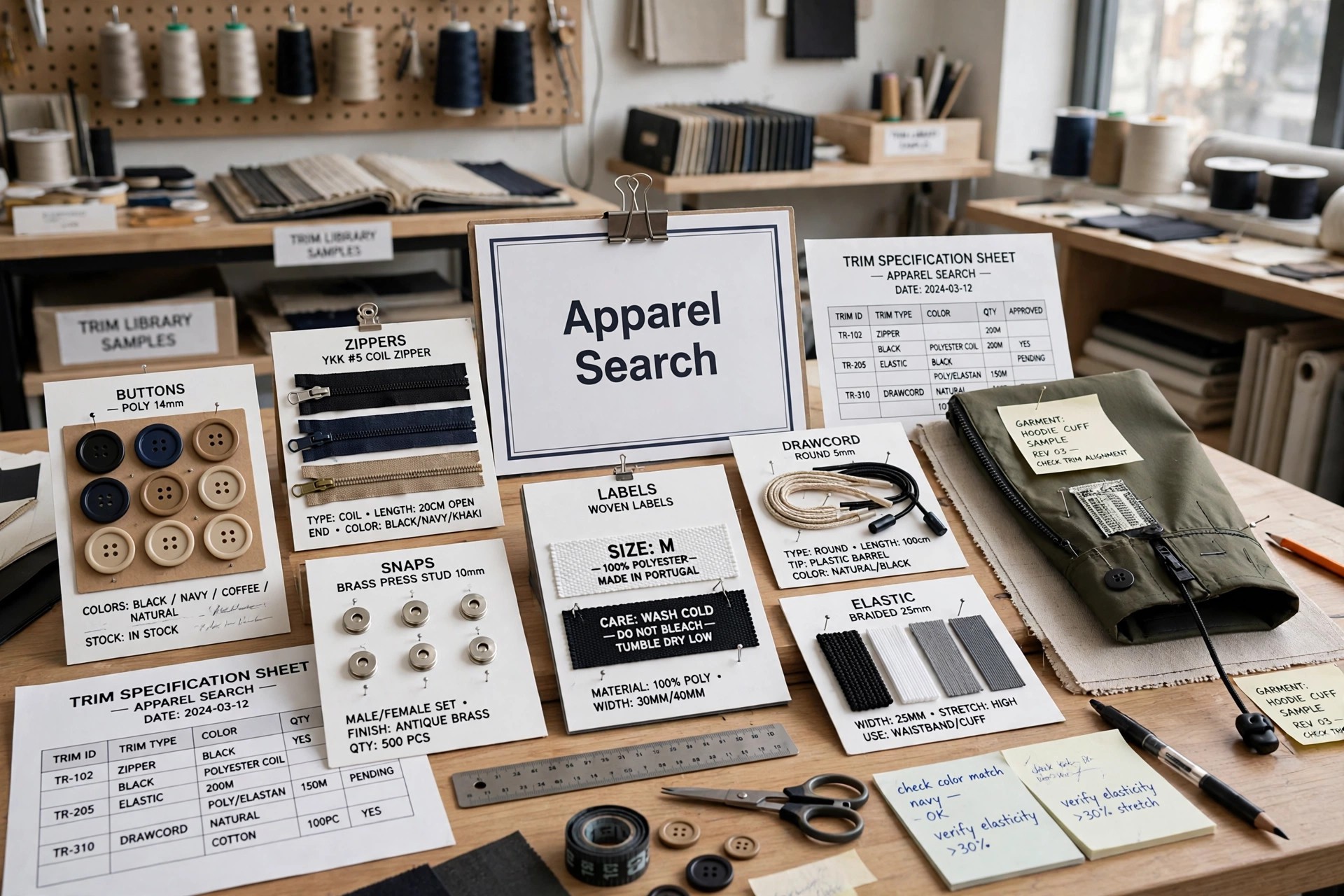
A trim developer develops everything on a garment that is not the main fabric: the buttons, zippers, snaps, hooks, labels, elastic, drawcords, tapes, threads, interlinings, shoulder pads and packaging components collectively called trims or notions. It is easy to overlook the role and impossible to produce without it — a jacket whose zip fails, a shirt whose buttons crack in washing, or a range whose labels arrive a week after the garments are sewn are all trim failures, and each was preventable at development. The trim developer sources, samples, tests, costs and approves every component so that bulk production is never waiting on a button.
More Production Job Descriptions by Letter:
Sourcing and Developing the Trim Package
Development starts from the design brief and the bill of materials. For each style, the trim developer identifies every component the garment needs, then sources options: stock trims from established suppliers where they serve, and custom developments — dyed-to-match buttons, branded zip pullers, woven labels with the house artwork, printed tapes — where the design demands them. Samples are requested, compared for appearance, hand and match to the design intent, and presented with prices and lead times so designers and product developers choose with the full picture in view.
Custom trim development is a craft of small tolerances. A button is specified by material, diameter, thickness, hole or shank type and finish; a zip by chain type, gauge, length, slider and puller, and whether its tape must dye with the garment; a woven label by yarn, weave, fold and edge finish so it does not scratch the wearer. The developer briefs suppliers in these terms, reviews counter-samples round by round, and keeps the development critical path honest — trims are small, but a custom label or a moulded button can carry the longest lead time on the whole garment.
Testing, Standards and Approval
Trims must survive the garment's life, and the developer proves it before bulk. Buttons are pull- and impact-tested and washed with the garment; zips are cycle-tested and checked for strength and for colourfastness of their tapes; snaps and rivets are tested for attachment strength — a loose small part on a child's garment is a safety hazard, and trim testing for children's products follows strict standards for attachment and for sharp edges and points. Metal components are checked for nickel and other restricted-substance compliance, and every trim is assessed on the actual garment fabric, because a trim that passes alone can still fail attached — a rigid label in a soft collar, an elastic that marks a delicate cloth.
Approved trims become standards. The developer issues the approved sample, specification and supplier reference for each component into the style's tech pack, seals reference standards for the factory and the quality team, and controls substitutions: a factory that cannot obtain the approved button may not quietly fit a similar one, because similar buttons differ in the wash, in the dry-cleaner's press and in the customer's third wearing. Substitution requests come back to the developer with samples and test evidence, and the standard changes formally or not at all.
Costing, Suppliers and Bulk Readiness
Trim is where small numbers multiply. A few cents on a button set, across a hundred thousand garments, is real money, and the developer costs the trim package component by component, negotiating prices, minimum order quantities and lead times with trim suppliers and consolidating across styles where designs allow — shared label programmes, common zip specifications, standard thread ranges — so the business buys fewer components in larger, cheaper quantities without flattening the design differences customers see.
Bulk readiness is the role's finish line. Before production, the developer confirms every trim is approved, priced and orderable in bulk quantities at the sampled quality, that supplier capacity and lead times fit the production schedule, and that factories hold the correct standards and application instructions — button sew settings, snap dies, label placements. When a trim problem surfaces in production, the developer is the person who can solve it at the source, because no one else holds the supplier relationships and the component history.
Skills, Qualifications and Career Path
Trim development needs component knowledge above all: how buttons, zips, fasteners, labels and elastics are made, specified, tested and applied, built up by handling thousands of samples and learning each supplier's craft. Around it sit sharp organisational skills — dozens of styles each carrying a dozen components through sampling at once — costing numeracy, and precise written specification, because trim instructions travel to factories and suppliers who never see the design meeting. An eye for colour and finish matching matters daily: dyed-to-match is a judgement, not a measurement alone.
Trim developers usually arrive from product development assistance, buying or merchandising support, garment technology or trim suppliers themselves, where component knowledge is deepest; fashion, textiles or garment-technology study supports entry, and employers promote on a record of ranges whose trims arrived approved, tested and on time. Progression leads to senior trim and materials development roles — broadening from trims into fabric and full materials management — and into product development and sourcing management, where the same discipline runs across everything a garment is made from.
Common Questions
What counts as a garment trim?
Every component that is not the main fabric: buttons, zippers, snaps, hooks, rivets, labels, elastic, drawcords, tapes, threads, interlinings, shoulder pads and packaging items. Together they are the trims or notions listed on a style's bill of materials.
What does a trim developer actually do day to day?
Sources and samples trims for each style, briefs custom developments such as dyed buttons and woven labels, arranges testing for strength, wash performance and safety compliance, costs the trim package, issues approved standards into tech packs and controls substitutions.
How do you become a trim developer?
Usually from product development, buying support or garment technology roles — or from a trim supplier — building component knowledge across buttons, zips, fasteners and labels. Employers look for specification precision and a record of trims approved and delivered on time.
More to Explore
Trim & Materials Resources
References & Further Reading
More Job Description Categories
- Buying Job Descriptions
- Design Job Descriptions
- Marketing & PR Job Descriptions
- Miscellaneous Job Descriptions
- Planning & Allocation Job Descriptions
- Production & Sourcing Job Descriptions (current)
- Sales & Selling Job Descriptions
- Transportation & Warehouse Job Descriptions