Spec Technician Job Description
Measuring garments against their specifications and keeping the measurement packs factories and brands trust
A spec technician — also called a measurement technician or spec tech — is the guardian of a garment’s numbers. Every style carries a specification pack listing the exact measurements it must achieve, point by point and size by size; the spec technician measures the samples that arrive from factories against that pack, records every variance, and maintains the pack itself so that design, technical teams and factories are all working to the same set of figures.
More Production Job Descriptions by Letter:
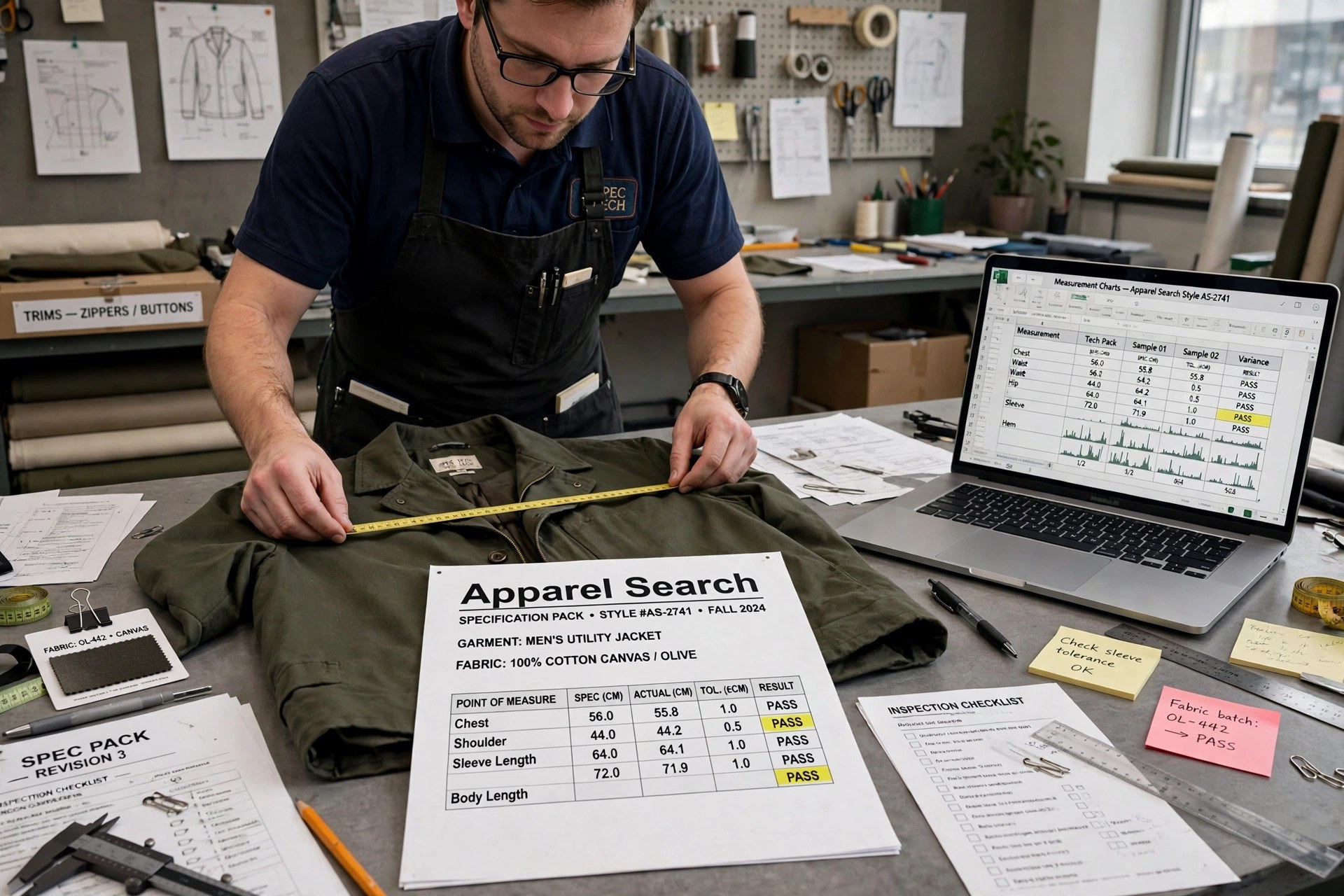
Measuring Garments Point by Point
The daily work is measurement. Garments are laid flat, relaxed and measured at defined points of measure — chest, waist, hip, body and sleeve lengths, shoulder, armhole, neck, hem sweep and dozens of style-specific points — following the pack’s stated method for each point, because a measurement taken a centimetre from the defined landmark is a different number. The technician records actuals against the specified figures and their tolerances, flagging every out-of-tolerance point clearly rather than averaging it away.
Accuracy is a discipline, not a talent: the same garment measured twice must give the same numbers, tapes are checked and replaced as they stretch, garments are conditioned and measured consistently, and results are entered exactly as read. A spec technician’s measurements decide whether a sample is approved, a fit session proceeds, or a factory is told to correct its patterns — so the numbers are trusted only because the method behind them never varies.
Maintaining Spec Packs and Supporting Fittings
Between measuring sessions, the technician maintains the packs themselves: updating figures when fittings agree changes, carrying approved measurements across the size range, checking graded increments between sizes for consistency, and keeping revision history clean so a factory never works from a superseded version. When a style is adopted from a previous season or a block, the technician verifies that inherited figures still describe the garment in front of them.
In fit sessions the technician is the record-keeper: measuring the fit sample before the session, noting the fit team’s agreed corrections against each point of measure, and issuing the updated pack afterwards. The technician also measures production and shipment samples on arrival, comparing bulk against the approved pre-production standard, so drift in a factory’s output is caught in figures before it becomes a returns problem.
Modern spec work is increasingly digital: measurements are entered into product lifecycle systems that factories read directly, graded spec tables are checked on screen across the full size range, and measurement histories accumulate into data that shows which factories hold tolerance and which points of measure cause repeated trouble. The technician’s care with data entry matters as much as the measuring itself, because the system record is what the factory, the brand and any later dispute all rely on.
Spec Technician vs Size Spec Development
The two S-letter spec roles divide authorship from execution. Size spec development is the senior, authoring side: deciding what the measurements should be — building a size specification from a block, a fit model or a brand’s size standards, choosing grading rules, and setting tolerances. The spec technician executes and maintains: measuring against the agreed specification, recording variances faithfully, and keeping the live pack correct through every revision and season.
In small companies one technical person does both jobs, and experienced spec technicians commonly grow into spec development and garment-technology roles as their judgement develops. The distinction matters for accuracy on both sides: development decisions are made deliberately and recorded once, while the technician’s measurements report what factories actually produced — and confusing the two, by quietly adjusting a pack to match a wrong sample, hides problems instead of fixing them.
Skills, Training and Career Path
The role needs precision, numeracy, patience and an orderly mind, plus enough garment construction knowledge to understand what each measurement controls — why a front rise figure changes a fit, or which points interact when a shoulder moves. Training comes through garment technology, pattern and fashion production courses, and through junior technical roles where measuring method is taught by senior technicians; employers test practically, asking candidates to measure a garment and compare results.
Spec technicians work in brand and retailer technical departments, in factories and buying offices, and for testing and inspection companies, usually in a sample room or technical office with the measuring table as the workstation. Career paths lead to garment technologist and senior technologist roles, into size spec development and fit specialism, quality assurance, or technical management — every step resting on the reputation for numbers that can be trusted.
Common Questions
What does a spec technician do in fashion?
Measures sample and production garments point by point against the style’s specification pack, records variances against tolerances, maintains and revises the pack, supports fit sessions, and checks bulk samples against the approved standard.
What is the difference between a spec technician and size spec development?
Size spec development authors the specification — deciding the measurements, grades and tolerances a style is built to. The spec technician executes and maintains it: measuring garments against those figures and keeping the pack accurate through revisions.
How do you become a spec technician?
Through garment technology, pattern or fashion production study, or junior technical and sample-room roles where measuring method is taught. Precision and numeracy are essential, and employers usually test candidates by having them measure a garment.
More to Explore
Measurement and Spec Resources
References & Further Reading
More Job Description Categories
- Buying Job Descriptions
- Design Job Descriptions
- Marketing & PR Job Descriptions
- Miscellaneous Job Descriptions
- Planning & Allocation Job Descriptions
- Production & Sourcing Job Descriptions (current)
- Sales & Selling Job Descriptions
- Transportation & Warehouse Job Descriptions