Product Development Job Description
Turning a design idea into a garment a factory can make — samples, specs, costing and approval
Product development is where a clothing idea becomes a manufacturable product. On the production side of a fashion business, the product developer takes a designer's sketch or a buyer's concept and does everything needed to make it real at a price: builds the tech pack that tells a factory exactly what to make, arranges fabric and trim, commissions and reviews samples round by round, drives fit and quality approvals, and costs the style until design ambition and commercial reality agree. Nothing goes to bulk production until development says it is ready — this role is the gate between imagination and the factory floor.
More Production Job Descriptions by Letter:
Building the Tech Pack and Specification
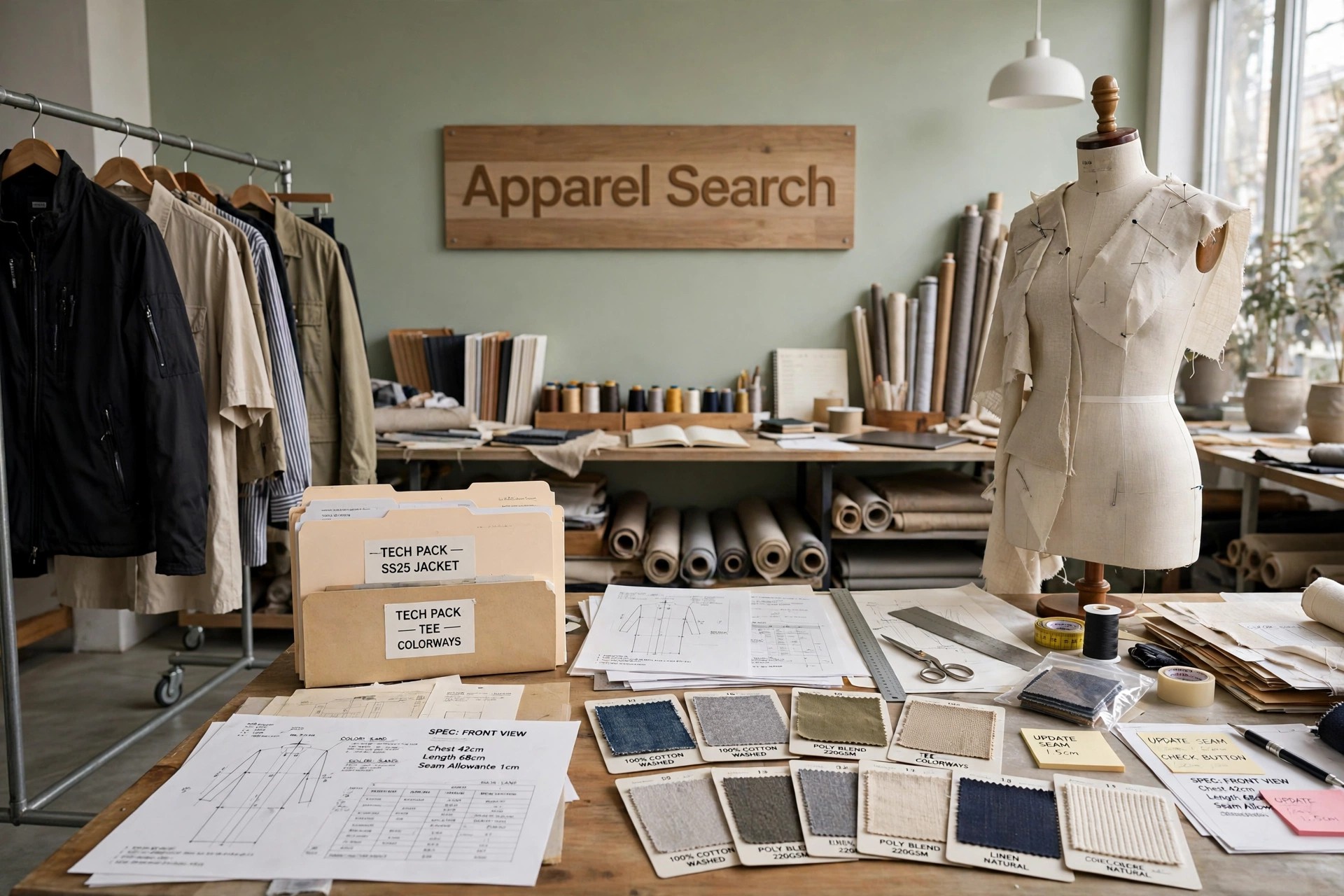
The developer's central document is the tech pack: the garment's complete written identity. It carries the technical drawings, the bill of materials listing every fabric, trim, label and thread, the measurement specification size by size, construction details and stitching standards, colourways, and the packaging and labelling requirements. A good tech pack can be handed to a competent factory anywhere in the world and produce the intended garment; a vague one produces questions, delays and samples that come back as surprises. Developers write packs to be unambiguous to someone who has never seen the original sketch.
Specifications live and change. Each sample round produces comments — a collar reshaped, a pocket moved, a measurement eased — and the developer updates the pack so the written record and the intended garment never drift apart. Version discipline sounds clerical and is anything but: factories sew from the pack they hold, and the developer who sends revision three to one factory and forgets another has manufactured a discrepancy, not a garment.
Samples, Fit and Approvals
Development proceeds by samples. A first prototype tests the pattern and silhouette; fit samples are measured, worn and reviewed, with corrections recorded against the specification; pre-production samples confirm the garment in its real fabric and trims, made the way bulk will be made. The developer manages this calendar of rounds — chasing factories for dates, measuring samples on arrival, organising fit sessions with designers and technicians, and issuing the comments that start the next round. Every round costs money and weeks, so the developer's skill is converging: each sample should be closer than the last, and the reasons it is not are identified precisely.
Approvals gate the process. Lab dips approve colour, strike-offs approve prints, trim submissions approve every button, zip and label, and performance testing confirms the product meets the standards claimed for it. The developer tracks every approval against the critical path, because a style whose fabric is approved but whose trim is not is a style that cannot be cut — and a season's launch does not move for one missing zip.
Costing, Sourcing and Production Readiness
A garment that cannot be made at its target price has not been developed, however beautiful the sample. The developer costs each style as it evolves — fabric consumption, trim, make cost, freight and duty — and negotiates the variables when the number is wrong: a fabric alternative, a construction simplification, a factory whose costs fit the product. This commercial work runs alongside sourcing: finding mills and trim suppliers who can supply the specified materials at the required quality, quantity and date, and confirming that what was sampled can actually be bought in bulk.
The handover to production is the role's finish line. When samples are approved, costs agreed and materials secured, the developer confirms the style as production-ready: final tech pack issued, approvals documented, quantities and delivery requirements clear. Production teams then place and track the bulk order — the work described in the Production Coordinator and Production Manager pages — and the developer answers for the style's definition if questions arise in the factory, because nobody knows it more completely.
Skills, Qualifications and Career Path
Product development demands a rare mixture: garment construction knowledge deep enough to specify how a garment is made, commercial numeracy for costing, and the organisational drive to run dozens of styles through parallel sample rounds without losing any of them. Developers need to read patterns and measurements, understand fabrics and trims as materials with prices and lead times, and communicate precisely with designers, technicians and factories across time zones and first languages. Product lifecycle management software, spreadsheets and specification systems are the daily tools.
Most developers arrive from garment technology, fashion design, buying or production coordination, often starting in the supporting role described on the Assistant Product Developer page and taking on styles of their own as their judgment is trusted. Degrees in fashion, garment technology or textiles support applications, but the decisive asset is a record of styles developed cleanly — approved on time, costed accurately, produced without drama. Senior paths lead to product development management, technical management, or across into production and sourcing leadership, where the same discipline runs at the scale of whole ranges instead of single styles.
Common Questions
What does a product developer do in apparel production?
Turns a design concept into a production-ready garment: builds the tech pack and specification, manages sample rounds and fit approvals, sources fabric and trim, costs the style, and confirms it ready for bulk production.
How is this different from an assistant product developer?
The assistant supports the process — tracking samples, updating packs, chasing approvals — under a developer's direction. The product developer owns styles end to end: the specification, the costing decisions and the production-ready sign-off are theirs.
What is a tech pack?
The complete written specification of a garment: technical drawings, bill of materials, measurements for every size, construction and stitching details, colourways and packaging requirements. Factories make bulk production from the tech pack, so its accuracy decides the product.
More to Explore
Product Development Resources
References & Further Reading
More Job Description Categories
- Buying Job Descriptions
- Design Job Descriptions
- Marketing & PR Job Descriptions
- Miscellaneous Job Descriptions
- Planning & Allocation Job Descriptions
- Production & Sourcing Job Descriptions (current)
- Sales & Selling Job Descriptions
- Transportation & Warehouse Job Descriptions