Size Spec Development Job Description
Deciding the numbers a garment is built to — creating size specifications, points of measure, tolerances and grading rules
Size spec development is the authoring side of garment measurement: creating the specification that defines, size by size and point by point, exactly how big every part of a garment must be. Before a spec technician can measure a sample, before a factory can cut a size run, someone must decide those numbers — from the brand’s size standards, its fit model and block patterns, and the fit the designer intends. That decision work, and the grading logic that spreads one approved size into a whole range, is size spec development.
More Production Job Descriptions by Letter:
Building a Size Specification
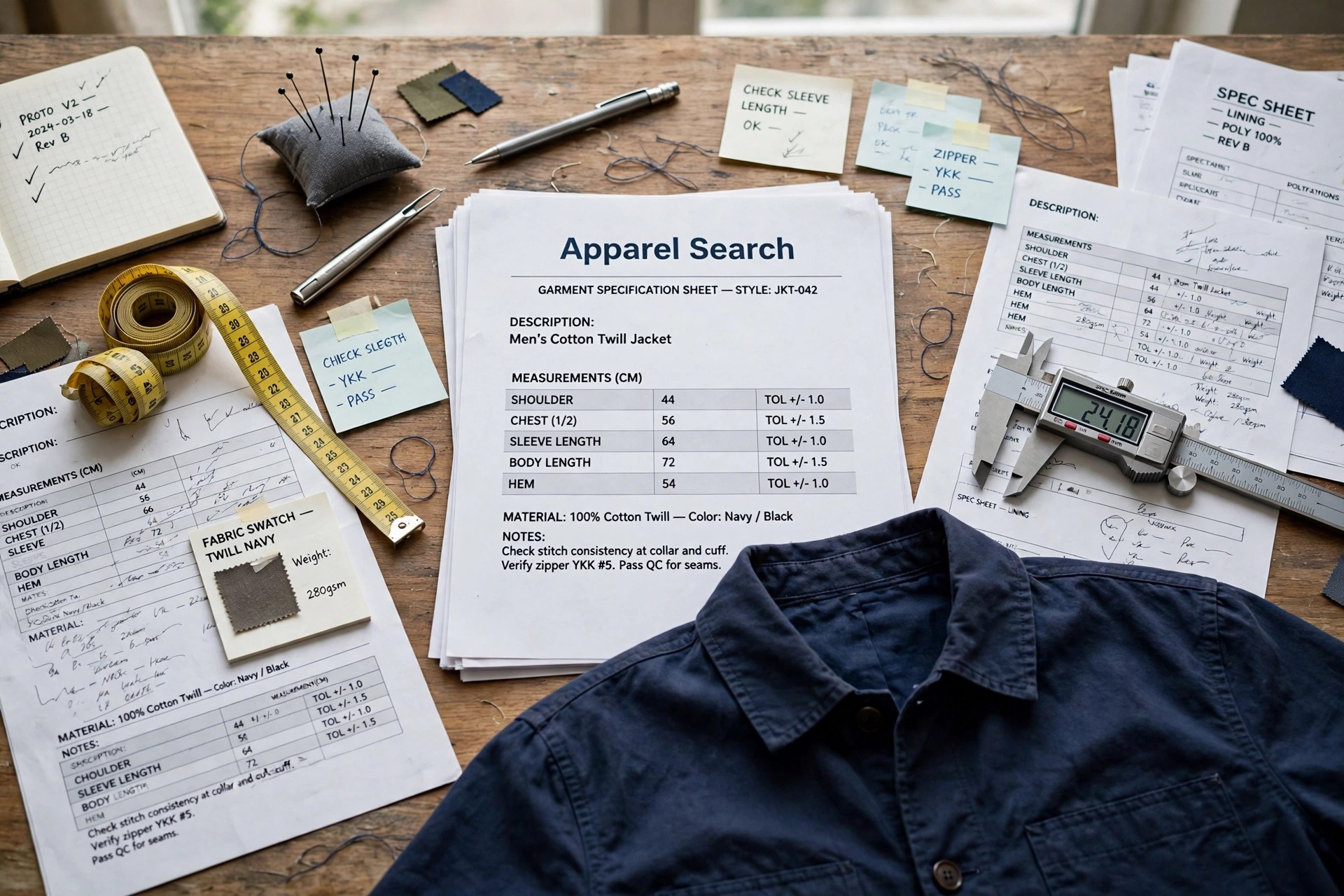
Development starts from intent. The developer studies the style’s design, its target customer and its fit category — slim, regular, relaxed — and the brand’s established size standards and block measurements, then sets the base-size specification: the full list of points of measure (chest, waist, hip, lengths, shoulder, armhole, neck, rises, sweeps and style-specific points) with a target figure for each. Every number is a judgement connecting pattern shape, fabric behaviour and the body the garment is meant to fit; stretch fabrics, shrinkage and garment washing all change what the cut figures must be for the worn garment to land on standard.
The developer also defines how each point is measured — the exact landmarks and method — and sets the tolerance for each figure: how far a factory’s garment may vary before it fails. Tolerances are commercial decisions as much as technical ones, tight where fit is critical and a customer will feel half a centimetre, looser where a point is forgiving, and always achievable by a competent factory, because an impossible tolerance produces argument, not accuracy.
Grading Rules and the Size Range
A specification for one size is a sample; a specification for a range is a product. The developer sets the grade rules: how much each point of measure grows or shrinks between sizes, and where those increments change — across a missy range, into plus sizes, through children’s age bands. Grading is not uniform arithmetic: bodies do not scale evenly, so a chest grade, a length grade and a neck grade follow different logic, and a badly graded range fits nobody except the base size it was developed on.
Range strategy is part of the role: which sizes to offer, where the volume sits, how the spec interacts with the pattern’s grade, and how new fits are tested — by measuring graded samples across the range, not just the base size, and by fit-checking the extremes where grading errors concentrate. The developer maintains the brand’s spec libraries and block standards season over season, so fits stay consistent enough that a returning customer can trust their size.
Working With Fit, Patterns and Spec Technicians
Spec development lives inside the fit process. The developer attends or directs fittings, translates the fit team’s decisions — take the waist in, lengthen the body, ease the armhole — into revised specification figures and pattern corrections, and reissues the spec with clean revision control. The work is iterative by design: each fit round sharpens the numbers until the base size is approved, then the grades are proven across the range.
The relationship with spec technicians is the control loop: developers author, technicians measure and report. A developer reads measurement reports critically — a consistent variance at one point across sizes suggests a pattern or grade issue, while a random variance suggests factory execution — and decides whether the specification, the pattern or the factory must change. That diagnostic judgement, separating a wrong number from a wrongly made garment, is the experienced developer’s core value.
Skills, Qualifications and Career Path
The role needs garment technology depth: pattern and fit knowledge, body measurement and sizing-system understanding, numeracy, and the commercial sense of what a size range must do in the market. Developers typically grow from spec technician, garment technology, pattern or fit roles, often with garment technology or fashion production qualifications, and they work in brand and retailer technical departments, in large factories’ technical offices and in sourcing organisations.
Career paths lead to senior garment technologist, fit and technical management, head of technical or quality roles, and consultancy on sizing systems and fit consistency for brands whose returns data says their sizes are costing them money. As sizing standards and digital fit tools evolve, the developer who combines old fit judgement with clean data thinking is increasingly central to how brands compete on fit.
Common Questions
What is size spec development in apparel?
Creating the size specification a style is built to: choosing the points of measure, setting the target figure and tolerance for each, defining how each point is measured, and setting the grade rules that spread the base size across the full size range.
How does size spec development differ from a spec technician’s work?
Development authors the numbers — deciding what the measurements, tolerances and grades should be. The spec technician executes against them: measuring garments, recording variances and maintaining the live pack. Developers set the standard; technicians police it.
Why do grade rules matter so much?
Because bodies do not scale evenly. If the increments between sizes are wrong, only the base size fits as intended and every other size drifts — a common cause of returns. Good grade rules keep the intended fit true across the whole range.
More to Explore
Spec Development Resources
References & Further Reading
More Job Description Categories
- Buying Job Descriptions
- Design Job Descriptions
- Marketing & PR Job Descriptions
- Miscellaneous Job Descriptions
- Planning & Allocation Job Descriptions
- Production & Sourcing Job Descriptions (current)
- Sales & Selling Job Descriptions
- Transportation & Warehouse Job Descriptions