Shipping Clerk Job Description
The records behind every dispatch — documents, labels, shipment files and carrier paperwork for clothing
A shipping clerk is the record-keeper of a clothing company's dispatch operation. Garments leave a warehouse as physical cartons, but they travel as documents: an order record, a packing list, carton labels, a bill of lading, a tracking number and, at the end, a signed proof of delivery. The clerk creates, checks and files that paper trail for every shipment, so that what the customer ordered, what the warehouse packed and what the carrier collected can all be proved to agree. It is a clerical role with operational consequences — a label or document error made at this desk becomes a misdirected delivery, a chargeback or a lost claim further down the road.
More Transportation & Warehouse Job Descriptions by Letter:
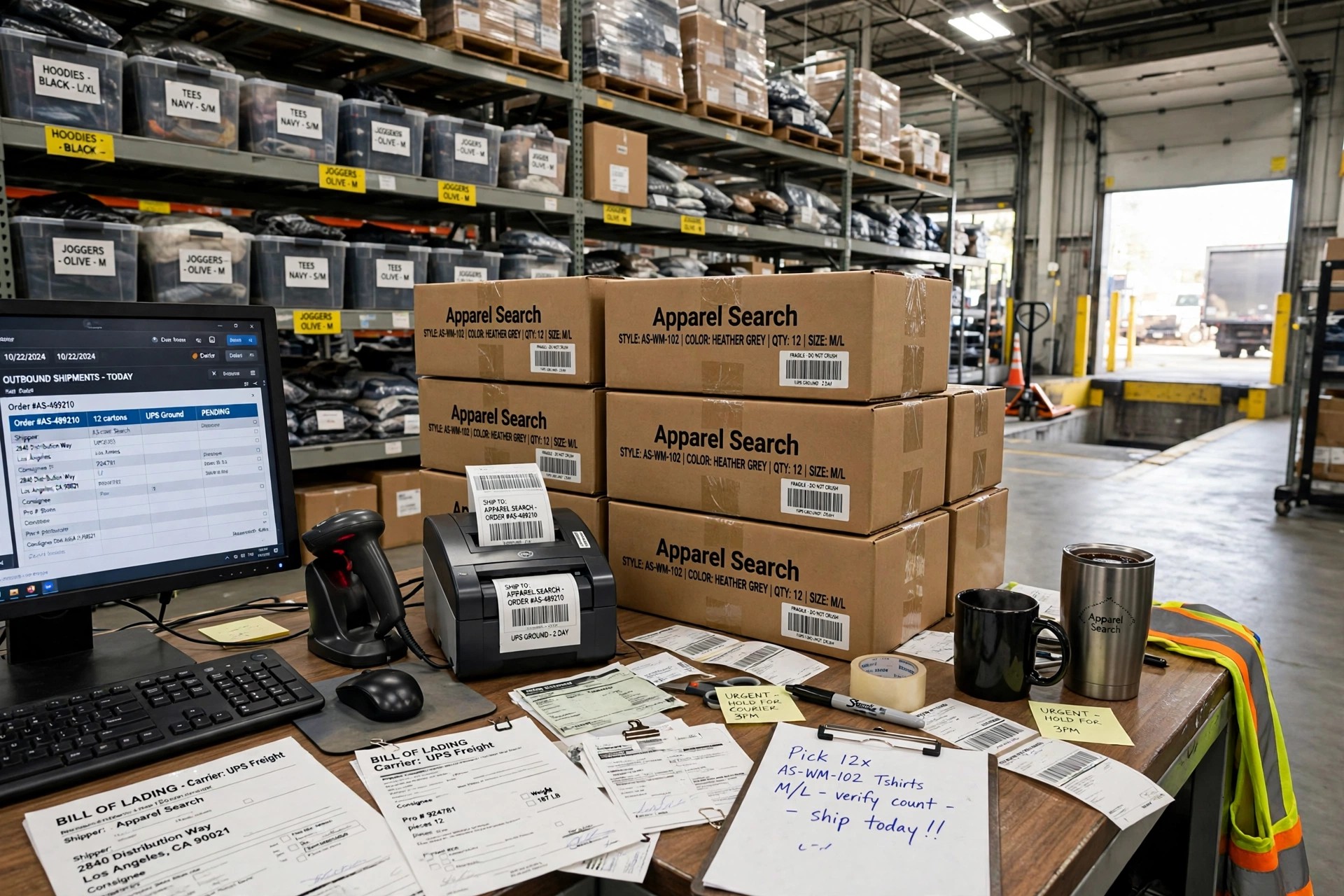
Documents and Labels: Building the Shipment on Paper
The clerk's day begins with the day's orders released for dispatch. Working from the warehouse or order system, the clerk prepares the documents each shipment needs: packing lists that state what is in every carton by style, size and colour; address and routing labels printed to the customer's or carrier's specification; and the bill of lading or carrier manifest that legally hands the freight over. Retail customers impose detailed routing guides — label placement, carton markings, advance shipping notices sent electronically before the truck arrives — and the clerk is the person who makes each shipment comply, because non-compliance is charged back to the shipper at rates that dwarf the cost of doing it carefully.
Accuracy is checked, not assumed. The clerk matches document quantities against the pick and pack records, confirms that the number of cartons, their weights and their destinations agree across every piece of paper and every system screen, and holds a shipment whose records disagree until the floor resolves it. A carton count typed one digit out does not stay a typing error: it becomes a shortage claim at the destination, an invoice dispute, and a service failure recorded against the company. The clerk's checking habit is the cheapest insurance in the whole dispatch process.
Bookings, Collections and Tracking
Finished shipments must physically leave, and the clerk arranges that too: booking collections with the parcel carriers and freight companies the company uses, preparing the end-of-day manifests, and handing the driver a set of documents that matches the freight on the vehicle. Cut-off times govern this work absolutely. A shipment whose paperwork is finished ten minutes after the last collection is a shipment that leaves tomorrow, whatever the customer was promised, so the clerk works the day backwards from the carriers' deadlines and warns the dispatch supervisor early when volume threatens them.
Once freight has left, the clerk owns its paper afterlife: tracking numbers recorded against orders, shipment confirmations sent to customers and sales teams, and proofs of delivery retrieved and filed when accounts or customers query a delivery. When a shipment goes missing, the clerk assembles the claim file — the bill of lading, the signed collection record, the declared contents and value — from which the carrier claim is made. Companies discover in that moment whether their shipping records were a system or a hope, and the clerk is the difference.
Filing, Queries and the Shipping Office Rhythm
Shipping generates a query stream, and much of it lands on the clerk's desk. Stores ask where a delivery is; the accounts department needs a proof of delivery before it can invoice or defend a deduction; a customer reports a carton short and someone must reconstruct what was packed, labelled and collected, from records rather than memory. The clerk answers from the files, in writing, with document references — which is why the filing itself, physical and electronic, is maintained as a working tool and not an archive chore: retention periods, audit trails and claim deadlines all depend on finding a two-year-old bill of lading quickly.
The rhythm of the office follows the warehouse's peaks. Order releases surge before store launches, promotions and season changes, and the clerk's workload surges with them: more documents, more labels, more carrier bookings, all against the same cut-offs. Experienced clerks plan for it — label stock and printer maintenance checked before the surge, recurring customers' routing requirements kept as standing notes, the day's problem shipments flagged at the morning meeting rather than discovered at the evening collection.
Skills, Qualifications and Career Path
Employers look for accurate, methodical clerical work: confident use of order and warehouse systems, spreadsheets and label-printing software; careful numeracy for carton counts, weights and freight charges; and handwriting-free clarity in written communication, because the clerk's emails and document notes are the record other departments act on. Previous experience in a dispatch office, warehouse administration or transport paperwork helps, but the role is also a recognised entry point into shipping for organised administrators — the specific systems and carrier procedures are taught in the job, while the accuracy the job runs on is what the interview tests.
The career path runs through the shipping office the shipping manager page beside this one describes: senior clerk and dispatch coordinator posts, shipping supervisor, and into the manager's chair for clerks who add carrier knowledge, cost awareness and team leadership to their records expertise. The clerk who understands freight paperwork completely is also well placed sideways, into traffic coordination under T in this category, where the same documents are used to move freight rather than record it.
Common Questions
What does a shipping clerk do day to day?
Prepares and checks the documents and labels for outbound clothing shipments — packing lists, carton and routing labels, bills of lading and carrier manifests — books carrier collections against cut-off times, records tracking numbers, retrieves proofs of delivery, and files the shipment records that claims, invoices and audits depend on.
How is a shipping clerk different from a shipping manager?
The clerk works on shipments: their documents, labels, bookings and records. The manager runs the shipping function: the team, the carrier contracts and rates, the budget and the service results. Clerk is the records desk inside the operation the manager leads, and a common route toward it.
What skills does a shipping clerk need?
Accuracy above all — document quantities, carton counts and addresses must agree everywhere they appear — plus confident system and spreadsheet skills, clear written communication for queries, and the organisation to work a day's paperwork backwards from immovable carrier cut-off times.
More to Explore
Shipping Resources
Transportation & Warehouse Directory Pages by Letter
References & Further Reading
More Job Description Categories
- Buying Job Descriptions
- Design Job Descriptions
- Marketing & PR Job Descriptions
- Miscellaneous Job Descriptions
- Planning & Allocation Job Descriptions
- Production & Sourcing Job Descriptions
- Sales & Selling Job Descriptions
- Transportation & Warehouse Job Descriptions (current)