Shipping Manager Job Description
Leading the dispatch function — the shipping team, carrier contracts, freight cost and delivery promises
A shipping manager runs the function that turns packed clothing into delivered clothing. The role owns outbound dispatch end to end: the shipping team and its clerks, the carriers who collect the freight, the contracts and rates that decide what each delivery costs, and the service levels customers actually experience. Where the shipping clerk works on individual shipments, the manager works on the system that produces thousands of them — its staffing against volume, its cut-off discipline, its routing compliance and its freight budget. When delivery performance is discussed by senior management, it is the shipping manager who answers for it.
More Transportation & Warehouse Job Descriptions by Letter:
Running Dispatch: Team, Volume and Cut-Offs
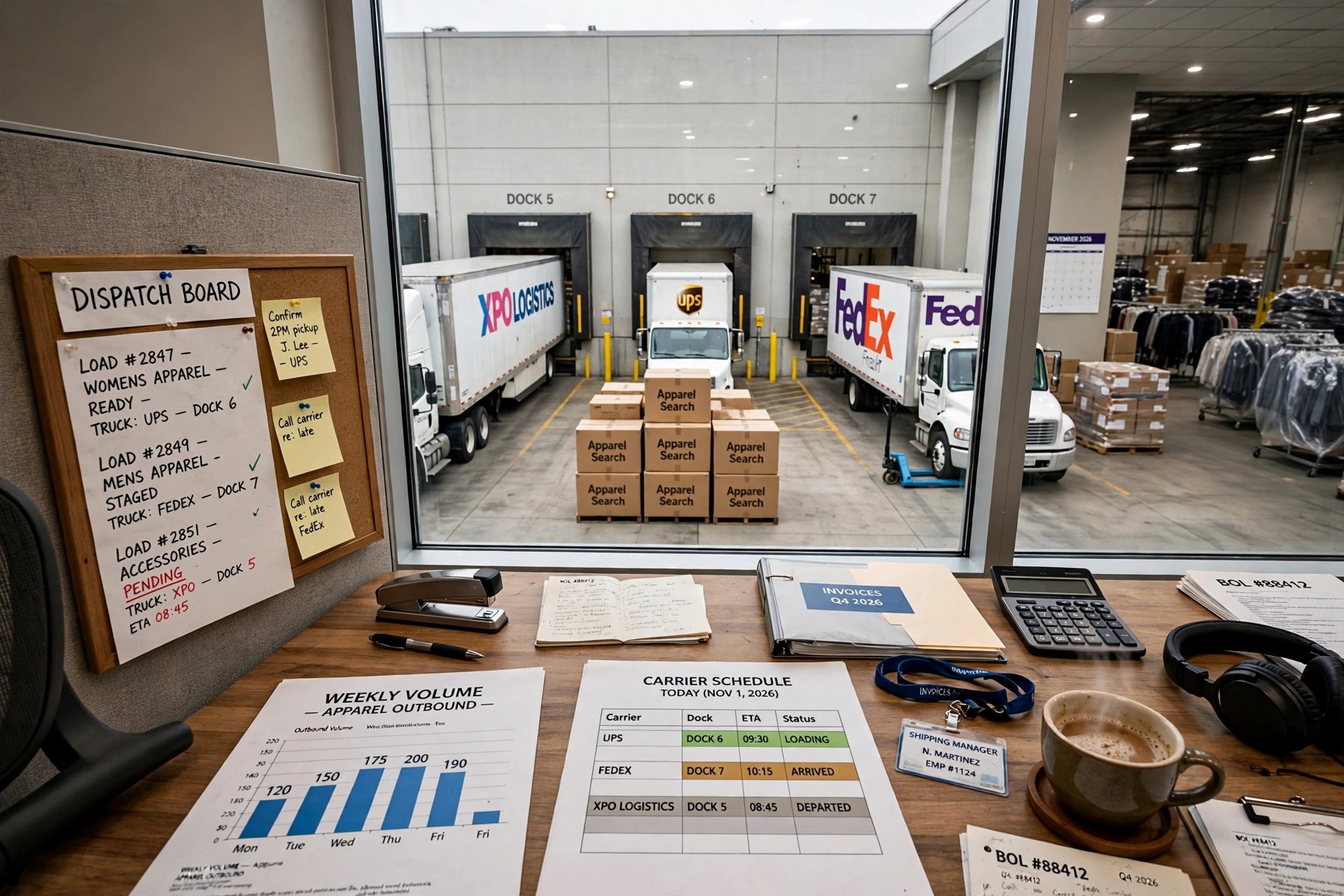
The manager plans the shipping operation around the order flow. Volumes in apparel are spiky — season launches, promotions and sale periods multiply daily dispatch — and the manager forecasts them with the sales and warehouse teams, staffs the shipping office and dock to match, and sets the daily rhythm: order release waves, documentation deadlines, carrier collection times. The collection cut-off is the function's hard edge; the manager's planning exists so that the day's promised freight is documented, labelled and staged before it, with contingency — a later carrier, a second collection, overtime agreed in advance — for the days the forecast loses.
People management is the daily substance. The manager leads shipping clerks, dispatchers and dock shipping staff through supervisors or directly: training them on customer routing requirements, checking document quality, reviewing the errors that produced claims and chargebacks, and feeding the causes back into procedures and system settings. A routing guide updated by a major retail customer is worthless until every clerk works to it, and making that happen — briefing, checking, auditing — is management work, done by this role.
Carriers, Contracts and Freight Cost
Freight is one of the largest controllable costs in a clothing business, and the manager owns the buying of it. Parcel carriers, pallet networks, freight forwarders and dedicated hauliers are selected and contracted against the company's shipment profile: destinations, carton sizes and weights, service promises and peak volumes. The manager negotiates rates and surcharges, reviews carrier invoices against the agreed tariffs — freight billing errors are endemic, and recovering them is a measurable saving — and monitors each carrier's performance: collection reliability, transit times, damage and loss rates, claim settlement behaviour.
Cost and service are traded deliberately. A cheaper carrier with weaker rural coverage, a faster service reserved for dated deliveries, split volumes that keep two carriers competitive — the manager models these choices against the freight budget and the customer promises the business has made, and reports both numbers honestly: what dispatch cost per order, and what delivery performance bought. When rates rise at contract renewal, the manager brings options, not surprises: re-tendered prices, packaging changes that cut dimensional-weight charges, consolidation of orders into fewer, fuller shipments.
Compliance, Claims and Customer Requirements
Major retail customers ship under routing guides that specify carriers, labelling, notice and timing, with financial penalties — chargebacks — for breaches. The manager owns the company's compliance with them: keeping the guides current in the shipping systems, training the team on changes, auditing dispatched shipments against the requirements, and disputing chargebacks that the records show were wrongly applied. The shipping clerk's document discipline, described beside this page, is what makes those disputes winnable; the manager builds the system that produces the discipline.
Loss and damage complete the accountability. The manager oversees the claims process for lost and damaged freight, tracks claim values and recovery rates by carrier, and attacks the physical causes — packaging that fails in transit, carton construction, pallet presentation — with the warehouse team. Insurance, declared values and carrier liability limits are set as policy by this role, balancing premium and cover against the real loss history rather than habit.
Skills, Qualifications and Career Path
Shipping managers are usually promoted from inside the function: shipping clerk and dispatch roles, supervisory posts, then management, with a record of peak seasons delivered and freight costs controlled. Employers look for working knowledge of carrier networks and rate structures, freight audit and claims practice, warehouse and order systems, and the numeracy to run a budget and a cost-per-shipment model. Formal logistics and supply chain qualifications strengthen a candidacy, but the decisive evidence is operational: volumes shipped accurately, on time, at a defended cost.
Neighbours in this directory should not be confused with this role. The shipping clerk under S is the records desk within the team this manager leads; shipping receiving, also under S, is the combined dock role of smaller operations, working both directions of freight. The traffic manager under T manages the carrier relationships for freight movement across a whole company rather than one site's dispatch. From shipping manager, progression runs to distribution and logistics management, multi-site shipping responsibility, and the wider supply chain roles under S and L in this category.
Common Questions
What does a shipping manager do?
Runs a clothing company's outbound shipping function: leading the shipping team, planning dispatch against order volumes and carrier cut-offs, negotiating carrier contracts and rates, auditing freight bills, controlling freight cost and delivery service, and owning routing-guide compliance, claims and chargeback disputes.
How is a shipping manager different from a traffic manager?
The shipping manager runs dispatch from a shipping operation — its team, its dock, its daily cut-offs. The traffic manager, under T in this category, manages freight movement and carrier strategy across a company's wider network of sites and suppliers. The two work closely; their scopes differ.
What experience leads to shipping manager?
Progressive experience inside shipping: clerk and dispatch work, supervision, carrier and rate knowledge, freight audit and claims handling, and a record of accurate, on-time peak dispatch at a controlled cost. Logistics qualifications support the case; delivered operations decide it.
More to Explore
Shipping Resources
Transportation & Warehouse Directory Pages by Letter
References & Further Reading
More Job Description Categories
- Buying Job Descriptions
- Design Job Descriptions
- Marketing & PR Job Descriptions
- Miscellaneous Job Descriptions
- Planning & Allocation Job Descriptions
- Production & Sourcing Job Descriptions
- Sales & Selling Job Descriptions
- Transportation & Warehouse Job Descriptions (current)