Warehouse Assistant Job Description
The support role that keeps an apparel warehouse supplied, sorted and counted — receiving, records and help wherever the floor needs it
A warehouse assistant helps with the numerous warehousing functions that keep an apparel warehouse running. It is a support role in the truest sense: receiving and checking what arrives, putting it where the system expects to find it, keeping the records that prove it is there, and supplying the other warehouse workers with the materials — hangtags, hangers, price tickets and the rest — that their own jobs consume. Assistants are often a newcomer's first post in a clothing warehouse, and a good one learns the whole building faster than almost any other beginner.
More Transportation & Warehouse Job Descriptions by Letter:
Receiving, Checking and Putting Stock Away
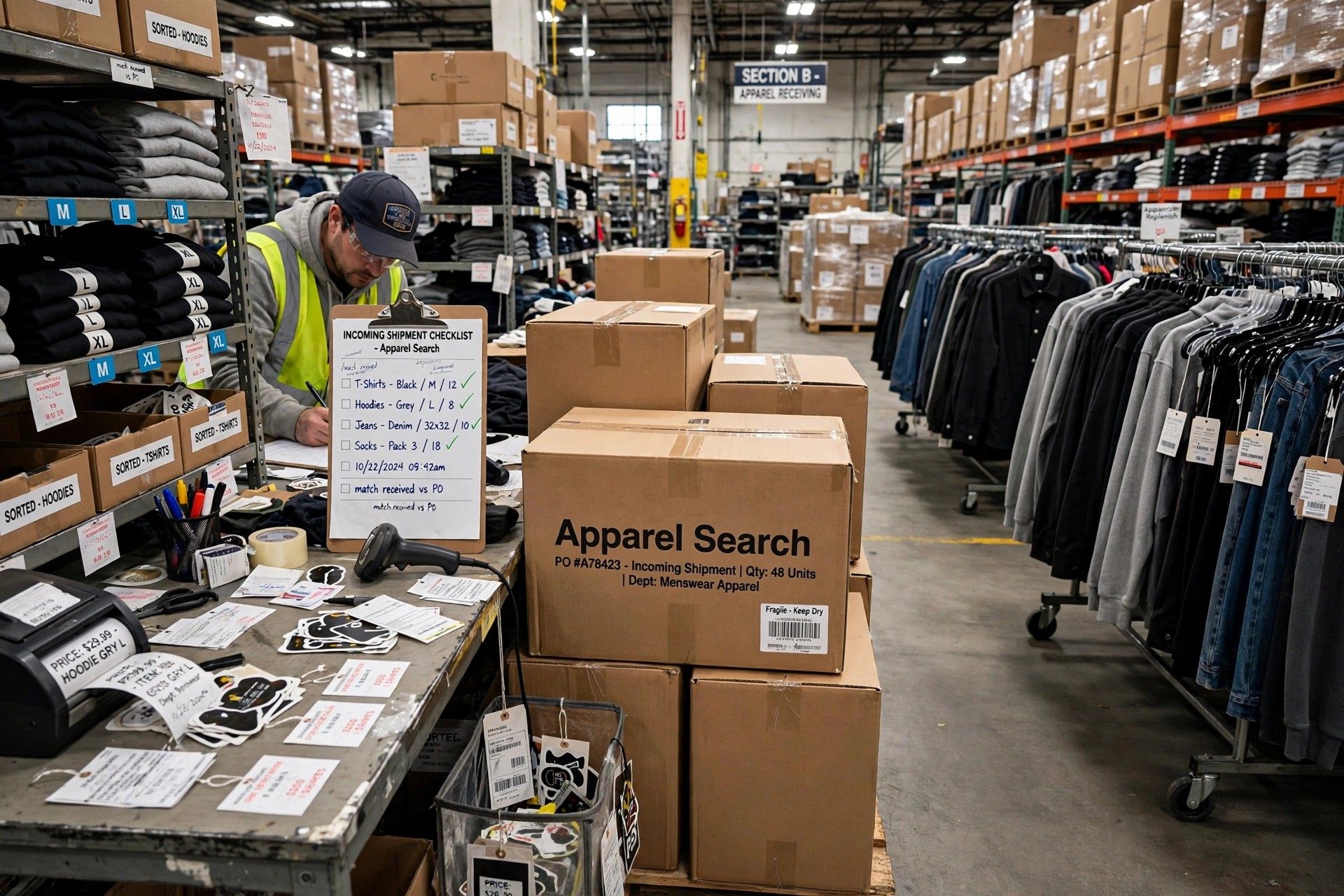
The day often starts at the receiving door. The assistant receives incoming apparel and accessory shipments and verifies their accuracy against the delivery paperwork — carton counts, styles, sizes and colors — reporting shortages and damage before the goods disappear into the building. Verified stock is then sorted and placed on racks, on shelves or in bins according to a predetermined sequence such as size, type, style or color, so that pickers later find exactly what the system says is there. Materials are marked with identifying information where necessary, because an unmarked carton in a large warehouse is stock the company owns but cannot use.
Accuracy at this stage is worth more than speed. A mis-shelved style or a miscounted size run is not discovered at the shelf; it is discovered days later, at the picking face, against a store order or a customer promise. The assistant's checking habit — paperwork against cartons, cartons against system — is the warehouse's first line of defence, and supervisors notice quickly which assistants can be trusted with it unsupervised.
Serving the Rest of the Team
Much of the role faces inward, toward colleagues. The assistant pulls and distributes materials, tools and other stock items to other warehouse workers so that orders can be filled: the hangtags, hangers and price tickets that garment processing consumes by the thousand, cartons and packaging for the packing benches, and the everyday supplies each department runs through. Merchandise is prepared for shipment as required, and the assistant helps oversee truck loading and unloading operations, making sure the warehouse's policies and procedures are followed at the door where goods and vehicles meet.
Woven through all of it is direct support to the warehouse manager: the assistant helps the manager with any tasks requested, which in practice means the role absorbs the warehouse's useful odd jobs — a recount in one aisle, a relabeled bay before an intake, a hand with an urgent despatch. That variety is the role's quiet advantage: few other junior posts touch receiving, storage, processing, despatch and records in a single week.
Records, Counts and Equipment
The assistant maintains accurate inventory records through the computerized inventory system where one is in place, or a manual system where it is not — receipts entered, movements recorded, locations kept honest. Where the warehouse requires it, the assistant maintains an accurate inventory count, performs the end-of-day inventory count and submits the reports to management, so the numbers the business plans from are the numbers the building actually holds. Requisition forms are completed to order additional equipment and supplies before a shortage stops a department.
The role also uses materials-handling equipment, such as forklifts and pallet trucks, to move stock between receiving, storage and the work areas — always under the warehouse's training and safety rules, since powered equipment is where warehouse accidents concentrate. An assistant who combines careful records with safe, confident equipment handling is carrying two of the building's core disciplines at once.
Skills, Qualifications and Career Path — Support Role, Not Picking Core
Warehouse assistant posts are typically entry-level: employers look for reliability, basic numeracy and record-keeping care, enough computer confidence for the inventory system, physical fitness for a day spent standing, lifting and walking, and a helpful temperament for a job that exists to make other people's work possible. Previous warehouse experience helps but is rarely required; training in the building's systems, locations and equipment is given on the job, and any forklift certification the employer sponsors adds immediate value.
The distinction inside this letter matters. The warehouse worker, filed beside this page, is the production core of the building — picking, packing and loading as the main job. The warehouse assistant supports that core and the manager above it: receiving checks, put-away, records, counts and supplies. From assistant, the natural steps run to warehouse worker specialisms, to inventory or receiving responsibility, and in time toward warehouse supervisor, the front-line leadership role under the same letter.
Common Questions
What does a warehouse assistant do day to day?
Receives and verifies incoming shipments, sorts and places stock by size, type, style and color, marks materials, supplies other workers with items such as hangtags, hangers and price tickets, prepares merchandise for shipment, keeps inventory records, completes requisitions, and helps the warehouse manager as requested.
How is a warehouse assistant different from a warehouse worker?
Emphasis. The assistant is a support role — receiving checks, put-away, records, counts and supplying colleagues — while the warehouse worker is the picking, packing and loading core of the building. Both are junior roles, and assistants often progress into worker specialisms.
What qualifications does a warehouse assistant need?
Usually none formal: reliability, numeracy, care with records, basic computer skills for the inventory system and the fitness for physical work. Forklift or materials-handling certification, where the employer offers it, is a strong advantage.
More to Explore
Warehouse Support Resources
Transportation & Warehouse Directory Pages by Letter
References & Further Reading
More Job Description Categories
- Buying Job Descriptions
- Design Job Descriptions
- Marketing & PR Job Descriptions
- Miscellaneous Job Descriptions
- Planning & Allocation Job Descriptions
- Production & Sourcing Job Descriptions
- Sales & Selling Job Descriptions
- Transportation & Warehouse Job Descriptions (current)