Bra Glossary / Clothing Definitions
Bra Cups: Bra Glossary Definition
Definition
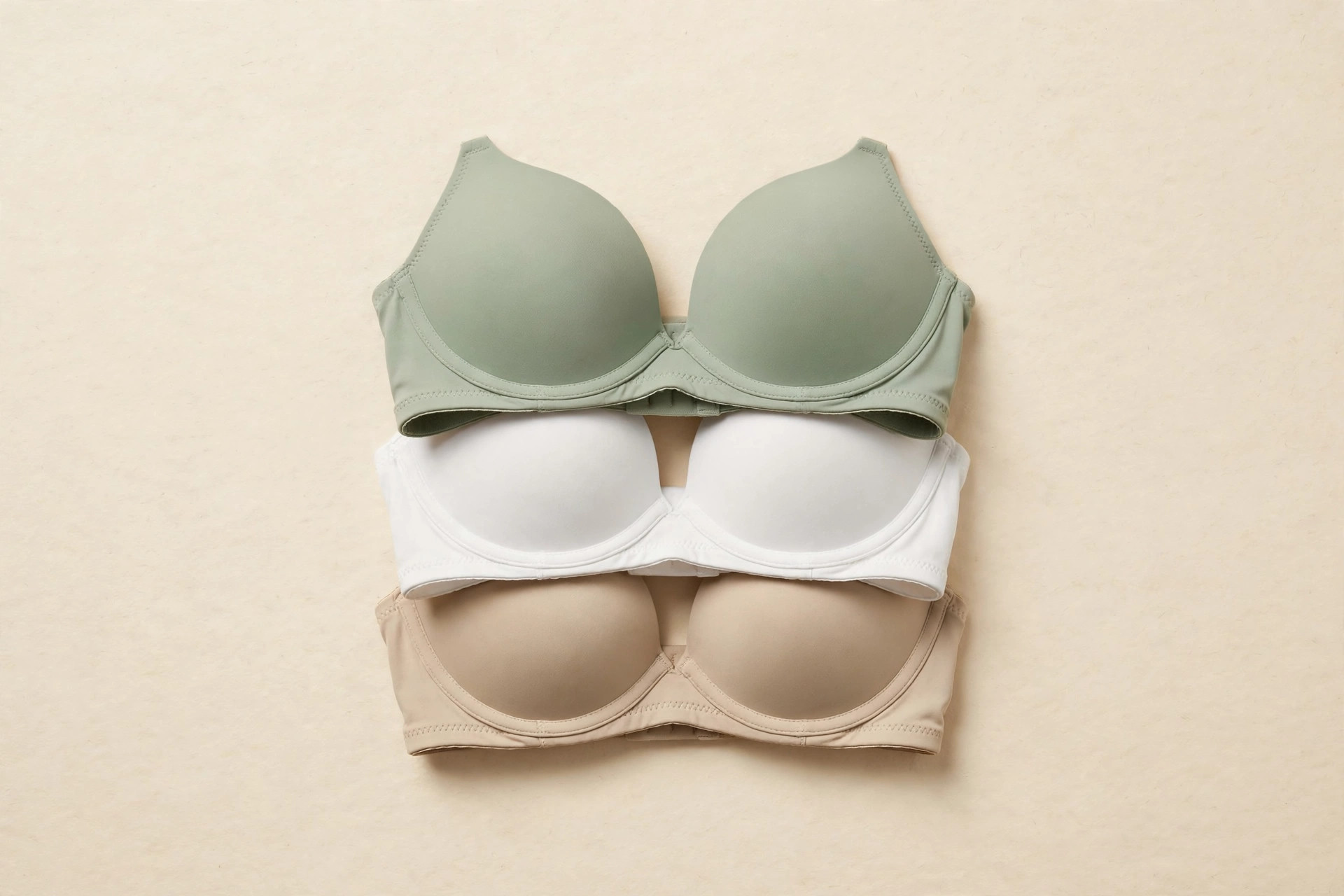
Bra cups consist of the fabric that covers and supports the breasts. Cups may be cut and sewn with multiple pieces seamed together, or they can be produced seamless, made of just one piece. Cups may be padded or non-padded.
Construction & Fit
How Bra Cups Work in Practice
Cup construction is the main dividing line in bra design. Seamed cups shape through their pattern pieces and seams; seamless and molded cups are formed to a pre-set shape. Around those two families sit the variations defined across this glossary: contour, foam, lined, soft, padded, minimizer and push-up cups.
Cup sizing works together with band sizing: the letter indicates the difference between band measurement and full-bust measurement, so the same letter represents a different cup volume on different band sizes. Accurate measuring — band snug under the bust, then fullest part of the bust — is the starting point for any cup style.
Cup shape is described by coverage as well as by construction. Full cups cover most of the breast, demi and balconette cups cover roughly the lower half, and plunge cups are cut away at the center front. The same construction — seamed, molded or foam — can be cut to several coverage levels, which is why a construction name and a style name are so often combined, as in a molded demi cup or a seamed full cup.
Inside the cup, small additions change performance. An inner sling of non-stretch fabric adds support along the side of the cup, a thin lining adds opacity and smoothness, and a cotton or moisture-wicking lining is used where comfort against the skin is the priority. Cup fabrics range from rigid lace and woven fabrics, which hold a fixed shape, to stretch lace and jersey, which adapt to the wearer.
Sizing & Volume
Cup Size, Volume and Sister Sizes
A cup letter is a difference, not a fixed volume. In the common measuring system, the band size comes from the snug underbust measurement, and each step of difference between that measurement and the full-bust measurement adds roughly one cup letter. Because the letter is relative, cup volume grows with band size: a C cup on a 38 band holds noticeably more than a C cup on a 32 band, even though the letter is the same.
That relationship produces sister sizes — combinations with approximately equal cup volume on different bands, such as moving up one band size and down one cup letter. Sister sizes are a practical fitting tool when a cup fits well but the band does not. Fit signs to check in any cup: tissue spilling over the edges means the cup is too small, a top edge that stands away means it is too large or the wrong shape, and the underwire, where fitted, should encircle the breast tissue and rest on the ribcage rather than on the tissue itself.
Sizing systems are not fully standardized. Letter sequences and starting points vary between countries and between brands, so a size that fits in one make is a starting point — not a guarantee — in another. Re-measuring when fit changes, and judging each bra by the fit checks rather than the label, gives more reliable results than the letter alone.
Care & Wear
Caring for Bra Cups
Cups last longest when they are rested and washed gently. Rotating bras so a cup has at least a day to recover between wearings protects its elastic and, in molded cups, its set shape. Washing after a few wears, with hooks fastened and the bra in a mesh bag on a gentle cycle with mild detergent, limits abrasion; air drying away from direct heat protects both elastic and foam.
Storage matters most for shaped cups. Molded and foam cups should be stacked with the cups nested in line, or laid flat — folding one cup inside the other can crease foam permanently. Seamed and unlined fabric cups are more forgiving and can be folded, though keeping any cup uncrushed under heavy items helps it keep its shape.
More to Explore
Related Bra & Clothing Guides
Common Questions
Common Questions
What are bra cups made to do?
The cups cover and support the breasts. Their construction — seamed, seamless, padded or unpadded — determines the shape, support and smoothness a bra gives.
What is the difference between seamed and seamless cups?
Seamed cups are cut and sewn from multiple fabric pieces, which allows many shapes and fabrics. Seamless cups are made from one piece, usually molded, for a smooth outline under clothing.
Can cups be padded or unpadded?
Yes. Both constructions come in padded and non-padded versions; padding adds thickness for shaping or size appearance, while unpadded cups follow the natural shape more closely.
Why does the same cup letter feel different on different band sizes?
Because cup volume scales with the band: the letter measures the difference between band and bust measurements, so a C cup on a larger band holds more volume than a C cup on a smaller band.
What are sister sizes?
Sister sizes are band-and-cup combinations with roughly the same cup volume — for example, going up a band size and down a cup letter. They are useful when a bra fits in the cup but the band is too tight or too loose.
Making Bras
Bra Manufacturing Directories
For the factories and component suppliers behind these constructions, see the Apparel Search manufacturing directories.
References & Further Reading
References & Further Reading
- Underwear Warehouse — an underwear retailer referenced for further shopping research.
Search Apparel Search