Bra Glossary / Clothing Definitions
Molded Bra Cup: Bra Glossary Definition
Definition
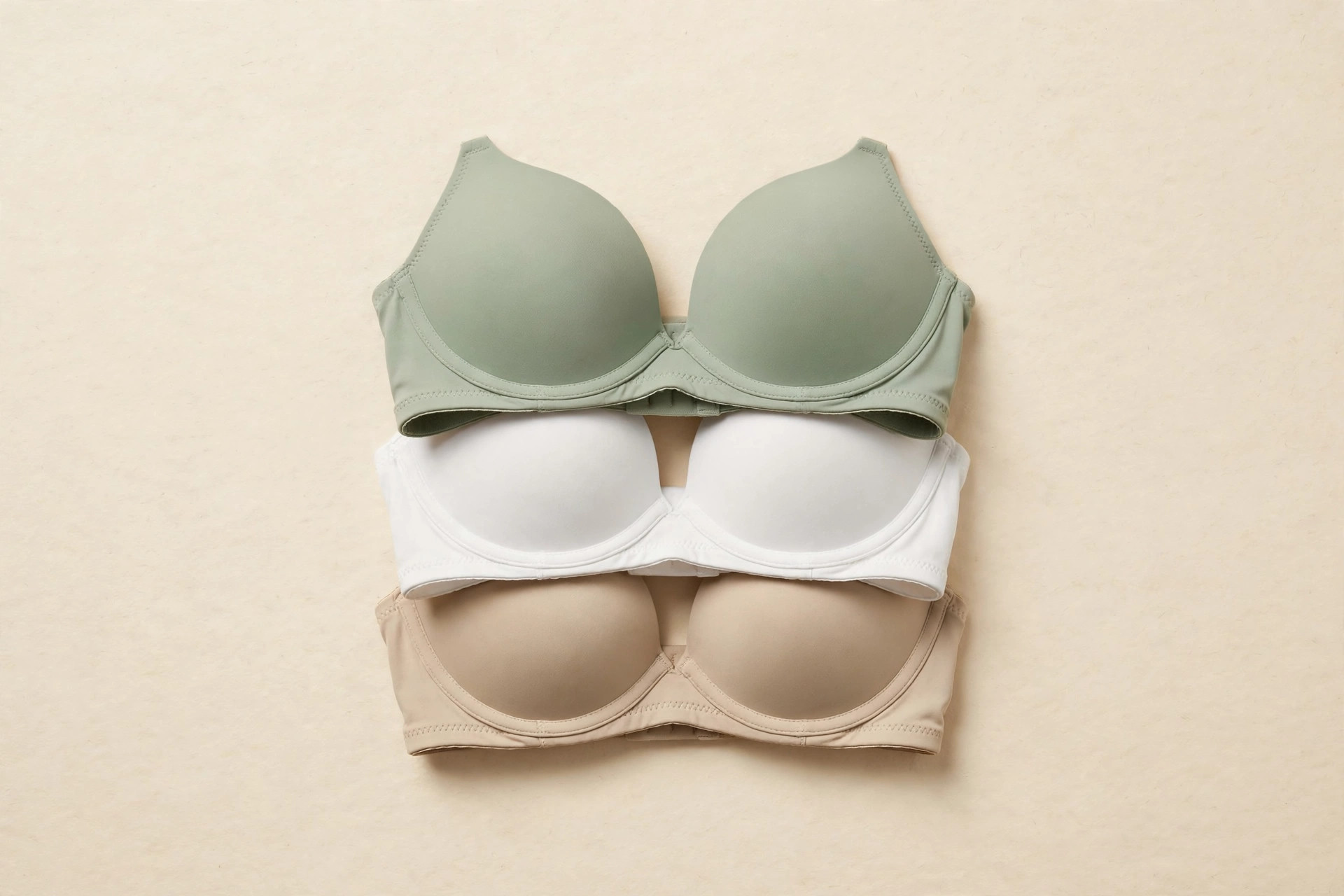
A molded cup is seamless and has a pre-formed shape molded into the cup's fabric.
Construction & Fit
How Molded Bra Cup Work in Practice
Molding is done with heat and pressure: fabric or foam is formed over a heated mold so it permanently takes the cup shape, which is why molded cups keep their form on the hanger. The process works with synthetic fabrics and foams that respond to heat, so molded cups are most common in microfiber and foam styles rather than natural-fiber lace.
The trade-off against seamed cups is range: a mold can only produce the shapes it was made for, while seaming can be patterned for many more shapes and sizes. In exchange, the molded cup gives the smooth, seam-free outline that makes it the standard choice under T-shirts and fitted knit tops.
The Molding Process
The Molding Process in Detail
Molding happens on heated metal forms shaped like a finished cup. A flat sheet of foam, or a panel of heat-settable fabric, is placed over the form and pressed under heat for a set time; the material takes the three-dimensional shape permanently and is then trimmed to the cup pattern. Foam thickness is chosen by style — thin foam for a light, natural shape, thicker foam where more structure is wanted — and a single foam sheet molds to an even thickness, which is why classic molded cups give such a uniform, rounded profile. A newer material family, spacer fabric, is a knitted three-dimensional textile with an airy middle layer; it molds the same way but stays lighter and more breathable than solid foam.
The process explains both the strengths and the limits of the style. Because shape comes from a fixed mold, every cup off that mold is identical, giving the smooth, seam-free surface that disappears under T-shirts and fitted knits. But a factory needs a separate mold for each cup size and shape it offers, so molded ranges cover fewer shape variations than seamed ranges, and the fixed shape either matches the wearer or does not — there is no seam placement to fine-tune the fit. Natural fibers such as cotton and silk do not heat-set, which is why molded cups are almost always synthetic: polyester and nylon microfibers and polyurethane foams.
Not to Be Confused With
Molded vs. Contour vs. Seamed — and Fitting a Molded Cup
The closest term is contour cup. In current industry usage a contour cup is a molded cup made from foam, with the word contour emphasizing the smooth, even, symmetrical shape it gives under clothing; most molded foam cups sold as T-shirt bras are described as contour. A molded fabric cup without foam, by contrast, gives shape with almost no added thickness. The seamed cup is the true opposite: flat fabric pieces sewn together, no heat-forming at all, and a far wider range of shapes and fabrics, at the cost of seams that can show under thin tops. Asking which process made the cup — heat or needle — settles most labeling confusion.
Fitting a molded cup means matching a fixed shape. The cup should fill out completely: gaping at the top edge means the mold's shape is too projected or the size too large, and spilling means too small, with little middle ground because the cup cannot adapt the way a stretch or seamed cup can. Care protects the mold. Wash cool, never wring, reshape the cups by hand while damp, and store the bra with cups nested open or stacked — folding one cup inside the other, or crushing molded cups in a drawer, dents the foam, and a dented molded cup rarely recovers its smooth surface.
More to Explore
Related Bra & Clothing Guides
Common Questions
Common Questions
What is a molded bra cup?
A seamless cup with a pre-formed shape molded into the fabric, so the cup holds its shape whether worn or not.
How are molded cups made?
Fabric or foam is formed with heat and pressure over a mold shaped like the cup. Heat-settable synthetic fabrics and foams are used.
Molded or seamed — which gives more shape options?
Seamed cups. Seaming allows many more variations in cup shape and fabric, while a mold produces one fixed shape very smoothly.
Is a molded cup the same as a contour cup?
Nearly. A contour cup is a molded foam cup, named for the smooth, even shape it gives under clothing. Molded is the wider term: it also covers cups molded from fabric without foam, which shape without adding thickness.
How should molded cups be stored?
With the cups open and nested or stacked, never folded one cup inside the other and never crushed. Folding inverts and dents the foam, and a dented molded cup rarely recovers its smooth shape.
Making Bras
Bra Manufacturing Directories
For the factories and component suppliers behind these constructions, see the Apparel Search manufacturing directories.
Search Apparel Search