Bra Glossary / Clothing Definitions
Findings / Bra Components: Bra Glossary Definition
Definition
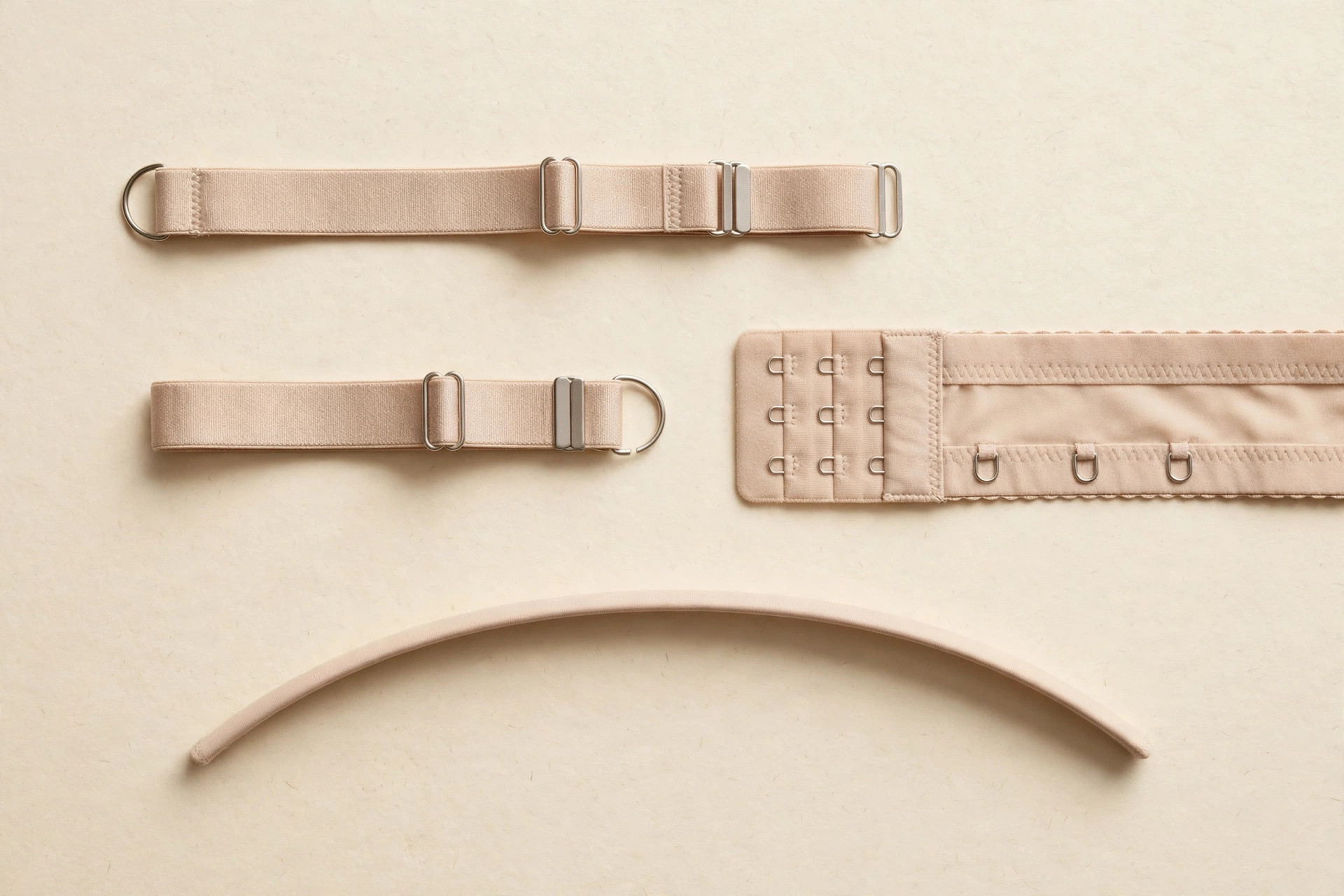
In the fashion industry, findings are also called trimmings or components. In regard to bras and lingerie, findings refer to the plastic or metal hardware found on bras. Findings may include rings, slide closures, and clasps of various styles.
Construction & Fit
How Findings / Bra Components Work in Practice
Findings may actually come in materials other than plastic or metal as well. They are often dyed to match the garment, but they can also be made in contrast colors such as gold or silver.
The standard finding set on a bra includes strap adjuster sliders, the rings that join straps to cups or wings, the hook-and-eye closure tape at the back, and any front clasps or decorative hardware. Quality findings matter to durability: metal hardware resists heat and wear, while coated and plastic findings keep weight down and avoid cold contact with skin.
Each finding is specified to a size. Rings and sliders are made to match the strap width they serve — strap widths run from about 8 mm on light styles to 18 mm or more on full-support bras — and a slider fitted to the wrong width will either jam on the strap or slip under load. Hook-and-eye tape is graded the same way: the number of hook rows increases with band and cup size so the closure carries the band's tension without distorting.
Findings are also the most repairable part of a bra. A bent hook, a cracked ring or a slider that has lost its grip can often be replaced by a tailor or with basic home sewing, extending the life of a bra whose fabric and elastic are still sound — one reason findings are stocked and sold as separate components by bra-making suppliers.
Component Guide
The Main Findings, Part by Part
The hook-and-eye closure is the hardest-working finding: coated metal hooks are sewn into tape at one end of the band and matching eyes into tape at the other, in one to four rows of hooks and usually three columns of eyes, so the band can be fastened at different lengths. Sliders — the flat adjusters on the straps, often in a figure-eight profile — grip the strap by friction and set its length. Rings join the strap to the cup or the back wing, letting the strap change angle without twisting; oval and D-shaped rings serve the same joint on some designs.
Beyond the standard set, front clasps — barrel or click closures between the cups — appear on plunge and some racerback styles, and detachable strap hooks, sometimes called swan hooks or G-hooks, are the finding that makes convertible bras possible, unhooking so straps can be repositioned or removed. Small bows and charms at the gore or strap joins are classed as trims rather than functional findings, though they are often grouped with findings in factory ordering.
Materials & Quality
Finding Materials, Finishes and Failure Points
Metal findings are usually cast alloy or steel with a plated or powder-coated finish; nickel-free finishes are made for wearers with nickel sensitivity. Plastic findings are molded nylon or acetal — lighter, rust-proof and warm to the touch, but more likely to crack with age or heat. Hooks and eyes are almost always metal under their coating, because the closure carries the band's full tension. Dye-to-match finishing colors the hardware with the garment; a finding that has been dyed is checked for colorfastness like any other dyed component.
Failure points are predictable. Sliders slip when their inner bar wears smooth, hooks bend when they are pulled sideways rather than unhooked, and rings crack at their thinnest point. Most failures are slowed by simple care: fasten the hooks before washing so they cannot snag other garments or bend in the wash, use a mesh bag, and keep plastic findings away from high dryer heat.
More to Explore
Related Bra & Clothing Guides
Common Questions
Common Questions
What are findings on a bra?
Findings are the hardware components of the bra — the rings, slide closures and clasps — also called trimmings or components in the fashion industry.
What are bra findings made of?
Most are plastic or metal, though other materials are used. They are often dyed to match the garment, or finished in contrast colors such as gold or silver.
Where are findings used on a bra?
At the strap adjusters and rings, the hook-and-eye back closure, and any front clasp or decorative hardware point.
What is hook-and-eye tape?
It is the fabric tape sewn to the ends of the back wings, carrying the metal hooks on one side and rows of eyes on the other. Using different eye rows adjusts the band's fit as the elastic relaxes.
Can broken bra findings be replaced?
Often, yes. Sliders, rings and hook-and-eye tape are stocked as separate bra-making components, and a tailor or confident home sewer can replace a damaged piece without rebuilding the whole bra.
Making Bras
Bra Manufacturing Directories
For the factories and component suppliers behind these constructions, see the Apparel Search manufacturing directories.
Search Apparel Search