01 — The System
Base, Mid and Outer: Three Jobs
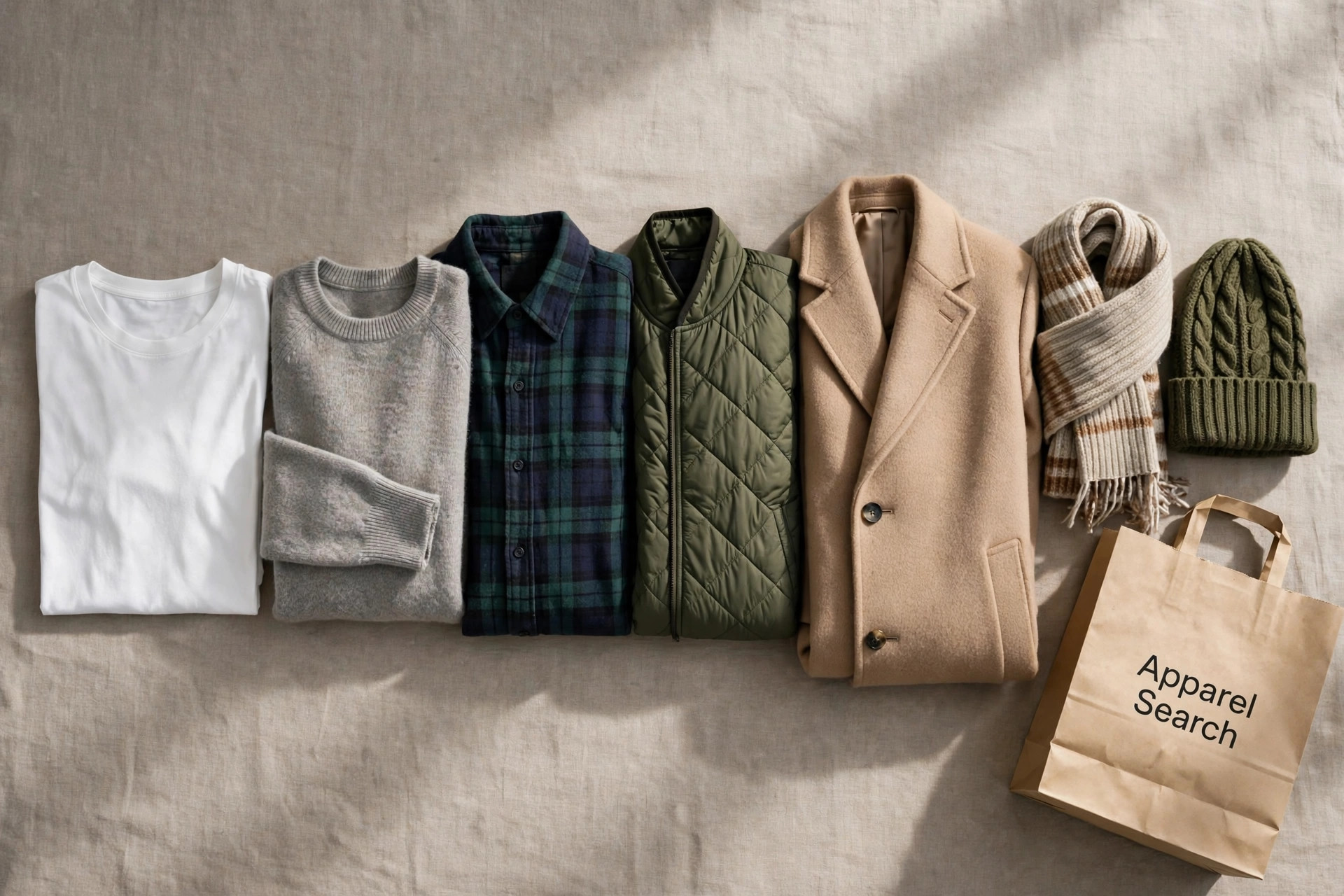
Layering works because it divides one impossible job — keeping a body comfortable as temperature, activity and weather change — into three manageable ones. The base layer sits against the skin and manages moisture: its task is to move sweat away so skin stays dry, because damp skin loses heat fast and feels clammy in warmth. Merino wool and synthetic knits do this job; the base layer guide compares the materials in detail, and the base layer weights page matches fabric weight to conditions. The mid layer is the insulation: it traps still air in a lofted or knitted structure — fleece, down, quilted synthetics, substantial knitwear — and still air, not the fiber itself, is what holds the warmth. The outer layer protects the other two: it blocks wind (which strips trapped air away) and sheds rain, and it is the layer the world sees, so it carries most of the outfit’s style.
In mild weather the system compresses gracefully: a base and a light outer may be the whole outfit, with the mid layer tied, carried or left at home. In serious cold all three roles multiply — the full cold-weather assembly is laid out in Dressing for Extreme Cold. The definition is kept precise on the layered clothing term page. What matters for everyday dressing is the habit of asking, for each piece, which job it is doing. A garment that cannot answer is decoration; a wardrobe of pieces that can answer is a system.
02 — The Wardrobe
The Key Pieces a Layering Wardrobe Is Built From
- Base tees, tanks and camisoles — smooth, close-fitting, in merino, silk or clean cotton for mild weather. They protect outer garments from skin oils as much as they warm, which is why a base under a good sweater doubles the sweater’s life between washes. Women’s layering under dresses and sheer tops has its own specialist treatment in the modest layering guide.
- Fine knits — a merino or cashmere-blend crew or roll-neck is the most versatile mid layer ever made: warm alone, invisible under a jacket, and thin enough to add under almost anything. Men’s versions anchor the solid layering tees approach to a capsule.
- Overshirts and shackets — the modern mid-outer hybrid: a shirt’s shape with a jacket’s weight, worn open over a tee or closed under a coat.
- Cardigans — the adjustable layer: buttoned, they insulate; open, they frame; removed, they change the outfit’s temperature by exactly one notch.
- Blazers and waistcoats — structure layers. A waistcoat under a jacket adds warmth with no sleeve bulk; a blazer over knitwear converts layers into an outfit.
- Mid jackets — light down, quilted liners and fleeces designed to disappear under a coat or work alone in autumn.
- Outer coats — the shell of the system, chosen for the worst weather the season offers, not the average.
- Scarves — the cheapest layer: a scarf seals the neck gap where layered outfits leak the most heat, and removes in seconds.
Notice what the list does not require: many pieces. A base in two weights, two mids of different warmth, and one honest outer coat layer in more combinations than a closet of unrelated garments — which is why layering sits at the heart of the capsule wardrobe method.
03 — Strategy
Temperature Strategy: Layering by Degrees
| Conditions | The working combination | The adjustment to carry |
|---|---|---|
| Mild, 55–65°F / 13–18°C | Base tee or shirt + one light mid (overshirt, fine knit or cardigan) | The mid layer itself is the adjustment — worn, opened, or over the shoulders |
| Cool, 45–55°F / 7–13°C | Base + insulating mid (sweater, light quilt) + a jacket or coat shell | A scarf seals the system; gloves appear at the bottom of the band |
| Cold, 30–45°F / −1–7°C | Thermal base + substantial mid (down or heavy knit) + a windproof outer coat | Hat and gloves stop being accessories and become layers |
| Severe, below 30°F / −1°C | Full system: wicking base, two mids of different lofts, expedition-weight outer | No exposed skin; the extreme-cold guide takes over from here |
Two principles govern the table. First, layer for the activity, not the thermometer alone: a walking commute generates heat that a standing wait does not, so the commuter’s system needs a layer that comes off — a mid that opens, a scarf that pockets. Second, adjust in small steps. The advantage of three thin layers over one thick one is granularity: each removal changes comfort by a degree or two instead of ten. Dress so that the first adjustment is always easy — the top button, the open coat, the removed scarf — and the system never has to be dismantled to work.
04 — Getting It Right
Proportion Rules and the Mistakes That Undo Them
Layers fail visually for mechanical reasons, and the fixes are equally mechanical. Lengths should step: each layer slightly longer than the one beneath reads as intentional strata; layers ending at exactly the same point stack into a single visual lump. Bulk belongs in one place: a chunky knit under a slim coat strains both; put the volume in the outer layer or the mid, not both. Collars and necklines must negotiate — a roll-neck under a shirt collar, a crew under an open overshirt — rather than competing at the same height. And fabrics should slide: a grippy cotton tee under a wool sweater twists and binds, where a smooth base lets the layers move as one garment.
Layering is tailoring in motion: each piece is fitted not to the body, but to the piece beneath it.
The recurring mistakes are worth naming plainly. A cotton base layer in cold weather — it absorbs sweat, holds it against the skin and chills the wearer, the oldest error in the outdoor world. Too many statement pieces, each layer arguing for attention, where the system works best with one voice and a supporting cast. Identical lengths, covered above. And the quietest mistake: buying each layer in the same size, so outer pieces strain over inner ones — layers are bought as a sequence, each sized to contain the last, and a coat should always be tried on over the thickest mid it will meet.
05 — Good to Know
Common Questions
How many layers is too many?
For everyday dressing, three working layers — base, mid, outer — plus accessories is the practical ceiling; beyond it, adjustment becomes cumbersome and bulk accumulates at the arms and waist. Severe cold justifies more, but even there the outdoor solution is usually better layers rather than more of them: a warmer mid replaces two thin ones. If a layer is not managing moisture, trapping warmth or blocking weather, it is not a layer — it is just another garment.
Can you layer in summer?
Yes — summer layering inverts the winter logic. The base becomes the lightest possible skin layer (a breathable tank or tee), the “mid” is an open overshirt, kimono or unlined blazer that shades skin and catches breeze without trapping heat, and the outer problem is sun rather than cold. Air conditioning is the practical driver: one removable light layer is the difference between comfort indoors and out. Fabrics matter more than count — see the lightweight fabrics guide for the cloth choices.
What is the best base layer under a dress shirt?
A smooth, close-fitting undershirt in a fine knit — merino for temperature range, a cotton-modal for mild weather — cut so its neckline sits below the shirt’s open collar and its sleeves stay hidden under the shirt’s. The base protects the shirt from sweat and oils, smooths the shirt’s line, and adds a degree of warmth without visible bulk. Avoid thick cotton tees, whose hems and sleeves print through and bunch under a fitted shirt.
How do I layer without looking bulky?
Keep the base close, put the insulation in one mid layer rather than several, and let the outer layer carry the silhouette with a clean, slightly longer line. Step the lengths so each layer shows a deliberate edge, avoid stacking bulk at the waist, and choose smooth fabrics that slide over each other. Fit matters as a sequence: each layer should close comfortably over the one beneath — strain anywhere reads as bulk everywhere.
More to Explore
Search Apparel Search