Apparel Search Consumer Guides
Dressing for Extreme Cold
When the cold stops being ordinary, no single coat is enough. Build the layer system, seal the gaps, and manage sweat as carefully as warmth.
Ordinary winter dressing — a warm coat, a hat, a pair of gloves — works until the cold stops being ordinary: temperatures far below freezing, wind that finds every gap, hours rather than minutes outside. Past that point, warmth stops being a property of any single garment and becomes a property of a system. This page builds that system, layer by layer, as the cold-weather counterpart to our dressing for the climate guide. It draws on the site's layer-by-layer library — the base layer, mid layer and shell guides linked throughout — and pushes each layer to what extreme cold demands.
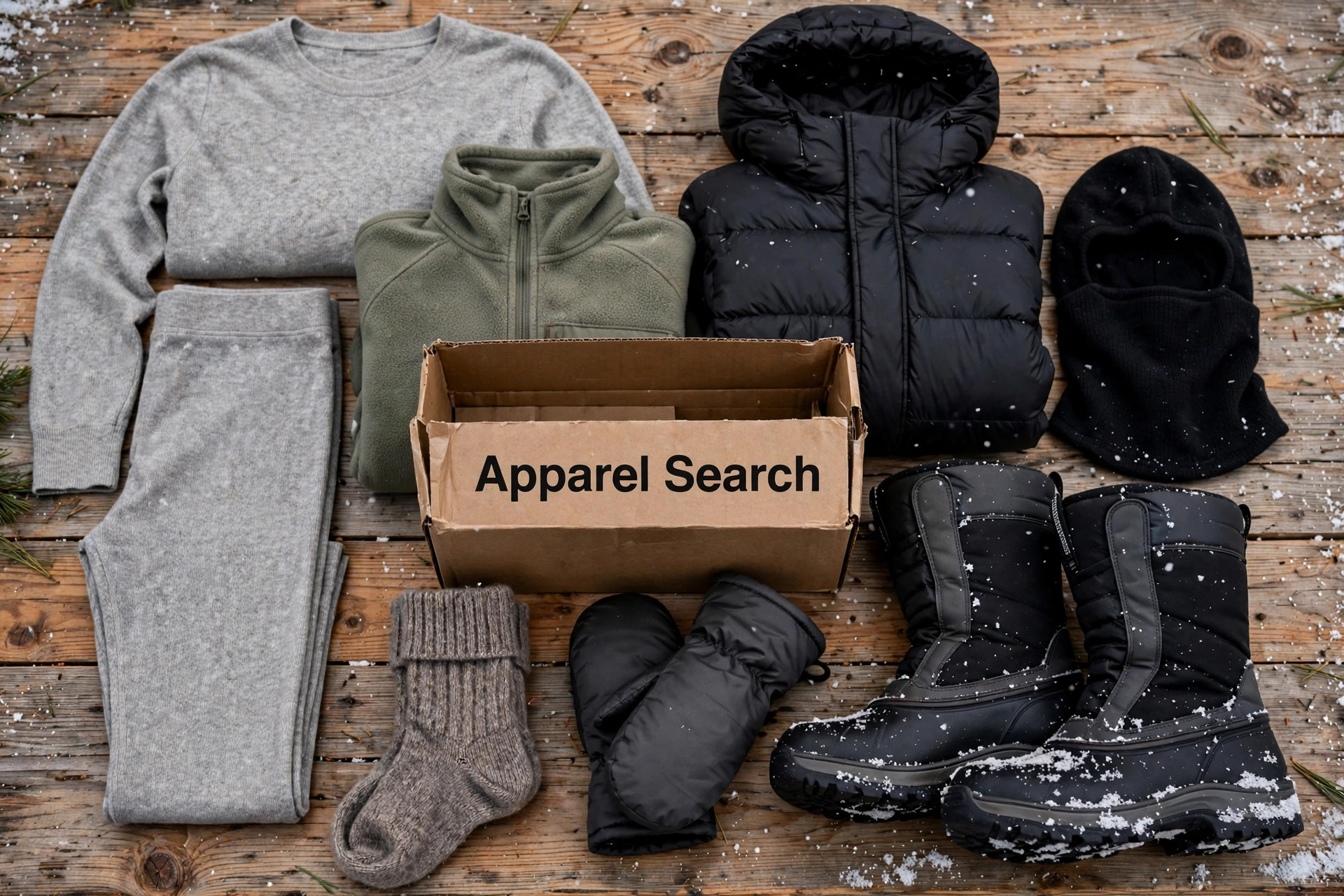
The System, Layer by Layer
Base layer: manage moisture first
The layer against the skin has one job in extreme cold: move sweat away and stay warm while doing it. Merino wool and purpose-built synthetics do this; cotton does the opposite, soaking up moisture and holding it cold against the body — the single most repeated warning in cold-weather dressing is to keep cotton out of the system entirely. Fit matters: snug enough to contact skin and move moisture, with flat seams that will not chafe under everything else. Choose the weight for your activity from our base layer weights guide — heavier is not automatically better, because a too-warm base is a sweat factory. Legs get a base layer too; insulated trousers over nothing is the classic half-finished system.
Mid layer: trap the air
Insulation is trapped still air, and the mid layer is where most of it lives. Fleece is the workhorse — it insulates even when damp, breathes while you work, and comes in weights you can stack (our fleece weights guide explains the grades). Puffy insulation — down or synthetic fill worn as a mid layer under a shell, or as the outer coat itself — traps more air per weight; down fill power explains the quality scale, and synthetic insulation covers the fills that keep insulating when wet, which down does not. In extreme cold, two mid layers beat one heroic one: they trap air between them as well as inside them, and one can come off when you work hard.
Shell: stop the wind, shed the weather
All that trapped air is useless if wind blows it away. The outer layer must be windproof first and waterproof or water-resistant as conditions demand: a hardshell for wet and windy extremes, a softshell for dry cold and high activity. Length is a feature — a parka that covers the hips seals the gap where jackets end — and so are the closures: storm flaps over zips, cuffs that close over glove gauntlets, a hem that cinches. A 3-in-1 jacket, which marries a shell to a zip-in insulated layer, is the system sold as one garment, and works well for city use.
Head, Face and Neck: No Exposed Skin
In extreme cold the rule for skin is simple: cover all of it. A hat alone leaves the face, ears and neck to the wind, and those are both the most uncomfortable and the most vulnerable areas. The working combination is a warm hat or the parka's insulated hood, plus a neck warmer or snood pulled up over the chin, and in real severity a balaclava that covers everything but the eyes. Seal the junctions — collar over the neck warmer's top edge, hood over the hat — because wind exploits the gaps between garments exactly as it exploits the gaps in a house. Sunglasses or goggles earn their place on bright, windy days, protecting eyes that water and blink against the cold.
Hands: The Liner-and-Mitten System
Fingers get cold first and suffer most, because the body protects its core by reducing circulation to them. Mittens are warmer than gloves — fingers share their heat instead of facing the cold separately — so the serious system is a thin liner glove (for the moments a task needs fingers) inside an insulated mitten or heavy gauntlet glove, with heated gloves as the modern option for people whose hands run cold or whose work is stationary. Whatever the combination: cuffs overlap the jacket sleeves with no bare wrist between, and spare dry liners ride in a pocket, because a damp liner is a cold one.
Feet: Socks, Space and Traction
Warm feet need three things: insulation, dryness and room. The sock system is a thin liner under a thick wool or synthetic hiking sock — our thermal socks and ski socks guides cover the choices — and the boot must be sized to hold that system without squeezing. This is where a famous mistake bites: thick socks crammed into ordinary-fit boots compress both the sock's insulation and the foot's circulation, and the foot ends up colder than in thinner socks with room. Boots themselves should be insulated, waterproof for wet cold, and high enough to meet insulated trousers with no ankle gap. On ice, the sole is the safety feature: deep-lugged rubber stays grippier than smooth leather, and removable traction cleats turn a polished boot into a practical one for the iciest days. The boot guides for cold weather boots and winter boots go into the product detail.
Getting Dressed: The Order
- Base layer, top and bottom, snug and dry — and dry feet into liner socks before anything else, since everything after assumes it.
- Mid layers, one or two, zipped and settled; check that nothing bunches at the waist or shoulders, where straps and outer layers will press on it all day.
- Insulated trousers or salopettes over the base-layer legs, then boots, laced firmly but never circulation-tight.
- Shell or parka, closed fully, hood up or ready; tuck and overlap every junction — parka over glove gauntlets, collar over neck warmer.
- Head, face and hands last: hat or hood, neck coverage, balaclava in severity, liner gloves then mittens. Then the pocket check — spare liners, and nothing essential buried under a layer you cannot open with mittens on.
The Mistakes That Make People Colder
- Cotton anywhere in the system — jeans, a cotton hoodie, cotton socks. It absorbs sweat and ambient moisture, loses its insulation, and chills the wearer; the effect is worst in the base layer.
- Boots too tight for the sock system, compressing insulation and circulation at once (see above — the most counterintuitive mistake on this list).
- Overdressing, then sweating. A system sized for standing at a bus stop will drench an active wearer; the chill when activity stops is the penalty. Start out feeling slightly cool and vent early — open zips, remove a layer — before sweat builds.
- Exposed junctions: the inch of wrist between glove and sleeve, the gap at the neck, bare ankles. Extreme cold is a audit of gaps, not of garments.
- One giant coat instead of a system. A single heavy coat cannot adjust, seals poorly at its one opening, and leaves legs, face and hands as afterthoughts. The system is warmer at the same weight and adjusts across the day.
City Cold vs. Outdoor Cold
The same system flexes by setting. City extreme cold is intermittent: short exposures between heated buildings, standing still at transit stops, wind funneled between towers. Coverage and windproofing matter most, activity is low, and a longer parka with the full head-and-hands kit carries the day. Outdoor cold is continuous and active: work, sport or walking for hours. There, moisture management rules — lighter base and mid layers than instinct suggests, constant venting, and spare dry layers for stops. Dress for the version of cold you will actually meet; the standing-still outfit worn for a long active trek is the overdressing mistake at full scale. And in either setting, treat numb or stinging skin as the signal it is: get inside and warm up, and shorten the next exposure. No errand or itinerary outranks that.
About Temperature Ratings
Coats and boots are often sold with temperature figures, but there is no standard test behind them — one maker's number assumes an active wearer in a full layer system, another's a person standing still. Judge a garment by its construction instead: what insulation, how thick, how windproof, how much coverage — and how it combines with the layers around it. The system is the rating.
Runners meet this same cold at speed: what to wear running by temperature translates the layer system into running bands, down through the below-20°F full-coverage end of the scale.
Common Questions
What is the most common mistake people make dressing for extreme cold?
Wearing cotton — especially as the layer against the skin. Cotton absorbs sweat and holds it, and wet fabric pulls heat from the body far faster than dry fabric, a problem outdoor workers summarize as 'cotton kills.' In extreme cold the base layer should be merino wool or a synthetic made to move moisture, and every layer after it should keep working when damp. Denim jeans over no base layer are the everyday version of the same mistake.
Are mittens really warmer than gloves?
Yes, for warmth alone. Fingers in gloves are separated, each losing heat on its own; fingers in a mitten share one warm air space and keep each other warm. The trade is dexterity — gloves let you use your hands. The standard solution in serious cold is a system: a thin liner glove for tasks, inside an insulated mitten or heavy glove, so hands are never bare and never stuck with only the thin layer.
Can a coat be too warm?
Yes, once you start moving. A system built for standing still will overheat an active body, and the sweat it produces then chills you the moment you stop — often colder than if you had worn less. Dress for your activity level, start slightly cool, and use zips, vents and removable layers to dump heat before you sweat. In extreme cold, managing sweat is as important as adding insulation.
Do coats and boots have standardized temperature ratings?
No — there is no shared standard behind the numbers on tags. One maker's rating may assume an active wearer and a full layer system; another's may assume standing still. Treat any temperature figure as a rough claim by its maker, and judge a garment instead by its construction: insulation type and thickness, windproofing, coverage, and how it fits into the layer system around it.
Back to the Dressing for the Climate Guide
The full framework — heat, humidity, cold, wind and rain, and how to read a forecast for your clothes.