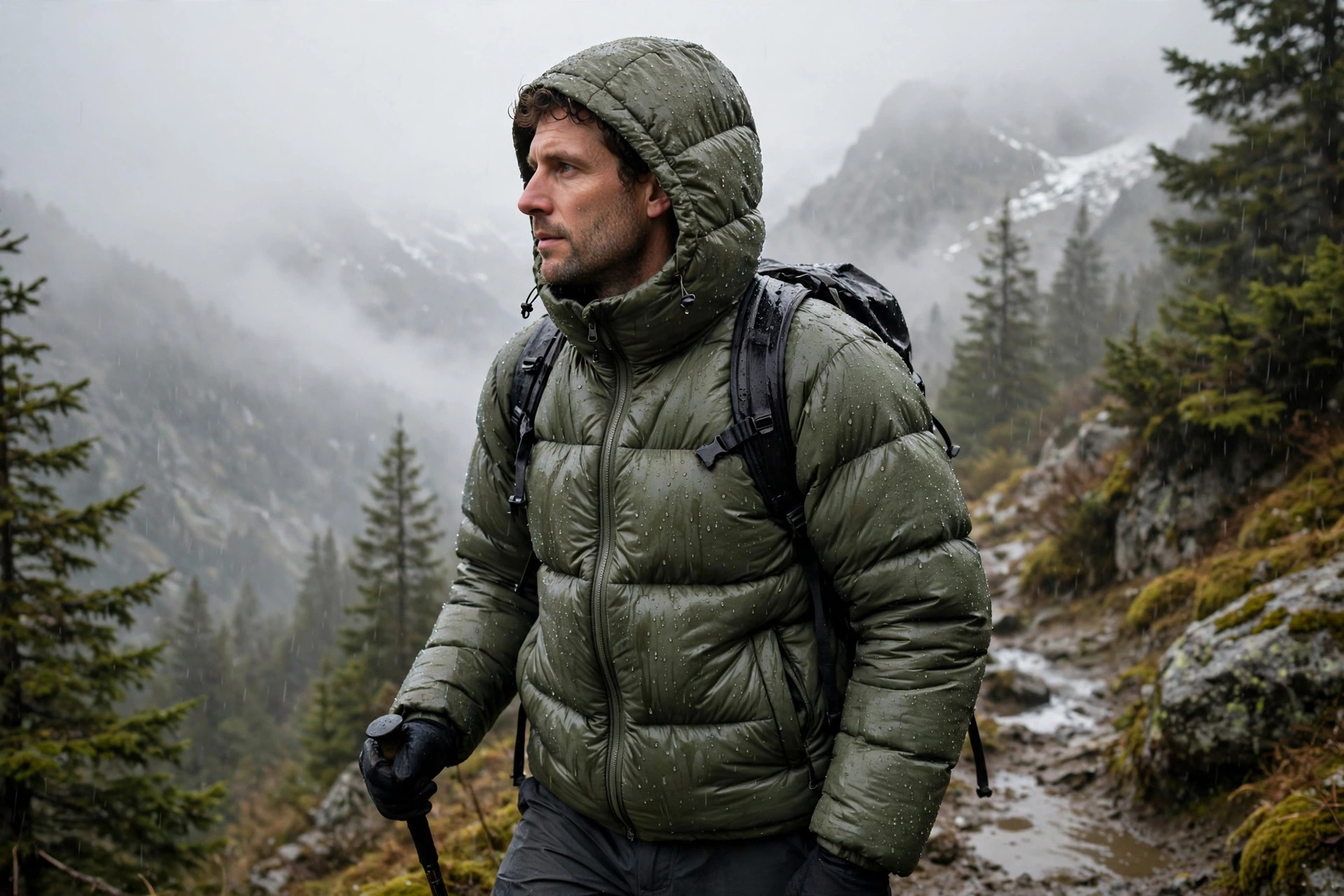
Synthetic insulation is man-made fill, almost always polyester, engineered to mimic the loft of down by trapping still air in a tangle of fine fibers. It gives up some warmth for its weight compared with good down, but it keeps insulating when damp, dries relatively quickly, costs less, and is easier to care for — trade-offs that make it the practical choice for wet climates and hard, everyday use.
How Synthetic Fills Work: Short-Staple and Continuous Filament
Synthetic fills fall into two broad families. Short-staple fills use short fibers cut and crimped to imitate down clusters. They feel soft and drape well, compress reasonably small, and are common in jackets meant to resemble down puffies. Because the fibers are short and mobile, these fills can shift and break down with repeated compression, gradually losing loft.
Continuous filament fills use long, unbroken strands laid in sheets. The long fibers resist shifting and hold their structure well, which makes these fills durable and consistent, though typically a little stiffer and bulkier. Sheet fills of both families are quilted or bonded into garments in layers, and warmth is built by adding thickness. Unlike down, synthetic fill does not need baffles to keep it from migrating, so designers can use it in panels, sleeves, and hybrid garments that mix insulation with fleece or softshell fabrics.
Warmth comparisons are usually given as warmth for weight against down equivalents, and the honest summary is that good synthetic fill approaches the performance of mid-range down when dry, weighs more for the same warmth, and takes more pack space. Its advantages appear precisely where down is weakest.
Wet Performance, Loft Loss, and Trade-Offs Versus Down
Polyester fibers absorb very little water, and the structure of a synthetic fill holds much of its loft even when damp. A synthetic-insulated jacket worn in wet snow or damp cold therefore keeps a substantial share of its insulation, and it can be wrung out and dried in the field far faster than down. For maritime climates, shoulder seasons, and users who cannot guarantee dry storage, that reliability is worth more than a theoretical warmth advantage that disappears when wet.
The main weakness is longevity of loft. Repeated compression in packs and stuff sacks, heat, and years of use gradually break fibers and flatten the fill, so a synthetic jacket slowly becomes less warm, while good down, properly stored, can recover its loft for many years. Synthetic insulation is generally less expensive to buy, easier to wash, and a suitable option for people avoiding animal products. Down remains lighter, more compressible, and longer-lived. Choosing between them is a judgment about conditions and priorities, not a verdict that one is simply better.
Common Questions
- How does synthetic insulation work?
- Fine polyester fibers are arranged to trap still air, mimicking the loft of down. Short-staple fills use short crimped fibers for a soft, down-like feel, while continuous filament fills use long strands that hold their structure and resist shifting. Warmth is built by adding fill thickness.
- Is synthetic insulation warm when wet?
- It retains a substantial share of its insulation when damp because polyester absorbs very little water and the fill keeps much of its loft. It also dries much faster than down. That wet-weather reliability is its main advantage over down.
- Does synthetic insulation lose loft over time?
- Yes. Repeated compression, heat, and years of use gradually break the fibers and flatten the fill, so warmth declines slowly. Storing the garment hung up or loosely, rather than compressed in a stuff sack, slows the loss considerably.
- Should a buyer choose down or synthetic insulation?
- Down is lighter, more compressible, and longer-lived in dry cold, and costs more. Synthetic is less expensive, easier to care for, and more reliable in wet conditions. Wet climates and everyday hard use favor synthetic; weight-sensitive trips in dry cold favor down.
Outdoor Layering & Insulation Series
This guide is part of the Apparel Search outdoor layering and insulation series. Browse the full series below, or start from the women's winter clothing guide.