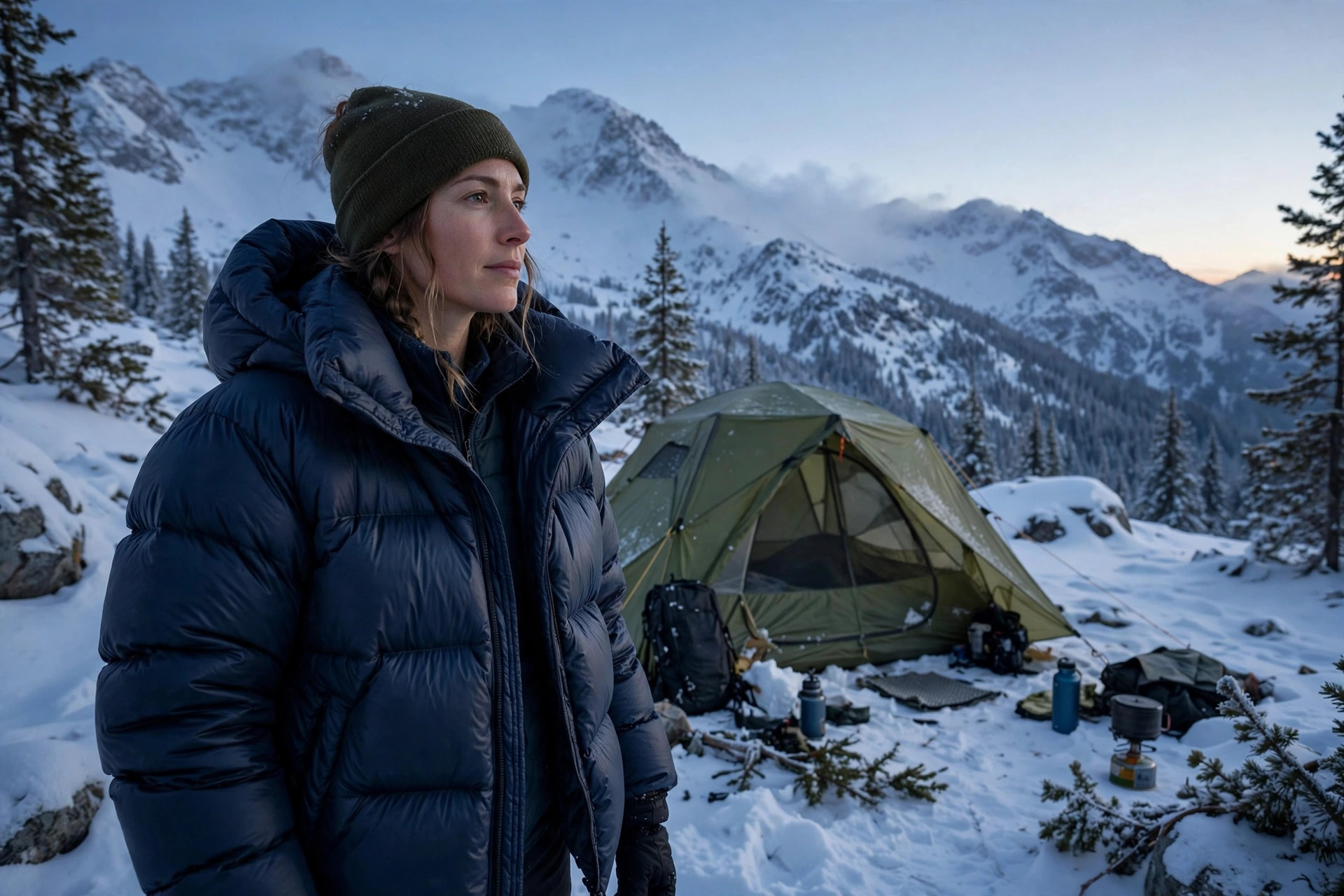
Fill power is a measure of down quality that describes how much space a given weight of down occupies when it lofts — in other words, how much insulating air the down traps per ounce. Higher fill power means more loft, and therefore more warmth, for the same weight of fill. It does not, by itself, state how warm a particular jacket is, because the amount of down in the jacket matters just as much.
What Fill Power Measures and the Common Ranges
In the standard test, in general terms, a set weight of conditioned down — commonly one ounce under the widely used methods — is placed in a cylinder, compressed with a standardized weight, and the volume it occupies is recorded in cubic inches. A result of 800 means that ounce lofts to about 800 cubic inches. Test methods differ slightly between regions and have changed over time, so numbers from different eras and standards are not perfectly interchangeable, but the scale gives a reliable sense of quality within modern ranges.
Common ranges run from roughly 550 fill power at the practical, value end, through 650 to 750 for good all-purpose jackets, to 800 to 900 and above for premium, ultralight products. Higher fill power down uses larger, more mature clusters that trap more air, compress smaller, and recover loft well. It also costs considerably more, and the benefit shows most clearly in weight-sensitive uses such as backpacking and mountaineering, where saving ounces matters.
Fill weight is the companion figure: how many ounces or grams of down are actually inside the garment. A jacket with a modest fill power but a generous fill weight can be warmer than a jacket with very high fill power and very little fill. Responsible product listings give both numbers, and comparing warmth requires both, along with the size and spacing of the baffles that hold the down in place.
Warmth Is Not Fill Power Alone, and Caring for Down
Shell fabric, baffle construction, fit, and total coverage all shape warmth. Sewn-through baffles have cold spots at the stitch lines; box baffles hold more loft and suit colder use. A high-loft jacket that fits loosely loses heat through drafts at the hem and cuffs, while one compressed under a tight shell loses the loft that provides its insulation. Fill power describes the down, not the finished garment, and should be read that way.
Down insulates poorly when wet because the clusters collapse and clump, losing the air spaces that trap heat. Hydrophobic treatments slow that process but do not make down waterproof. Care is straightforward: wash only when needed with a down-specific cleaner, dry thoroughly with low heat until the clusters separate and loft returns — tennis balls or dryer balls in the dryer help break up clumps — and store the jacket uncompressed, hung or in a large storage bag, rather than in its small stuff sack.
Common Questions
- What does fill power mean on a down jacket?
- Fill power measures how much volume one ounce of down occupies when lofted under a standardized test, in cubic inches. Higher fill power means the down traps more air per ounce, giving more warmth for the same weight and compressing smaller in a pack.
- Is higher fill power always warmer?
- No. Warmth depends on fill power multiplied, in effect, by fill weight — how much down is in the jacket — plus baffle design and fit. A jacket with 650 fill power and a generous amount of fill can be warmer than a jacket with 850 fill power and very little fill.
- What fill power is good for a winter jacket?
- For everyday winter use, roughly 550 to 750 fill power offers a good balance of warmth, durability, and price, provided the fill weight is adequate. Fill power of 800 to 900 and above mainly saves weight and pack size, which matters most for backpacking and mountaineering.
- What happens when down gets wet?
- Wet down clusters collapse and clump, losing the trapped air that provides insulation, and down dries slowly. Hydrophobic treatments slow wetting but do not prevent it. In persistently wet conditions, synthetic insulation is usually the more reliable choice.
Outdoor Layering & Insulation Series
This guide is part of the Apparel Search outdoor layering and insulation series. Browse the full series below, or start from the women's winter clothing guide.