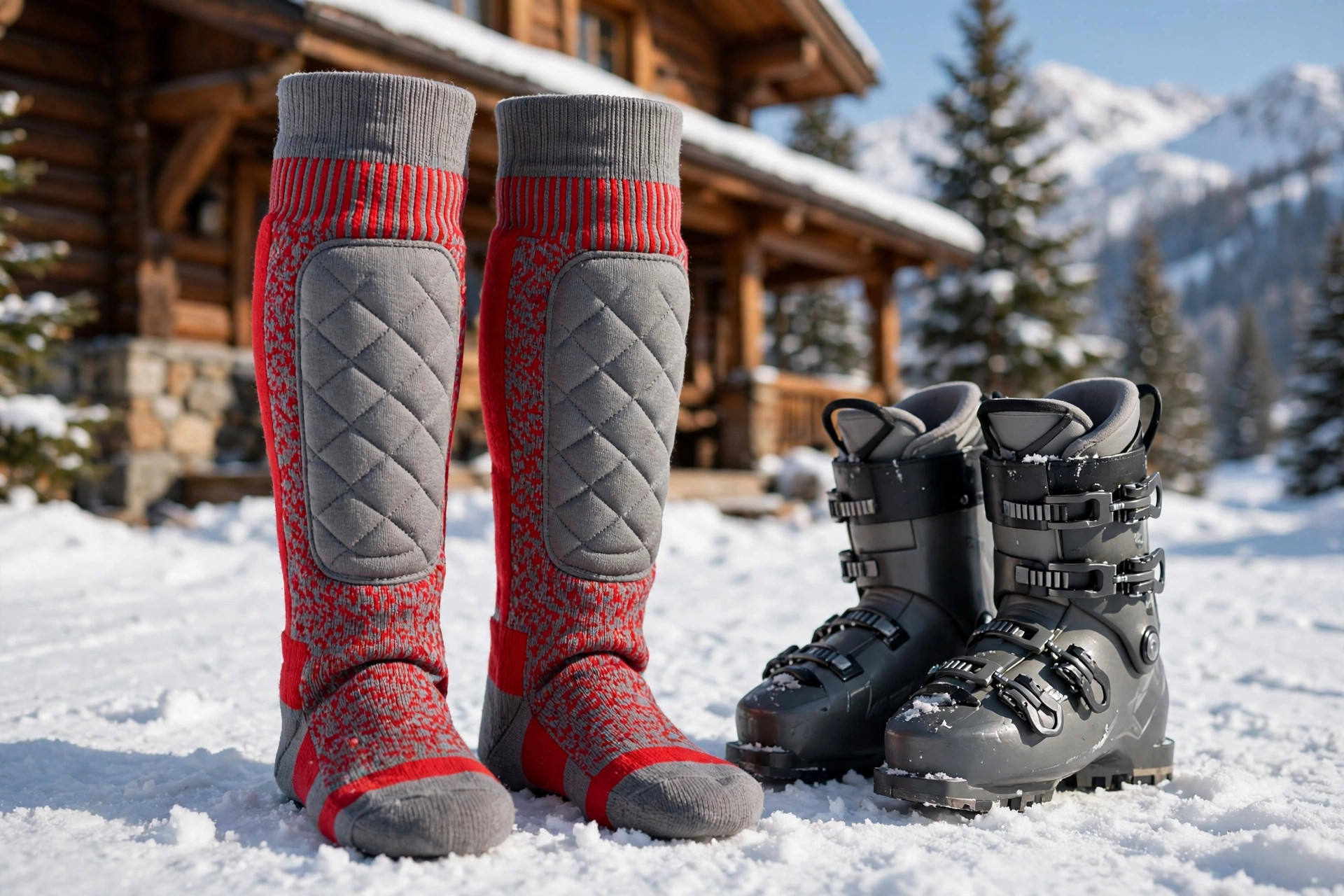
Ski socks are knee-high technical socks designed for one environment only: the inside of a ski or snowboard boot. They run over the calf, pad the shin where the boot tongue presses, cushion the heel and toe, and use elastic and flat seams to stay smooth for a full day of flexing. They look like tall sports socks, but every feature answers a problem created by a rigid plastic boot.
The One-Pair Rule
The most useful fact about ski socks is that you wear exactly one pair. Two pairs — the instinctive fix for cold feet — bunch and wrinkle inside a close-fitting boot, create pressure points and blisters, and can restrict circulation enough to make feet colder, not warmer. A ski boot is fitted assuming one sock's thickness; the sock is part of the boot system, not an extra. If feet are cold in one good pair, the causes are usually boot fit, damp socks from the day before, or a cold core — all better fixed directly than by layering socks.
Thickness is therefore chosen against your boots. Snug, performance-fitted boots pair with ultralight or lightly cushioned ski socks; roomier rental or comfort boots can take a medium cushion. The padding map differs from ordinary socks: dense cushion at the shin, lighter fabric over the instep where buckles press, and a flat toe seam that will not rub at the end of a long run.
Materials, Height, and Fit
Merino wool blended with nylon and elastane is the dominant recipe: merino brings warmth, moisture management, and odor resistance over multi-day trips, while the synthetics add the durability and snap that pure wool lacks. Full-synthetic versions dry faster and cost less. Height is non-negotiable — a ski sock must clear the top of the boot, ending just below the knee, so no boot edge ever touches bare shin. Mid-calf hiking socks fail here, however good they are on the trail; the hiking socks in this site's product coverage are built to a different map.
Fit should be compressive without being tight: the sock should hug the calf and stay up unassisted all day. A sock that slides down inside a ski boot is nearly impossible to retrieve gracefully and will wrinkle into a blister by lunch.
On the Trip: Rotation and Care
Pack two or three pairs for a ski trip and rotate them, drying the worn pair overnight — a merino ski sock dries happily draped over a lodge radiator, and starting dry matters as much as any feature on the label. Wash inside out, cool and gentle, and skip the fabric softener that coats the fibers. Retire pairs whose shin padding has packed flat; that cushion is functional, and when it goes, the boot tongue wins. For the rest of the slope kit, the men's skiwear guide and the base layer guide cover the layers these socks work under.
Common Questions
- Why should you wear only one pair of ski socks?
- Two pairs wrinkle and bunch inside a close-fitting boot, causing pressure points and blisters, and the squeeze can restrict circulation and make feet colder. Ski boots are fitted for one sock; a single well-made pair is the engineered answer.
- How thick should ski socks be?
- Match thickness to boot fit. Tight, performance boots need ultralight or lightly cushioned socks; roomier comfort and rental boots can take medium cushion. In all cases the cushioning should be concentrated at the shin, heel, and toe rather than uniform bulk.
- Are ski socks the same as hiking socks?
- Related, but not interchangeable. Ski socks are taller — they must clear the boot top and end below the knee — and their padding maps the shin where a boot tongue presses. Hiking socks are usually mid-calf with padding mapped for walking boots.
- How tall should ski socks be?
- Over the calf, ending just below the knee. The essential point is that the sock, never bare skin, meets every part of the boot, especially the top cuff and tongue. Anything shorter will eventually rub.
Cold-Weather Warmth and Hosiery Series
This guide is part of the Apparel Search cold-weather warmth and hosiery series: the small garments that decide whether winter dressing is comfortable. Browse the full series below, or start from the women's winter clothing guide and the women's hosiery guide.