01 — The Overlap
Where the Two Kits Overlap
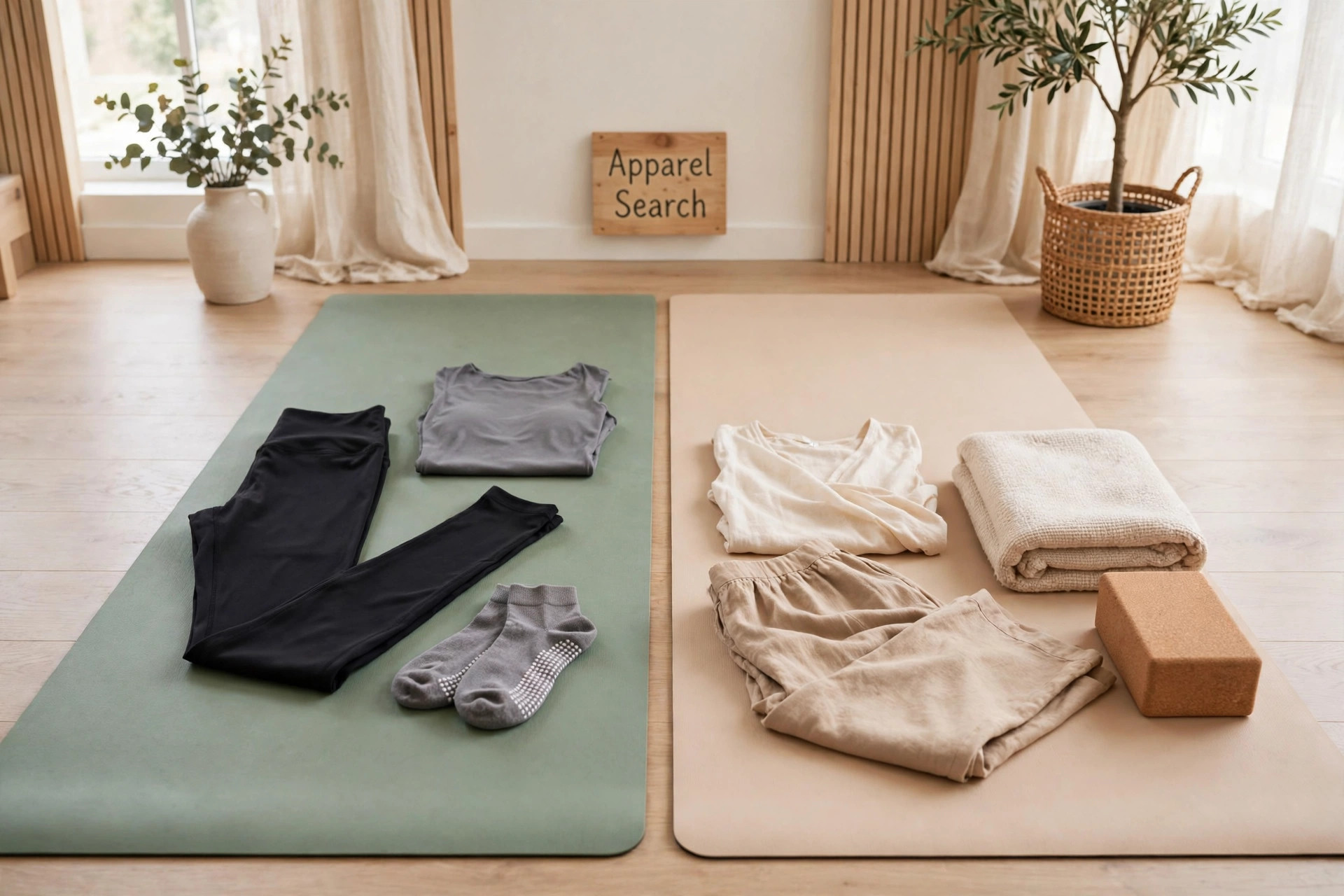
Start with the good news: the core of the two wardrobes is the same clothing. Both practices are built on controlled, full-range movement performed mostly at floor level, and both reward the same solution — four-way-stretch bottoms that move without shifting, tops that stay put in inversions, and fabrics that handle warmth without bulk. A good pair of high-waisted leggings is the foundation of both kits, which is why the women’s leggings guide serves both audiences, and why the women’s yoga clothing guide reads, for long stretches, like a Pilates guide with the props changed. Sports bras, fitted tanks, light layers and hair tied back transfer without translation.
The overlap is large enough that most people who practice both own one studio wardrobe, not two. The differences below are real but narrow — a pair of socks, a rule about hardware, a preference in fit — and each traces back to one cause: Pilates, in its reformer form, is practiced on a machine.
02 — The Differences
Where They Differ
| Element | Pilates | Yoga |
|---|---|---|
| Feet | Grip socks required at most reformer studios; common on mats too | Bare feet are the norm and the preference |
| Hardware | Zippers, buckles and clasps effectively banned — they dig in and scratch equipment | Tolerated; a back zip pocket is unremarkable |
| Fit | Close and precise, so instructors can read alignment and straps sit cleanly | Fitted works, but softer and looser cuts are common and accepted |
| Bottoms | Leggings dominate; shorts fitted or over a liner | Leggings plus a wider range — loose pants, capris, shorts |
| Layers | Slim, zip-free, removed once warm; nothing dangling near springs | Wraps and shawls welcome, including during closing relaxation |
Feet are the headline difference. Yoga’s barefoot tradition is functional — toes grip the mat and the practice reads the floor through the sole. Pilates keeps the same instinct and answers it with technology: the grip sock, because the reformer’s moving carriage and shared footbar make bare feet impractical and, for studios, unhygienic. The hardware row is the one that catches crossovers out: a favorite yoga legging with a back zip pocket is unremarkable on a mat and unwelcome on a carriage, for the reasons the Reformer Pilates Outfits guide spells out.
03 — One Wardrobe
Building One Kit That Covers Both
The economical strategy is to buy for Pilates and let yoga inherit. A hardware-free, close-fitting kit passes the strictest dress code in either building, and nothing in it is wrong for yoga: the same leggings, the same fitted tops, the same sports bra at low-to-medium support. Add the two practice-specific extras and the wardrobe is complete — grip socks that live in the bag for Pilates days, and one soft, loose layer or wrap that lives in it for yoga’s closing relaxation, when Pilates’ slim-layer rule no longer applies. Bottoms are the one category where a second style earns its space: many dual practitioners keep a softer, looser yoga pant alongside the leggings, as surveyed in the yoga pants directory, purely because the two practices feel different in them.
Budget follows the same logic. Spend on the shared foundation — leggings and tops you will wear four times a week across both timetables — and treat the extras as the small purchases they are: socks, a wrap, perhaps the loose pant.
04 — Switching
Switching Studios: What to Change First
Moving from yoga to a first reformer class, the shopping list has one essential item — grip socks — and one wardrobe check: scan your favorite leggings and tops for zips, clasps and buckles, and leave any piece with hardware at home that day. Moving the other way, from Pilates to yoga, nothing needs buying at all; expect only to leave the socks in the bag and to find the room more tolerant of the softer, looser pieces your Pilates kit excluded. Mat Pilates sits between the two worlds, closer to yoga in etiquette and closer to reformer work in fit — the Mat Pilates Outfits guide maps that middle ground. Whichever direction you travel, the transferable skill is reading a dress code as information about the practice itself: what a studio asks you to wear is a summary of what its equipment, floors and teachers need from you.
Good to Know
Common Questions
Can I wear my yoga clothes to Pilates?
Almost all of them, with two checks. First, scan for hardware: a back zip pocket, a hook-and-eye bra clasp or a buckle that is harmless in yoga will dig in on a reformer and may breach the studio dress code. Second, add grip socks, which most reformer studios require. Fitted yoga leggings and tops otherwise transfer directly — the two kits share their foundation.
Do yoga pants work for reformer Pilates?
Legging-style yoga pants do, provided they are opaque, high-waisted enough to stay flat in bridging, and free of zips and drawstring hardware. Loose, flowing yoga pants do not transfer: they catch in straps, hide leg alignment from the instructor and bunch on the carriage. The dividing line is fit, not the label on the garment — if the yoga pant is effectively a legging, it is a Pilates pant too.
Why does Pilates require socks when yoga is barefoot?
Equipment and hygiene. Reformer feet work against a moving carriage, a footbar and shared straps, where bare feet slide and where studios need a washable barrier between clients. Grip socks restore the traction bare feet give a yogi on a mat, in a form the machine can work with. On the mat, many Pilates classes relax the rule and allow bare feet, which is where the two practices meet again.
What is the single best purchase for a yoga kit going to Pilates?
A proper pair of grip socks — full-sole coverage, snug fit, silicone dots. It is the only item most reformer studios actually require, it is inexpensive next to any garment, and it changes the feel of strap and footbar work immediately. Everything else in a typical yoga kit, once checked for hardware, already passes the Pilates dress code.
More to Explore
Search Apparel Search