01 — The Brief
What Men's Pilates Clothing Has to Do
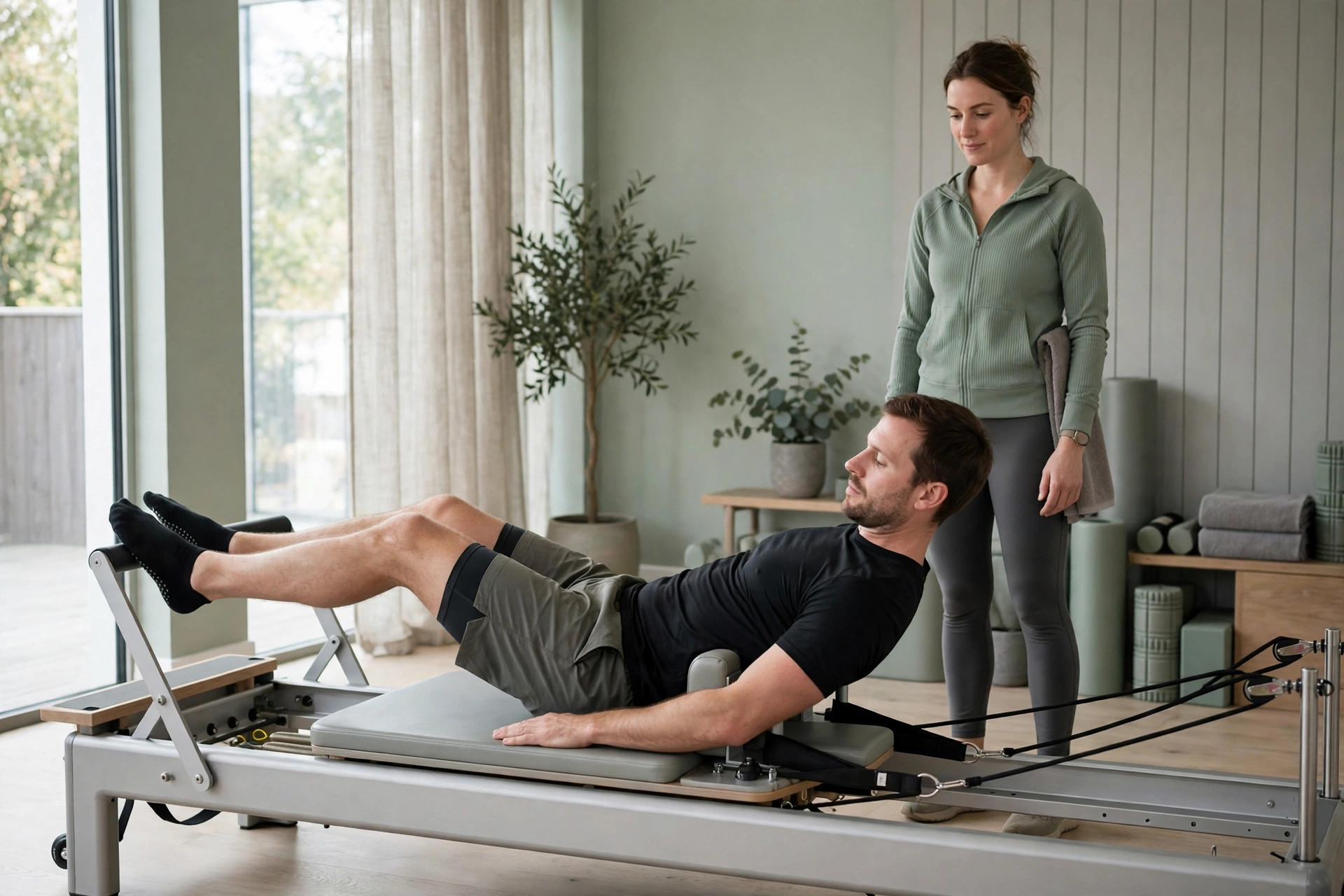
Men arrive at Pilates from the gym, and the gym kit almost fits — which is exactly the problem. Pilates movement is slower, lower and more inverted than most training: leg circles, straps, roll-overs and long plank variations test clothing in directions a squat rack never does. Loose shorts that behave perfectly under a barbell gap and ride in strap work; a baggy tee that is fine for lifting pools toward the face in a roll-over and hides the rib and hip alignment the instructor is coaching. The studio dress code that results is the same one described across this cluster — fitted, hardware-free, grippy at the feet — translated into a men’s wardrobe. Most men’s first class is on the machine, so the Reformer Pilates Outfits guide is worth reading alongside this one; its rules about straps, springs and upholstery apply to every body in the room.
The good news is economy: the men’s Pilates kit is three pieces deep. Get the shorts system, the top and the socks right, in duplicate for laundry, and the wardrobe question is settled for years.
02 — Shorts
Shorts Over Compression: The Standard Solution
The near-universal men’s answer is a two-layer bottom: a fitted compression short or tight underneath, and a lightweight training short over it. The compression layer does the Pilates work — it stays in place through leg circles, frog and inversions, keeps everything covered and supported in open-leg positions, and gives the instructor a clear line of thigh and knee to coach from. The outer short keeps the look relaxed and gym-familiar, adds a pocket for the locker key, and covers the compression layer for the walk through the studio. Either layer can lead: some men wear the compression short alone in warm studios, and fitted bike-style shorts designed as a single garment achieve the same result in one piece. The men’s shorts guide compares the outer-short styles, lengths and fabrics in full.
Length matters more than brand. An inseam around the mid-thigh keeps the outer short clear of the knees in footwork without riding; very long, loose boardshort cuts are the style that fails the strap test. For the layer underneath, the compression shorts directory surveys the category, and the compression garments guide explains what compression does and does not do, in plain terms. Full-length training tights are the cold-studio and personal-preference alternative, worn alone or under shorts, and several men’s ranges now cut them for exactly this crossover use.
03 — Tops
Fitted Tops That Stay in Place
The top’s examination is a plank and an inversion. A fitted training tee or tank in a stretch knit passes both: it stays at the hip when the body is horizontal, does not curtain over the face when the hips go overhead, and shows the shoulder and spine lines the instructor is reading. A standard loose gym tee fails all three politely — wearable, but a low-grade distraction for the whole class. Fit should be close without being compression-tight, with enough length that the hem overlaps the waistband at full reach. Sleeveless cuts suit warm studios and men who run hot; short sleeves protect shoulders during long side-lying and floor sequences on firm mats. The men’s tank tops guide covers cuts and fabrics for the sleeveless route, and the broader men’s activewear guide places the studio pieces within the full training wardrobe.
Fabric follows the room: moisture-managing synthetics for reformer circuits, softer blends acceptable on the mat. As everywhere in this cluster, the back of the garment should be featureless — no zips, no hanging locker loop with a metal tip, nothing to lie on or to meet the carriage.
04 — Socks and Etiquette
Grip Socks, Hair and Studio Etiquette for Men
Grip socks are required of men on exactly the same terms as everyone else — the carriage does not distinguish — and men’s sizing is the only wrinkle: studio ranges skew small, so larger feet should shop by foot length and look for the ankle and crew cuts stocked in extended sizes, as the Grip Socks Buying Guide details. The rest of the etiquette transfers too. Long hair tied back, rings and watches off for strap and grip work, lotion saved for afterwards, shoes left at the door. The men’s socks guide is the wider reference for what a good sock wardrobe looks like beyond the studio.
One honest note on walking in: men are still the minority in most Pilates studios, and the dress code can feel like one more unfamiliar rule. It is worth knowing the rules are purely mechanical — every item in this guide exists because a machine, a mat or an instructor’s sightline asked for it — and that within two classes the outfit stops being a thought at all, which is precisely what a good kit is for.
Good to Know
Common Questions
What shorts should men wear to Pilates?
A fitted short system: a compression short or tight as the base, with a light training short over it, or a fitted bike-style short on its own. The base layer keeps everything covered and in place through leg circles, straps and inversions, where loose gym shorts shift and gap. Mid-thigh length keeps fabric clear of the knees. In cold studios, full-length training tights under shorts are a common and accepted variation.
Do men need grip socks for Pilates too?
Yes — at most reformer studios the rule applies to everyone, because it is about the equipment: feet must not slide on the moving carriage and footbar, and socks are the hygiene barrier on shared machines. Mat classes are often more relaxed. Men with larger feet should shop by foot length and choose ankle or crew styles in extended sizes, since studio ranges are often cut small.
Can men wear regular gym clothes to Pilates?
Partly. A fitted gym tee and training shorts are close; the classic loose basketball short and oversized tee are the combination that struggles, riding up and pooling in inverted and strap work. The zero-cost fix for a first class is shorts over any fitted liner or swim-tight you own, a closer-fitting top, and a pair of grip socks bought at the desk. Upgrade only what the first class proves annoying.
What should a man wear to his first reformer class?
Shorts over a compression layer, a fitted tee or tank that stays at the hip when you bend and reach, and grip socks — bought beforehand or at the studio desk. Tie long hair back, leave rings and a watch in the locker, and bring a towel and water. That outfit satisfies every common studio dress code, and nothing about it needs to be Pilates-branded.
More to Explore
Search Apparel Search