01 — The Machine
Clothing That Works With the Machine
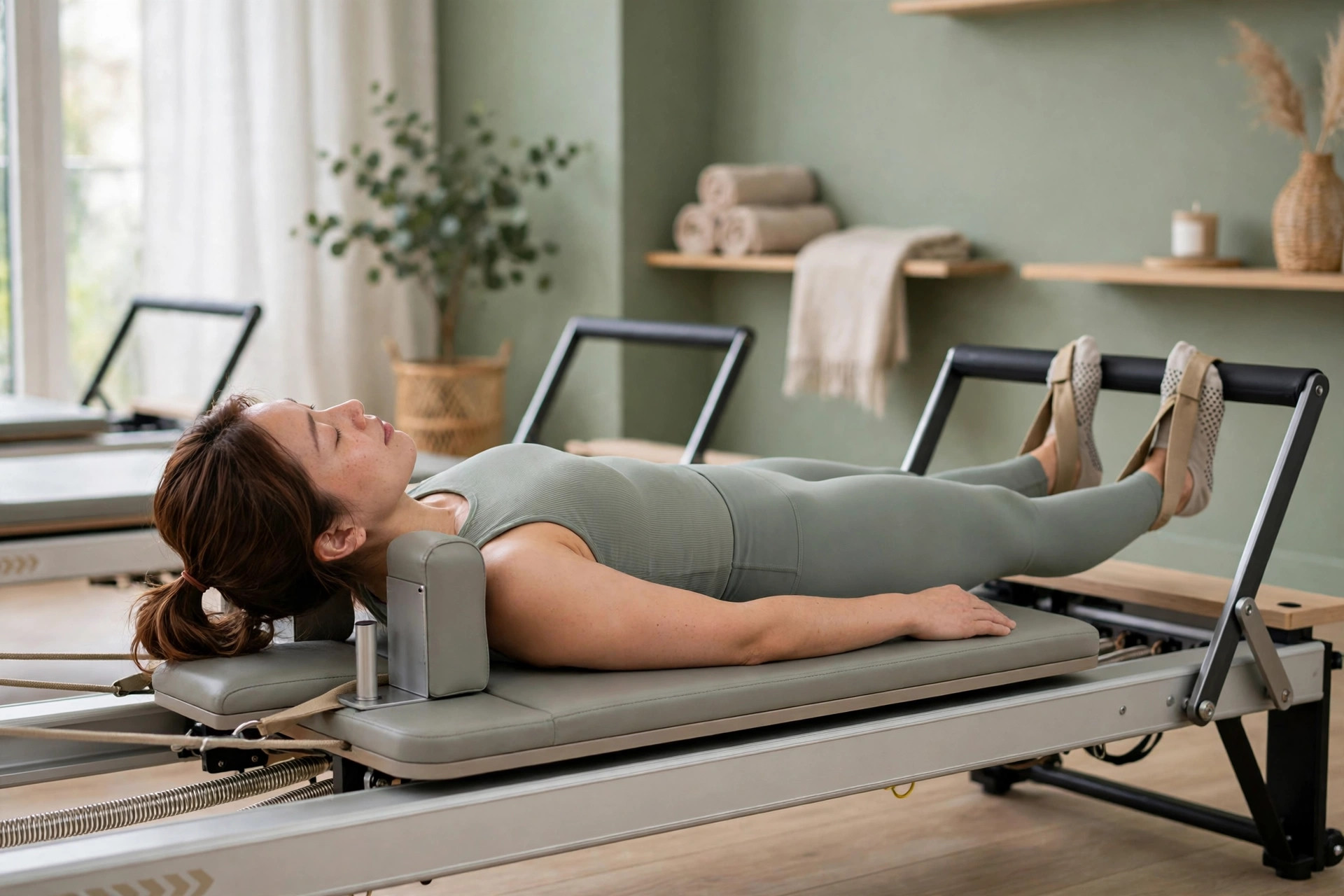
A reformer class dresses for a machine. Your feet press against a footbar and ride in straps, your body lies, sits and kneels on a carriage that slides under spring tension, and your hands grip handles attached to ropes. Every one of those contact points shapes the outfit. Feet need traction that bare skin and ordinary socks cannot give on a moving carriage, which is why studios require grip socks — the dotted silicone sole is effectively part of the equipment, and the buying guide covers styles and fit in full. Clothing needs to slide where the carriage slides and stay still everywhere else: fabric that bunches under the shoulder blades or catches at the hip changes how the carriage travels, and an experienced wearer can feel the difference within one set of footwork.
The reformer also explains the studio’s watchfulness about fit. Instructors read alignment from the body’s outline — hip placement in bridging, knee tracking in footwork, rib position in arm work — and a fitted silhouette makes those reads possible at a glance across a room of machines. Baggy clothing is not a style failure here; it is information the teacher cannot see.
02 — The Silhouette
The Fitted Silhouette: Leggings and Tops
Full-length or seven-eighths leggings are the reformer default for three practical reasons: they protect skin from strap friction at the ankles and thighs, they give the instructor an unobstructed view of leg alignment, and they never shift when feet go into straps. Choose a high, flat waistband with no drawstring, and a knit opaque enough to stay that way under spring-loaded stretch. The women’s leggings guide is the deep reference for rises, gussets and fabric weights. Fitted shorts over a compression liner are the accepted warm-studio alternative; loose shorts are not, because strap work and leg circles leave them nowhere to hide.
Tops follow one test: they must stay in place through a plank, a roll-over and a teaser without being tugged back down. Fitted tanks, close tees and longline tops pass; relaxed tees fail by pooling and sliding. A racerback or high-back cut keeps straps from wandering during arm series. For cooler studios, a fitted long sleeve beats a sweatshirt for the same reason everything else on the machine is fitted — sleeves that stay where they are put cannot drift toward the ropes. Styles across these categories are compared in the women’s tank tops guide.
03 — The Hardware Rule
Hardware-Free, Head to Toe
Of all studio rules, this is the one reformer studios enforce most strictly, and it protects two things at once. For the wearer: any hard point at the back — a legging zipper, a bra clasp, a rivet — becomes a pressure point through every rolling and bridging sequence, concentrated by body weight on a firm carriage. For the machine: that same hardware scores the vinyl upholstery, and a torn carriage cover is a repair bill, not a wipe-down. Studios that have paid it write the rule into the dress code; studios that have not, will. The pre-class check takes ten seconds: waistband pockets unzipped and emptied or, better, absent; bra in a pullover style rather than a hook-back — the sports bra guide flags which constructions are clasp-free; drawstring tips removed or knotted flat; watch and rings left in the cubby.
Seams deserve the same scan. Flatlock or bonded seams disappear under the body; raised, corded seams print through in supine work. This is where Pilates clothing genuinely differs from gym clothing: a legging built for squats may carry pocket zips and chunky seams that a reformer punishes.
04 — Around the Work
Layers, Hair and Jewelry on the Reformer
Studios run cool at the start of class and warm by the middle, so a light layer earns its bag space: a wrap top, a zip-free pullover or a long fitted sleeve for footwork and breathing, removed before the springs get serious. Avoid anything with a hood — it bunches under the head on the carriage — and anything with dangling ties, which drift toward straps. Hair belongs up and off the neck: springs sit inches from the headrest, and a loose ponytail on the carriage is a genuine snag risk, not a tidiness preference. Jewelry rules are identical in spirit — rings off for grip work, necklaces off for inversions, earrings small or out.
The contrast with the floor is instructive. Off the machine, most of these rules soften: the Mat Pilates Outfits guide shows a wardrobe that overlaps heavily with the reformer kit but tolerates softer fabrics, optional socks and a more relaxed top.
05 — The Bag
What to Pack for a Reformer Class
The regular’s bag is short: the outfit itself, a second pair of grip socks in case the first is still in the wash, a small towel, a water bottle, and a hair tie kept permanently in the bag. Shoes are street shoes only — the studio floor is a socks-only zone from the door. If you are buying one thing before a first machine class, buy the socks; a fitted pair of your own is the difference between feet that plant and feet that negotiate. The socks product directory shows how wide the studio-sock category now runs.
Good to Know
Common Questions
Are grip socks really required on the reformer?
At most studios, yes — it is the single most common dress-code rule in reformer Pilates. The grip pattern keeps feet planted on the footbar and in the straps while the carriage moves, and socks are a hygiene measure on equipment shared by every class of the day. Studios typically sell a pair at reception, and some keep a no-socks, no-class policy, so arriving without them is the one wardrobe mistake that can actually end a booking.
Can I wear shorts on the reformer?
Fitted shorts, yes; loose shorts, no. Strap work, leg circles and inverted positions shift loose fabric immediately, and instructors also lose sight of thigh and knee alignment. The styles that work are bike-length or fitted training shorts, ideally over a compression liner. Many regulars simply default to leggings on machine days and save shorts for mat classes, where the rules are looser.
Why do instructors ask about zippers before class?
Because a zipper at the back of a waistband or a bra clasp spends the whole class pressed between the body and the carriage. It is uncomfortable for the wearer during rolling work, and it scratches and can tear the vinyl upholstery, which is costly to re-cover. A quick hardware check before class is equipment care as much as comfort, which is why fitted, pull-on, pocket-free pieces are the reformer standard.
What top stays in place during reformer work?
A close-fitting tank, tee or longline top with enough length to stay tucked at the hip through planks, roll-overs and inversions. Racerback and high-back cuts keep shoulder straps settled during arm work. The honest test is at home: if the hem rides up when you raise your arms overhead or fold forward, it will do the same on the machine, only with an audience of springs.
More to Explore
Search Apparel Search