Poly Bag Heat Sealers for Garment Packing
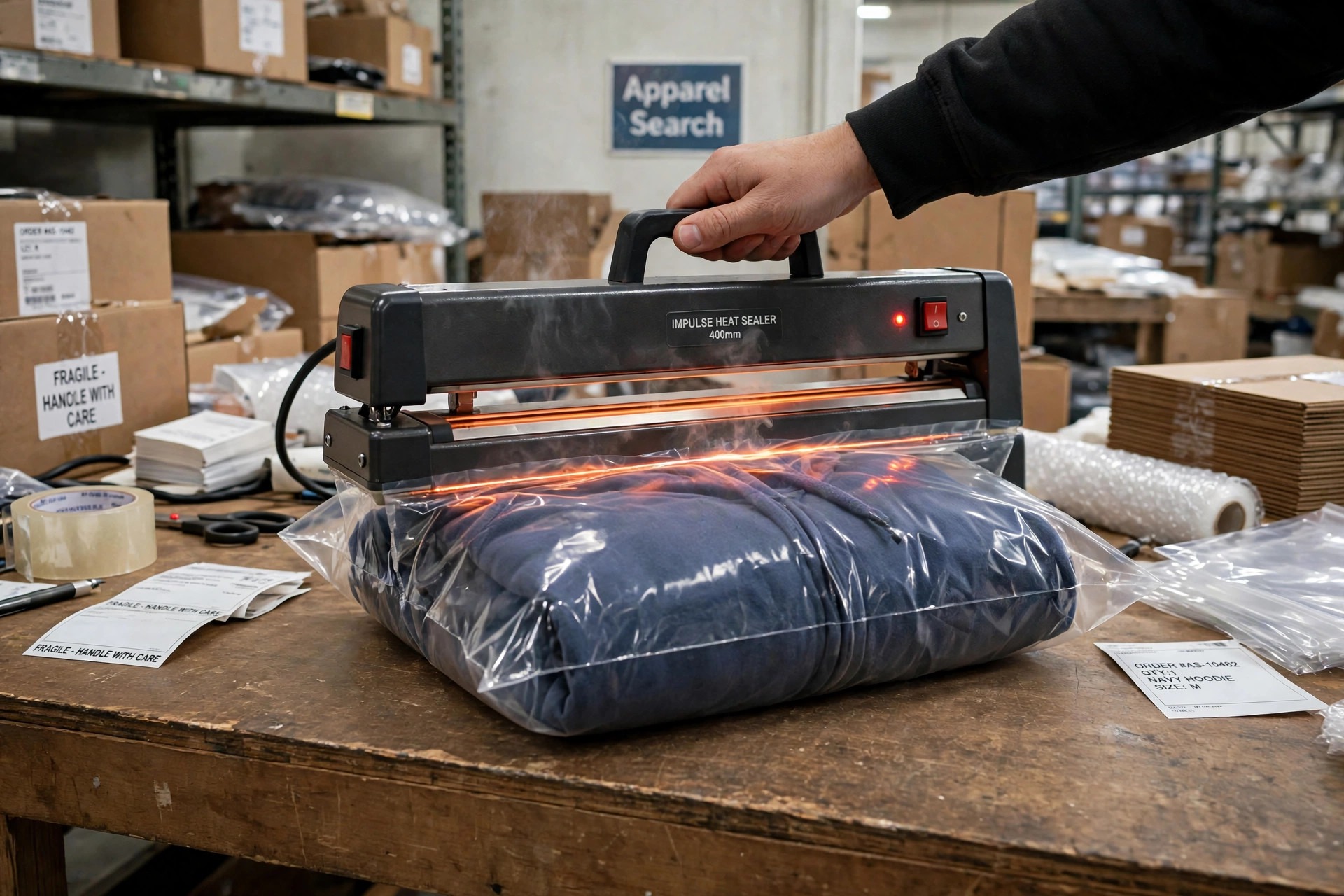
Heat and pressure that fuse a bag shut — the flat, tamper-evident seam on a sealed garment unit.
A poly bag heat sealer closes a bag by melting it shut. The open top of the filled bag is laid across the sealer's jaw; pressure and heat fuse a narrow strip of the film into a single welded seam, and the bag leaves the bench as a sealed unit — watertight and airtight along that seam, and visibly tamper-evident, since the seam must be cut or torn to open it. For clothing warehouses, the heat sealer is what turns a bagged garment into a finished, storable, shippable product.
Poly Bag Types & Bag Equipment
Impulse Sealers and Constant-Heat Sealers
An impulse sealer heats only for the moments its jaw is closed. The operator lays the bag across the element, presses the arm or pedal, and a timed pulse of heat makes the seal; a cooling beat under pressure sets it before the jaw opens. Impulse sealers suit the polyethylene and polypropylene films of garment bagging, start instantly, idle cold and safe, and cover most bench work in apparel packing.
Constant-heat sealers hold their jaws at temperature and seal thicker, laminated or coated films that a pulse cannot bring to fusion — the heavier end of packaging work. Between the two families sit the production machines: foot-operated bench sealers that free both hands and set a steady pace, band sealers that draw bags through continuously on a conveyor for volume lines, and the bag-closing systems of the filling and palletizing equipment makers listed below.
What the seal actually is matters for quality: the two film layers must reach fusion temperature across the full jaw width and cool under pressure. A seal that looks closed but peels apart by hand was too cold, too quick or contaminated — dust, moisture and garment fibres in the seal area are the everyday causes, and they are prevented at the bench, not at the machine.
Which Films a Heat Sealer Can Seal
A good sealer handles the whole bench range of films. The equipment listed on this page is offered for sealing polyethylene, polypropylene, nylon, PVC, Saran, Pliofilm, Kel-F, Mylar, poly flex, polyurethane and polyvinyl alcohol films, among others — effectively every film a clothing warehouse bags in, from the standard polyethylene garment bag to coated presentation films.
Each film has its own sealing window — the combination of temperature, dwell time and pressure at which it fuses without scorching — and the window narrows as film gets thinner. Bench discipline is to set the sealer for the film in hand, test the first seals of a run with a firm hand pull, and re-test whenever the film, gauge or bag supplier changes. A seal log sounds formal for a packing bench; in practice it is one tested bag kept at the bench as the standard.
Sealer size follows bag size: the jaw must exceed the bag's width with room to lay the top flat and straight. Crooked seals come from bags wider than the jaw sealed in two bites — the overlap point is a leak and a weakness — so a warehouse bagging wide garment bags should own a wide-jaw sealer rather than improvise.
Poly Bag Heat Sealer — Suppliers & Manufacturers
Fischbein
For more than ninety years, the Fischbein family of companies has designed, manufactured and provided bag packaging equipment and complete systems to a worldwide customer base, offering a full range of filling, weighing, handling and palletizing equipment to industries that package their products in bags.
Supplies: Bag closing and sealing equipment, filling, weighing, handling and palletizing systems
Grainger
Grainger's heat poly bag sealers help package parts in plastic bags for shipping, distribution or storage. The sealers use pressure and heat to close poly bags with a watertight, airtight seal, crimping the top of the bag and melting a strip of the bag to close it.
Supplies: Heat poly bag sealers and bag accessories
Southwest Poly Bag
Southwest Poly Bag offers a full range of heat sealing equipment for all types of bags, sealing polyethylene, Saran, nylon, PVC, polypropylene, Pliofilm, Kel-F, Mylar, poly flex, polyurethane and polyvinyl alcohol films to maximise production with high quality results.
Supplies: Heat sealers and poly bags
Sealing Well on a Garment Packing Bench
Keep the seal area clean and empty: the top two centimetres of the bag should hold air and film, nothing else — no garment edge, no fold of knitwear, no size sticker. Lay the bag flat and straight across the jaw, seal, hold the cooling beat, and give the seam a visual check for the even, slightly milky weld line that shows a full fusion.
Maintain the wear parts. The element, its covering strip and the jaw pads are consumables; a worn covering gives the patchy seals that fail in cartons weeks later. Spares at the bench and a change at the first sign of patchiness cost minutes; a carton of failed seals found at a customer's warehouse costs a programme.
Common Questions
How does a poly bag heat sealer work?
The sealer presses the open top of the bag between heated jaws. Heat melts a narrow strip of the film and pressure fuses the layers into one welded seam as it cools, closing the bag with a watertight, airtight and tamper-evident seal. Impulse sealers heat only during the sealing pulse; constant-heat sealers hold their jaws at temperature for thicker or laminated films.
Which bag films can be heat sealed?
The sealers listed for this topic are offered for polyethylene, polypropylene, nylon, PVC, Saran, Pliofilm, Kel-F, Mylar, poly flex, polyurethane and polyvinyl alcohol films. Each film has its own temperature and dwell window, so the sealer is set and test-sealed whenever the film or gauge changes.
Why do heat seals sometimes peel apart?
A peelable seal was too cold, too short on dwell, or contaminated — dust, moisture or garment fibres trapped in the seal area prevent fusion. The cure is bench discipline: keep the top of the bag clean and empty, lay it flat across a jaw wider than the bag, test the first seals of each run by hand, and replace worn element coverings and jaw pads promptly.