Self-Sealing Poly Bags for Garments
A bag that carries its own closure — peel, fold, press, and the bag is sealed.
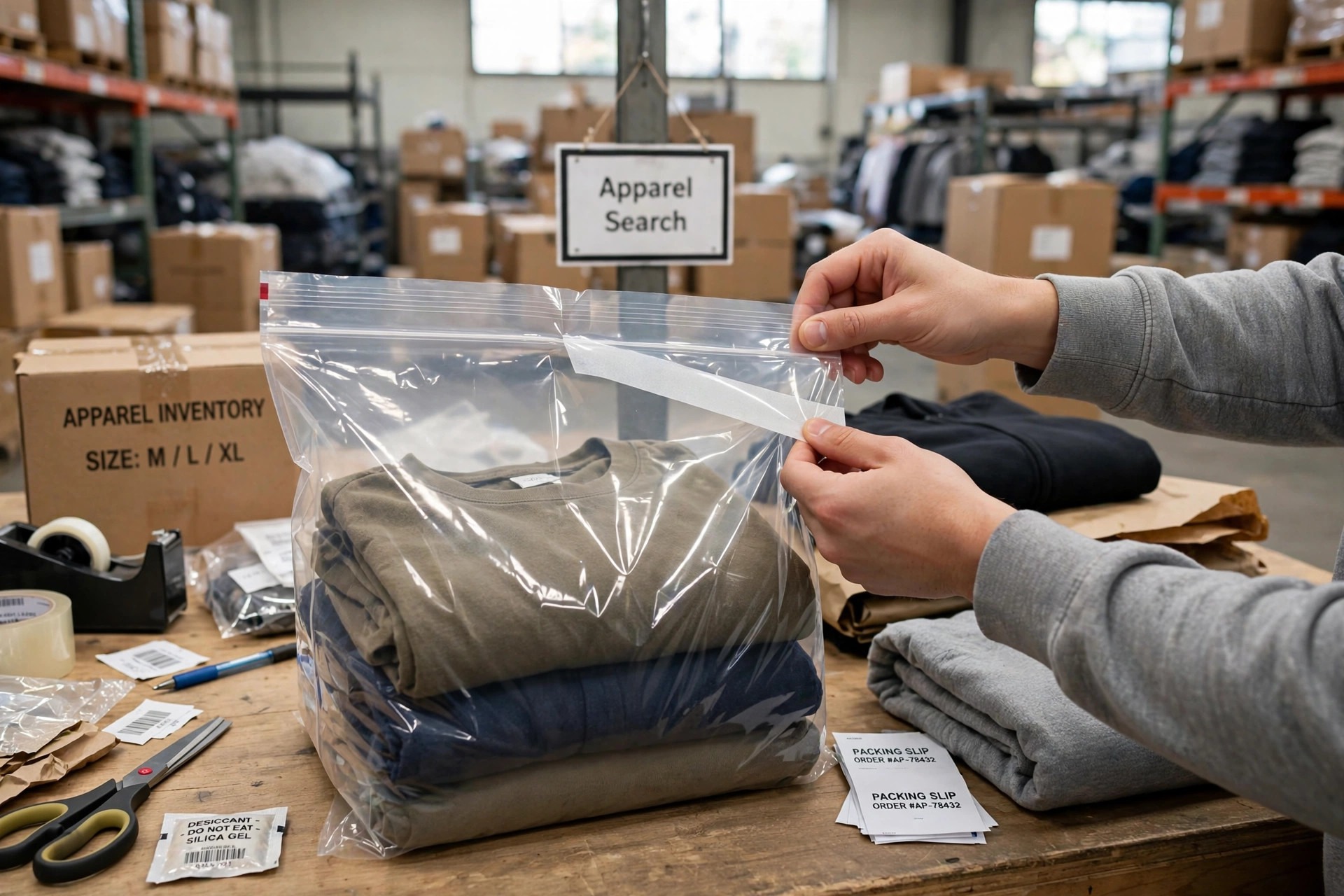
A self-sealing poly bag needs no machine. Its closure is built in: an adhesive strip on a flap, protected by a release liner, or a hook-and-loop fastening across the mouth. The packer bags the garment, peels the liner or aligns the fastening, folds the flap and presses — and the bag is closed, presentable and, in the hook-and-loop form, reopenable as often as the garment needs inspecting. For hand packing, small runs and returns work, the self-sealing bag removes the sealer from the bench entirely.
Poly Bag Types & Bag Equipment
Two Closures: Adhesive Strip and Hook-and-Loop
The adhesive-strip bag carries a flap extending past the bag's mouth, with a pressure-sensitive adhesive band under a peel-off liner. It closes once, cleanly and permanently enough for retail presentation — the flap folds over and bonds to the bag's face, giving a smooth, flat closure that looks like part of the bag. Many presentation and mailing bags use this form because the closed result is tidy and the packing motion is a single fold.
The hook-and-loop bag — the Janstrip design in the listing below is the named example — fastens with a Velcro-brand hook-and-loop closure across the mouth. Its distinction is that it does not require exact alignment to seal, and it is easier to open and close than zipper or tape closures: press anywhere along the strip and it holds; peel it apart and it opens, ready to close again. For garments that will be opened repeatedly — samples, inspection stock, rental and returns circuits — that reclosability is the point.
Both closures share the self-sealing virtue: no heat, no power, no bench equipment, and no seal-quality variation between operators beyond a firm press. What they ask in return is a clean closure area — adhesive and hook-and-loop alike lose grip over dust, fibres and moisture — and a flap kept straight in storage so it arrives at the bench ready to fold true.
Self-Sealing, Zippered or Heat-Sealed?
The three closures divide by reopening. A heat seal is permanent and tamper-evident: it opens by destruction, which is right for a finished retail unit. A zipper recloses many times along a track the fingers must align and run. A self-sealing adhesive flap closes once with the neatest finish; a hook-and-loop flap recloses many times with the least alignment effort of any closure in the bag range.
Cost follows the same order of thinking. The self-sealing bag carries its closure in its price, so the bag itself costs more than a plain flat bag — and the bench needs no sealer, no tape and no dispenser, which is where the money returns on hand-packing work. Programmes choose per garment family: heat-sealed for the sealed unit, self-sealing for the hand-packed, the sampled and the frequently reopened.
The manufacturer listed here specialises in this end of the range, making poly bags in a variety of shapes, sizes and printed colours for a wide array of applications, with the self-sealing lines — including its exclusive hook-and-loop Janstrip bags — as a speciality rather than an afterthought.
Self-Sealing Bags — Suppliers & Manufacturers
Jannel Packaging
Jannel Packaging, Inc. specialises in manufacturing poly bags in a variety of shapes, sizes and printed colours, making its poly bags suitable for a wide array of applications. Its Janstrip self-sealing poly bags feature Velcro-brand hook-and-loop closure systems and are available exclusively from Jannel Packaging. Janstrip bags do not require exact alignment to seal, and are easier to open and close than zipper-type or tape-closure poly bags.
Supplies: Self-sealing poly bags, including Janstrip hook-and-loop closure bags, in custom shapes, sizes and printed colours
Packing With Self-Sealing Bags
Keep liners on until the moment of closing — an adhesive strip exposed early collects the bench's dust and arrives at the fold half spent. Fold the flap in one straight motion and press along its full length; a flap pressed only at its centre holds at its centre, and a corner lifts in the carton to prove it.
Store the bags flat and in their bundles, flaps uncreased. A self-sealing bag is a small mechanism as well as a bag, and it rewards being treated like one: closures protected, stock rotated, and the first bag of each bundle test-closed before the run begins.
Common Questions
How does a self-sealing poly bag close?
The closure is built into the bag. An adhesive-strip bag has a flap with a pressure-sensitive adhesive band under a peel-off liner: peel, fold the flap over the mouth, and press to seal. A hook-and-loop bag, such as the Janstrip design, fastens with a Velcro-brand strip across the mouth that holds when pressed together without exact alignment. Neither needs heat or bench equipment.
Can self-sealing bags be reopened?
An adhesive-flap bag closes essentially once, with a neat, permanent finish for retail presentation. A hook-and-loop self-sealing bag opens and recloses repeatedly and easily, which suits samples, inspection stock and returns work — the uses where a heat seal would be destroyed at the first opening and a zipper would demand careful alignment at every closing.
When is a self-sealing bag better than a heat-sealed bag?
For hand packing, small runs, samples and garments that will be reopened, a self-sealing bag removes the sealer from the bench and closes consistently with a firm press. A heat seal remains the better choice for finished retail units that need a fused, tamper-evident seam for storage and shipping.