Poly Bags on Rolls for Packing Benches
Bags that arrive as one continuous roll — torn off one at a time, exactly where the packing happens.
Poly bags on rolls change the packing bench, not the bag. The bags themselves are ordinary flat or gusseted poly bags; what is different is their delivery: joined end to end, perforated between each bag, and wound on a core, so the packer pulls, tears and bags in one rhythm without reaching for a stack, fanning a bundle or separating clinging films. On a bench that bags garments all day, that small change in supply is the difference between a two-handed job and a flowing one.
Poly Bag Types & Bag Equipment
How Bags on Rolls Work at the Bench
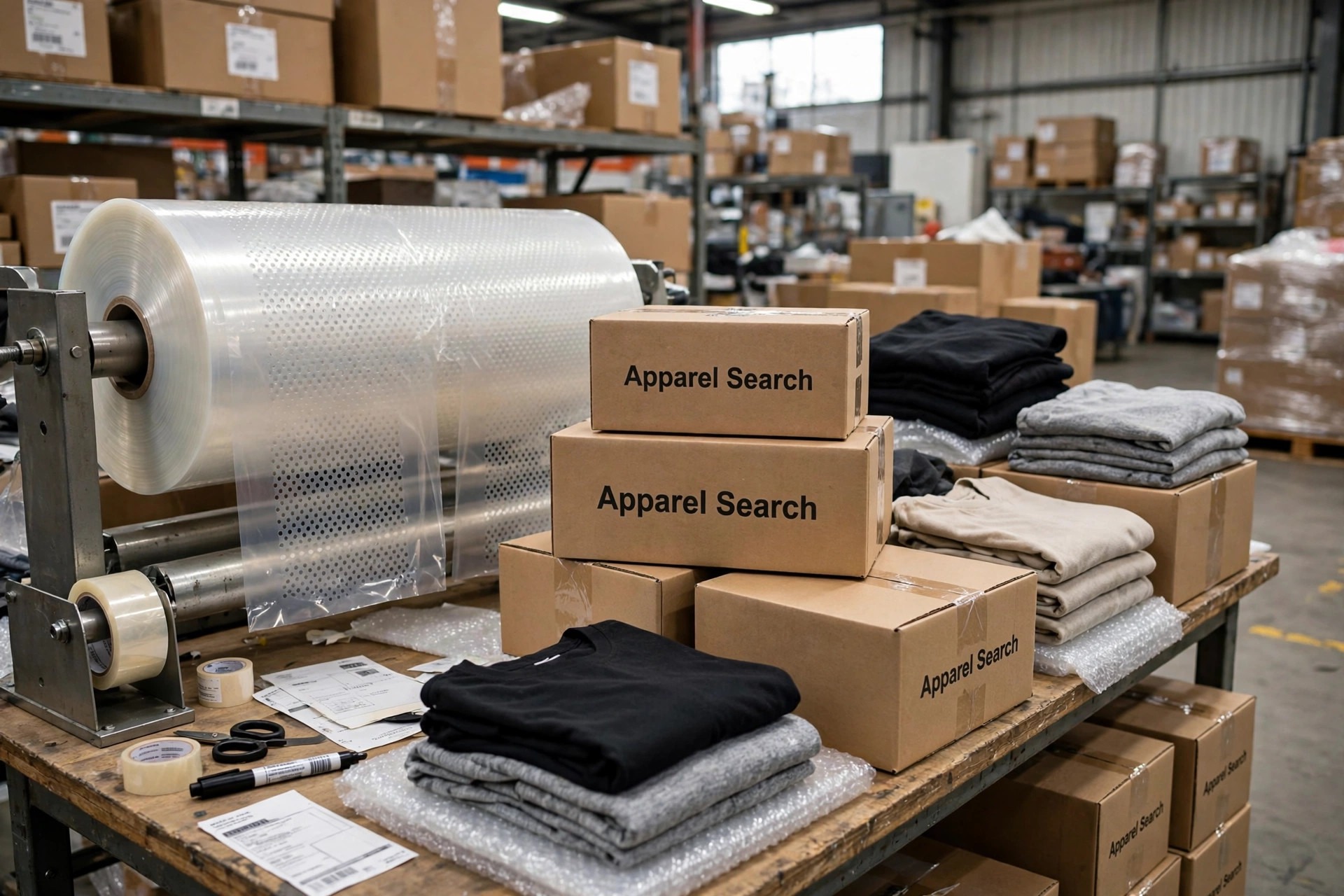
A roll sits on a spindle or in a dispenser frame at the bench, with the lead bag hanging within the packer's reach. Each bag is torn from the next along its perforation — the tear line is also, commonly, the sealed bottom of the following bag, an economy of manufacture that makes roll bags neat as well as quick. The packer opens the bag, often with a rub of the fingers or a puff from a bench air line, bags the garment, and the next bag is already presented.
Rolls suit repetition: one garment family, one bag size, long runs. A bench that changes bag sizes every few garments spends its savings on roll changes, while a bench running a season's shirts through one bag size never touches a bundle. That is why rolls are the standard supply form in high-volume garment bagging and in the mail-order and dispatch areas where the same parcel bag repeats thousands of times.
The roll form also disciplines stock: a part-used roll is one tidy object, counted by weight or by the maker's stated count, stored on its core, and protected by its own outer wraps — where loose bags spill, cling, pick up dust and lose count. A warehouse juggling many sizes can rack rolls by size the way it racks cartons, each labelled and each ready to mount.
Specifying Bags on Rolls
Specify the bag as you would its loose equivalent — size, gauge, film, venting, print — then specify the roll: the number of bags per roll, the core diameter that fits the bench spindle, and whether the bags are wound with the opening leading or trailing, which decides how each bag presents as it is torn free. Print, where wanted, repeats bag by bag down the roll without difficulty.
Perforation strength is the roll-specific quality: too strong, and tearing jerks the roll and strains the packer's wrist across a shift; too weak, and bags part company inside the roll or tear into the seal. A trial roll on the real bench, packed by the real packers at real pace, settles perforation, opening and slip together — the three properties that decide whether a roll speeds a bench or fights it.
The supplier listed here stocks bags on rolls as one form within a wider bag range — polyethylene, polypropylene, flat, zipper and gusset bags — so a programme can move a size from loose to roll supply, or back, inside one specification and one relationship as volumes change.
Poly Bags on Rolls — Suppliers & Manufacturers
United States Plastic Corp.
United States Plastic Corp. manufactures and distributes some 23,000 plastic and safety items, serving over 85,000 clients from a factory five acres under roof.
Supplies: Bags on rolls, polyethylene bags, polypropylene bags, flat bags, zipper bags and gusset bags
Rolls in the Wider Bag Programme
Keep one mounted roll and one spare at the bench, and the rest in racked storage — a roll is heavy for its size, and benches crowded with rolls for sizes not in today's work are benches slowed, not stocked. Rotate rolls as stock: film ages, and the oldest roll should be the next one mounted.
When a programme's volume in a size falls — end of a season, end of a line — finish the open roll and return the size to loose supply rather than leaving a slow roll ageing at the bench for months. The roll form rewards volume and repetition; used where those hold, it is the fastest bag supply a bench can have.
Common Questions
What are poly bags on rolls?
They are ordinary flat or gusseted poly bags joined end to end, perforated between each bag, and wound on a core. Mounted at a packing bench, the packer pulls and tears off one bag at a time in a continuous rhythm, without handling stacks or separating loose, clinging bags.
When do bags on rolls beat loose bags?
When the bench repeats one bag size across long runs — a season's shirts, a dispatch line's parcel bags. The roll presents each bag ready to open and keeps stock tidy and countable. Benches that change sizes every few garments lose the advantage in roll changes and are better served by loose bags.
What should be specified when ordering bags on rolls?
The bag itself (size, gauge, film, venting, print), then the roll: bags per roll, core diameter for the bench spindle, and winding direction so each bag presents correctly as it is torn free. Perforation strength matters too — it should tear cleanly at bench pace without jerking the roll or weakening the next bag's seal — and is best settled with a trial roll.