Kwanzaa Outfit Guide
Seven nights from December 26 to January 1 — a celebration of heritage dressed in kente, African prints and the colours red, black and green.
Kwanzaa is a week-long celebration of African American culture, community and heritage, created in 1966 by Dr. Maulana Karenga and observed every year from December 26 to January 1. Each of the seven nights honours one of the Nguzo Saba, the seven principles, and is marked by lighting a candle in the kinara — the seven-branched candleholder; the week builds to the karamu, a feast held on December 31. It is a home-and-community festival, and its dressing is some of the most distinctive of the winter season: African prints, kente cloth and the colours red, black and green. This guide explains the garments and the customs behind them; for the principles that apply at every festival, see our cultural and festival outfit guide.
A Week of Gatherings
The week runs at three levels. Home candle-lightings are family occasions: relaxed, but dressed — this is a celebration, not an ordinary December evening. Community celebrations fill cultural centres, libraries, schools and churches through the week, with programmes, drumming and children presenting; the dressing follows the venue, a step smarter. The karamu feast on December 31 is the dressiest night of the seven — it shares its evening with New Year's Eve, and the dressing carries the same celebratory weight. Across seven nights, the same rotation logic applies as at any week-long festival: one or two print garments as anchors, plain pieces in the palette around them.
Kente and African Prints
What Is Kente?
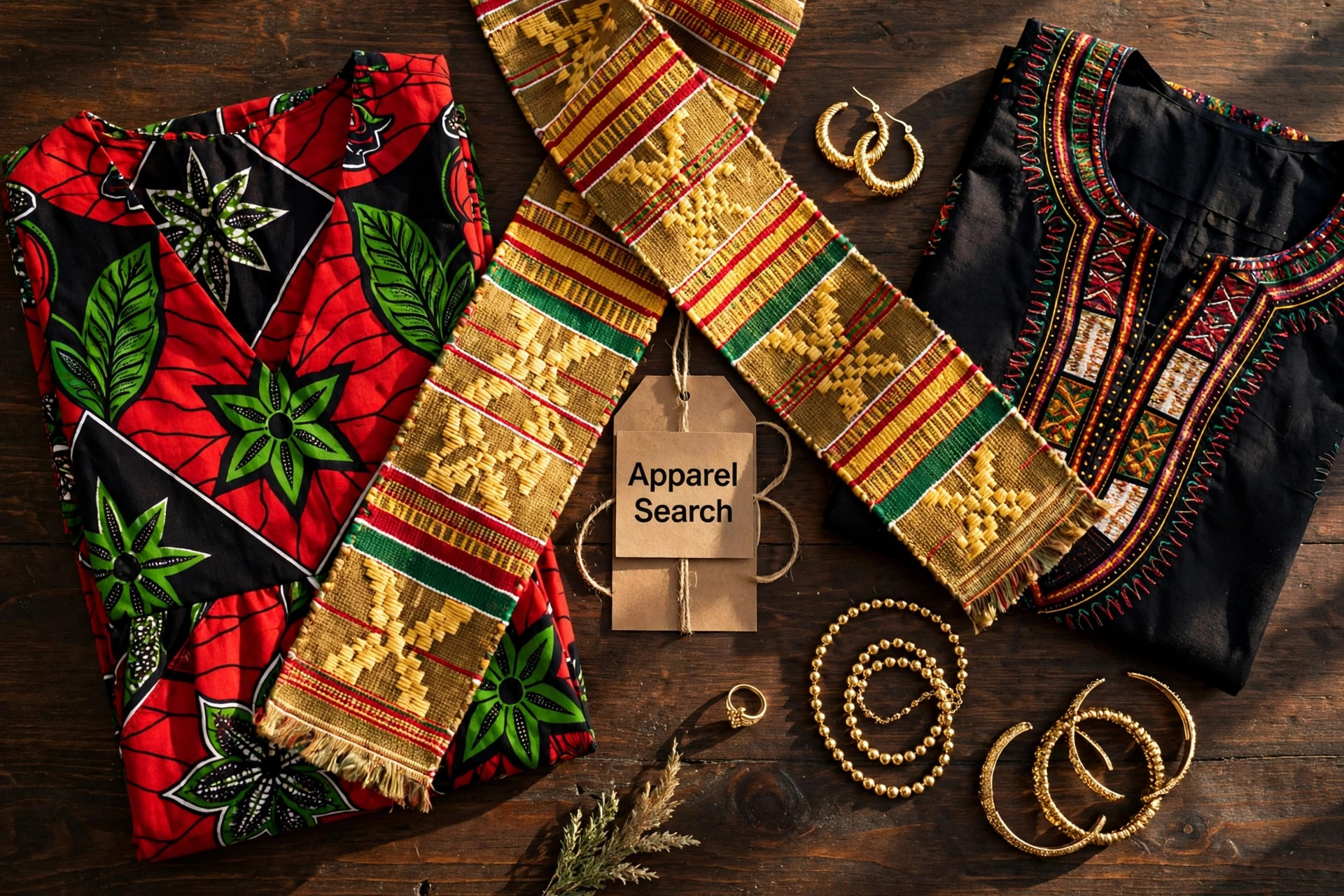
Kente is a strip-woven cloth from Ghana, woven by Asante and Ewe weavers on narrow looms and sewn together strip by strip into large cloths of geometric pattern — many patterns carry their own names and meanings. Silk kente was the royal cloth of the Asante court. At Kwanzaa it appears as full cloth, as a stole worn over a plain outfit, and worked into ties, caps and headwraps.
African prints — the bold, repeating wax-print cottons often called Ankara — are the week's workhorse fabric: dresses, shirts, skirts and matching family sets are cut from them, and a print worn well is the signature Kwanzaa look. The classic man's and unisex garment is the dashiki, a loose, richly embroidered tunic that reads festive over plain trousers. Two notes on wearing prints well: buy real garments, and where you can, buy them from African and Black-owned makers, whose work the celebration honours; and wear the prints as well-cut clothing, chosen the way you would choose any party clothes — Kwanzaa dressing is celebratory, and it is never a costume.
Red, Black and Green
The colours are the same three as the mishumaa saba, the seven candles in the kinara, and of the Pan-African flag: black for the people, red for the struggle, and green for the earth and for hope. Outfits build on the palette in every proportion — a print that carries all three, a black base lit by one red or green piece, a kente stole adding its woven gold. Gold jewellery is the natural accent: it picks up the gold threads in kente and the candles' flame. Our colour theory for dressing guide covers strong three-colour combinations if you want the underlying principles.
Children, Families and Photos
Kwanzaa is a family festival in the full sense: children light candles, recite principles and perform at community programmes, and matching family outfits in the same print are a beloved tradition rather than a novelty. Choose children's sets in soft cotton prints that survive a long programme and a feast; the photographs from the karamu tend to live on the wall all year.
Guests at a Kwanzaa Celebration
Guests are joining a cultural celebration, and the dressing asks for respect rather than ceremony. Festive clothes are right; if the host's family wears African prints, a print garment of your own is a welcome way to join in — and if you are unsure, ask, because hosts are glad to be asked. The greeting through the week is 'Habari Gani?' — 'What's the news?' — answered with the principle of the day. What never belongs is fancy dress: prints worn as clothing honour the celebration; anything worn as a joke costume does the opposite.
Shop Kwanzaa Outfits on Amazon
Kwanzaa outfits, African-print dresses and shirts, kente stoles and dashikis are all stocked on Amazon.
Shop Clothing on AmazonProduct links are kept in one place on the Apparel Search Amazon shopping guide, so this page can stay a guide rather than a catalogue.
Common Questions
When is Kwanzaa, and how long does it last?
Kwanzaa runs for seven days every year, from December 26 to January 1. Each night one of the seven candles in the kinara is lit and one of the seven principles — the Nguzo Saba — is honoured, and the week builds to the karamu feast on December 31.
What is kente cloth?
Kente is a strip-woven cloth from Ghana, woven by Asante and Ewe weavers in narrow bands that are sewn together into large cloths covered in geometric patterns, many with their own names and meanings. Silk kente was the royal cloth of the Asante court. At Kwanzaa it is worn as full cloth, as a stole over a plain outfit, and in ties, caps and headwraps.
Do you have to wear African prints for Kwanzaa?
There is no rule — but prints are the celebration’s signature, and most celebrants wear them at least on the bigger nights. If you are a guest and your hosts wear prints, wearing a print garment yourself is a welcome way to join in; festive dress in the red, black and green palette works too. Ask your host if you are unsure.
What do the Kwanzaa colours mean?
Black, red and green — the colours of the kinara candles and of the Pan-African flag. Black stands for the people, red for the struggle, and green for the earth and for hope. Gold, the colour threaded through kente cloth, is the natural accent.
Related Guides
Cultural & Festival Outfit Guide
The parent guide: the customs that touch your clothes at every festival — coverage, shoes, head coverings and colour symbolism.