Hanukkah Outfit Guide
Eight nights of candles, dinners and parties — festive winter dressing that runs from the family table to the synagogue, in blue, white and silver.
Hanukkah is the winter festival of lights: eight nights, beginning at sundown on Friday, December 4 in 2026 and running through Saturday, December 12, when families light the menorah, eat food fried in oil in honour of the holiday's story, spin the dreidel and exchange gifts. It is not one occasion but a week of them — home dinners, synagogue services, community candle-lightings and parties — and the dressing is festive rather than formal: a clear step up from the everyday, in the richest colours of the winter wardrobe. This guide covers the week occasion by occasion; the principles that apply at every festival are in our cultural and festival outfit guide.
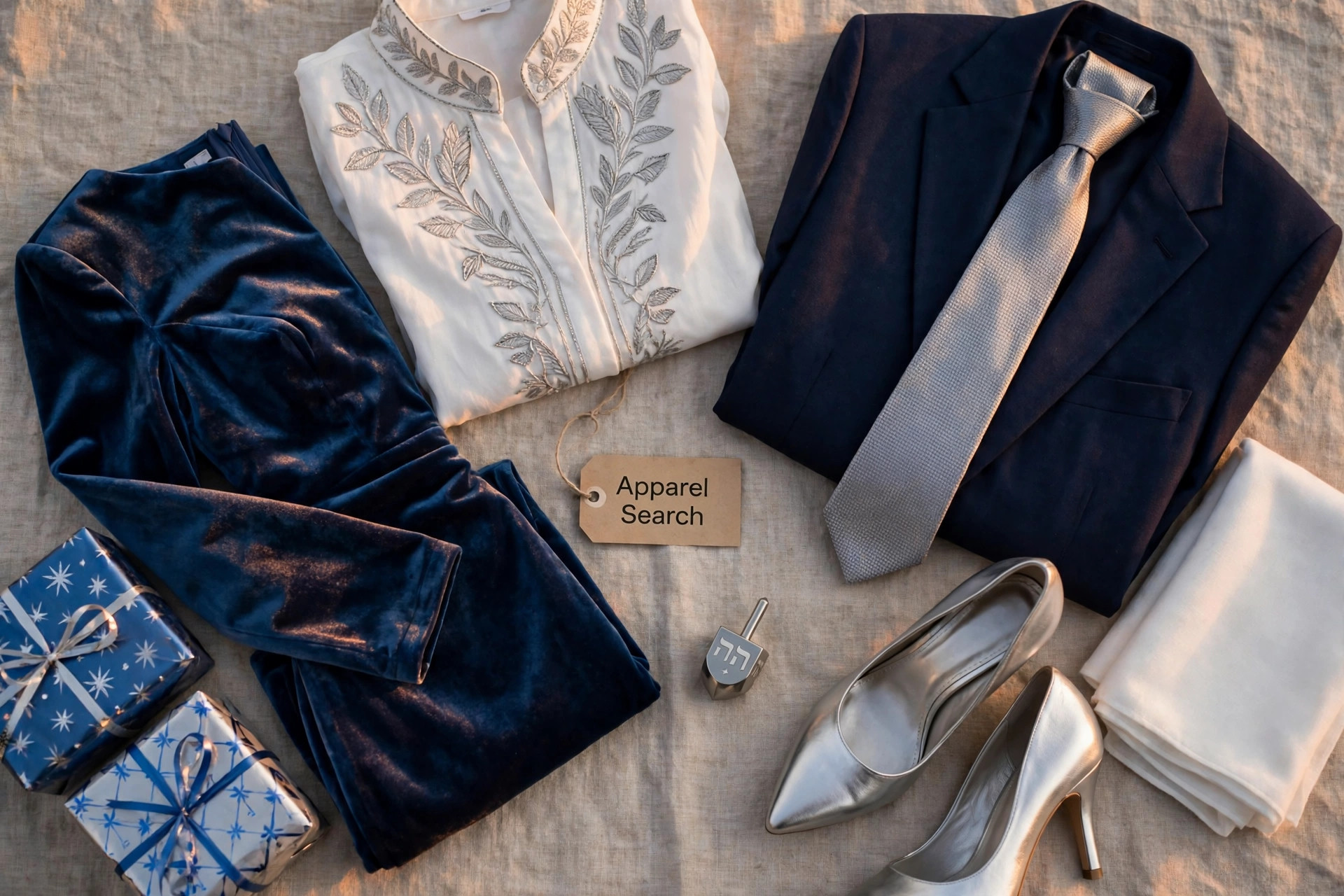
Eight Nights, Several Dress Codes
The week mixes three kinds of occasion. Family dinners at home are the heart of it: smart, comfortable clothes you can sit in for a long meal and get down on the floor in for a dreidel game with the children. Services — many synagogues hold them through the week — call for the covered, polished dressing covered below. Parties, at homes and community venues, are the dressiest nights: cocktail-level shine is welcome, and sequins read as festive rather than excessive.
Eight nights also reward a rotation strategy. Few people own — or need — eight party outfits. One best outfit for the biggest night, then separates in the palette that recombine: a velvet jacket over two different tops, a metallic knit with a skirt and then with trousers, one good dress worn twice with different jewellery. Planned once, the week dresses itself.
One Hero Outfit, Seven Remixes
Choose the hero outfit first — the first night, or the biggest family dinner — and build the rest of the week from separates in blue, white and silver. A velvet blazer, a silver top and one pair of dark trousers or a velvet skirt will carry most of the remaining nights without ever repeating a whole look.
Blue, White and Silver
The Hanukkah palette is one of the most recognisable in festive dressing. Blue and white are the colours of the Israeli flag and of the stripes on the tallit, the Jewish prayer shawl; silver and gold supply the metallic half — the metal of the menorah, the foil wrapped around chocolate gelt coins. In practice it means deep-blue velvet, white blouses with silver embroidery, navy tailoring, silver shoes and jewellery, and gifts wrapped in the same colours. It is a custom rather than a rule — plenty of other festive winter colours are worn — but an outfit built on the palette reads unmistakably as Hanukkah dressing. Our colour theory for dressing guide covers pairing metallics with deep colours in more depth.
For Services: Coverage That Varies by Congregation
There is no single synagogue dress code, and honesty about the range serves better than a false rule. In Orthodox congregations, women wear skirts or dresses that cover the knee, sleeves to the elbow or below, and higher necklines; men wear a suit or jacket, and head coverings are worn by men throughout and by married women in many communities. Conservative congregations usually sit a step less formal, with covered shoulders and longer hemlines as the comfortable default. Reform congregations span the widest range, from suits to smart festive dress. A guest who chooses covered shoulders, a knee-covering hemline and polished shoes will be appropriately dressed almost anywhere; men attending a service will usually be offered a kippah (skullcap) at the door, and wearing it during the service is the respectful norm. When in doubt, ask your host — the question is always welcome. Our modest fashion guide covers dressing to a congregation's code in general.
For Dinners and Parties
At home, dress for the evening's real activities: a long sit-down dinner, children underfoot, candle-lighting photos, and food that is proudly fried. Latkes and sufganiyot (jelly doughnuts) mean oil and powdered sugar, so the cook and anyone helping in the kitchen does well in washable fabrics or an apron over the good outfit; guests can simply choose pieces that are not precious about a splash. Parties move the dial up: velvet, satin and sparkle, cocktail dresses and dark suits, with the palette doing the seasonal signalling. Children wear party clothes they can play in — this is a festival of games and chocolate coins, and stiff outfits lose.
Clothing as a Hanukkah Gift
Gift-giving runs through the week in many families — often small gifts on each night rather than one large gift — and clothing has a beloved place in it: new pyjamas are a tradition in many American families, alongside cosy socks, scarves and the soft layers of December. If you are shopping for them, our holiday fashion shopping guide maps the season's shopping rhythm around the eight nights.
Shop Hanukkah Outfits on Amazon
Blue velvet dresses, metallic tops, men's blazers, silver accessories and Hanukkah pyjamas for the family are all stocked on Amazon.
Shop Clothing on AmazonProduct links are kept in one place on the Apparel Search Amazon shopping guide, so this page can stay a guide rather than a catalogue.
Common Questions
When is Hanukkah in 2026?
Hanukkah begins at sundown on Friday, December 4, 2026, and the eighth night falls on Saturday, December 12. The candles are lit each night at sundown, and most of the week’s dinners and parties are evening occasions — one reason the dressing leans rich, warm and a little bit shiny.
What colours do people wear for Hanukkah?
Blue and white are the classic Hanukkah colours, with silver (and gold) as the metallic accents — they echo the Israeli flag, the stripes of the tallit prayer shawl, the metal of the menorah and the foil on chocolate gelt. It is a custom, not a rule: any festive winter colour is worn, but an outfit built on blue, white and silver reads unmistakably as Hanukkah dressing.
What should a guest wear to a Hanukkah dinner?
Smart, festive clothes — a step up from everyday, short of black tie. If the evening includes a synagogue service, choose covered shoulders and a longer hemline as a respectful default, because modesty norms vary by congregation. Men may be offered a kippah (skullcap) to wear during a service; accepting it is the normal, respectful thing to do.
Do I need eight different outfits?
No — and few people wear eight. The week rewards a rotation: one best outfit for the biggest night, then separates in the blue, white and silver palette — a velvet jacket, a metallic top, one good skirt or pair of trousers — recombined across the remaining dinners and parties.
The other great family celebration in Jewish life dresses differently again: a bar or bat mitzvah is a single day holding a formal service and a full party, and the guest’s problem is covering both. Our bar and bat mitzvah outfit guide works through it — service coverage that varies by congregation, the party afterwards, and outfits for the celebrant and family — with a dedicated bat mitzvah outfit guide for the girl’s celebration.
Related Guides
Cultural & Festival Outfit Guide
The parent guide: the customs that touch your clothes at every festival — coverage, shoes, head coverings and colour symbolism.