Men's Merino Cardigans Guide
A merino cardigan is the open-front sweater - buttoned down the chest, in the classic cardigan form - knitted from the wool of the Merino sheep, a breed prized for some of the finest and softest wool of any sheep. Merino wool is finely crimped and soft, generally less than 24 microns in fiber diameter, with grades running from strong wool down through fine and superfine to ultra fine suitable for blending with silk and cashmere. In a cardigan, that fiber does specific work: it regulates temperature against the skin, draws moisture away so the wearer avoids the feeling of wetness, and knits fine enough to layer over a shirt and under a jacket without bulk. This guide is about the buttoned form in that fiber.
Shop Men's Merino Cardigans Now
Shop Men's Merino Cardigans on Amazon Shop Men's Merino Cardigans on eBayThe Amazon and eBay links on this page are affiliate links. If you make a purchase through them, Apparel Search may earn a commission.
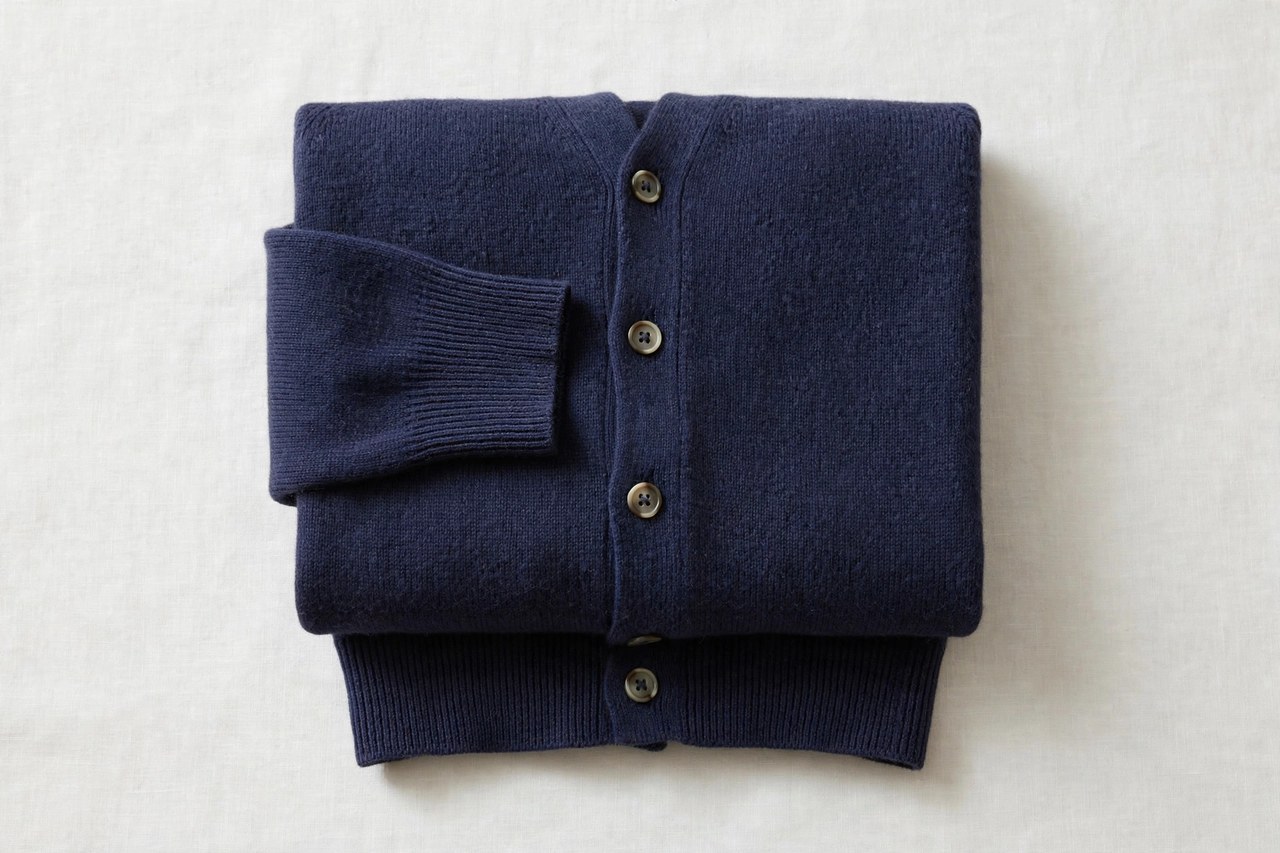
A merino cardigan is the open-front sweater - buttoned down the chest, in the classic cardigan form - knitted from the wool of the Merino sheep, a breed prized for some of the finest and softest wool of any sheep. Merino wool is finely crimped and soft, generally less than 24 microns in fiber diameter, with grades running from strong wool down through fine and superfine to ultra fine suitable for blending with silk and cashmere. In a cardigan, that fiber does specific work: it regulates temperature against the skin, draws moisture away so the wearer avoids the feeling of wetness, and knits fine enough to layer over a shirt and under a jacket without bulk. This guide is about the buttoned form in that fiber. This guide explains what to look for, how the sizing actually works, which fabrics and constructions earn their price, and how to care for the garment so it keeps doing its job season after season.
Fine Gauge, Honest Plackets
Read a merino cardigan by its knitting. Fine gauge - twelve gauge and finer - makes the dress cardigan: a smooth, almost jersey surface that reads as tailoring's soft alternative, worn buttoned over a shirt and tie or open over a tee. Coarser gauges and shawl collars take the style casual and warm. Buttons on better garments are horn, corozo or a quality resin, sewn to a reinforced placket that will not ripple; the placket is the cardigan's structure, and a wavy one announces cheap making louder than any label. Pockets, when present, are patch or inset at the hips. Because merino takes dye beautifully and resists odor across wears, the cardigan is the natural travel and office sweater - merino's fiber properties, temperature regulation and wicking, are precisely the properties a garment worn all day against a shirt needs.
Judge knitwear by gauge, ply and finishing rather than by softness in the shop, because every knit feels kind on day one. Gauge counts stitches per inch - finer gauges drape and layer, coarser gauges insulate and read casual. Ply counts the strands twisted into the yarn: more plies mean more warmth, roundness and price. Fully-fashioned shaping, knitted in rather than cut and sewn, marks better garments, and linked seams at the shoulders and neck lie flatter and last longer than overlocked ones.
The Double Life: Open and Closed
Fit a cardigan to its double life: closed, it should button without the placket pulling into scallops, the shoulders at your shoulders, the hem covering the waistband; open, it should hang in two clean columns that do not swing. Sleeves to the wrist bone, with a ribbed cuff that can push up and stay. The merino cardigan's party trick is layering both ways - over a shirt, under a blazer - so test both in the shop: under a jacket, the fine-gauge versions disappear except at the V of buttons, which is exactly the effect the style exists for. Between sizes, prefer the one that buttons calmly; a cardigan worn only open because it must be is a size wrong, whatever the mirror said.
Fit knitwear by the body, not the shoulders alone: a sweater should skim rather than cling, with ease for a shirt beneath at the chest, sleeves ending at the wrist bone, and body length covering the waistband without pooling. Knits relax with wear - a slightly firm new fit is often the right long-term fit - but ribbed cuffs and hems should recover when stretched, and a neckline should sit flat against the base of the neck, neither gaping nor strangling.
Airing Is Care, Too
Merino's care is gentler than its reputation for toughness suggests, and the cardigan's placket adds one rule: button it before washing, so the front's shape is supported, then wash cool on a wool cycle or by hand, dry flat reshaped with the placket straight, and fold. The fiber's natural elasticity and odor resistance mean the cardigan needs washing less often than cotton knits - airing between wears is genuine care, not neglect. Depill the friction points - under the arms, where a seatbelt crosses - and store folded with cedar against moths. A fine merino cardigan kept this way holds its placket, its cuffs and its temper for years of weekly service.
Knitwear care is gentle by default: wash cool by hand or on a wool cycle with knitwear detergent, never wring, roll in a towel to lift water, and dry flat on a mesh or towel, reshaped to its measurements. Fold for storage - hangers stretch shoulders into points - with cedar or lavender against moths, and rest a sweater a day between wears so its fibers recover their loft. Depill with a comb or electric shaver; pilling is loose fiber migrating, not the garment failing.
Common Questions
What is merino wool, and why use it for a cardigan?
Merino is the wool of the Merino sheep - a breed originating in Spain and developed in Australia - prized for fibers finer and softer than ordinary wool: generally under 24 microns, graded from strong through fine and superfine to ultra fine. It regulates temperature, wicks moisture from the skin, resists odor and knits very fine. In a cardigan - a garment worn open or closed against a shirt all day - those are exactly the working properties, which is why merino owns this category.
How should a merino cardigan fit?
It must work both open and closed: buttoned without the placket pulling into scallops, hem covering the waistband, sleeves to the wrist; open, hanging in two clean columns. Test it under a blazer too - the fine-gauge cardigan's classic role - where it should vanish except for the V of its buttons. If it only looks right open, it is a size small; the buttoned fit is the honest one.
How often should a merino cardigan be washed?
Less often than you would expect. Merino's fibers resist odor and release soil readily, so airing the cardigan after wear - a night on a chair or hanger in moving air - restores it for several wears between washes, unless it is actually soiled. When you do wash: cool, gentle, buttoned up, dried flat. Overwashing is the main way merino knitwear ages early; the fiber rewards restraint.
More in Men's Clothes Guide M
The Sheep, the Fiber, the Cardigan
The Merino is an economically influential breed of sheep prized for its wool; the breed’s origins are from Spain, but the modern Merino was domesticated in Australia, and Merinos are still regarded as having some of the finest and softest wool of any sheep. Merino wool is finely crimped and soft, with staples commonly 65–100 mm long, and is generally less than 24 microns in diameter — basic types run from strong wool at 23–24.5 microns through medium and fine to superfine at 15–18.5 and ultra fine at 11.5–15 microns, the ultra fine grades being suitable for blending with silk and cashmere. Merino is excellent at regulating body temperature, especially worn against the skin; it draws moisture away from the skin — wicking — so the wearer avoids the feeling of wetness. A cardigan is a knitted garment with an open front, commonly buttoned. The men’s cardigans guide and the merino family beside it are linked below.
More to Explore on Apparel Search
- Men's Cardigans
- Men's Sweaters
- Men's Merino Shirts
- Men's Clothes
- Clothes
- Fashion
- Clothing Retail Stores
- Fashion News
- Fashion Employment
- Fashion Designers
- Popular Brands
- Men's Fashion News
- Men's Clothing Stores
- Men's Clothing Wholesalers
- Men's Fashion
- Men's Clothes Guide H-P
- Men's Clothes Guide Q-Z
- Fashion Designer Directory
Looking for Men's Clothing Stores?
This guide explains men's merino cardigans. To browse where to buy, visit our men's clothing store directory, where you can find retailers that carry them.