Women's Cotton Turtleneck Guide
Fine-gauge cotton, a proper folding neck — the cool-weather layer that polishes everything over it.
Shop Women's Cotton Turtlenecks Now
Shop Women's Cotton Turtlenecks on Amazon Shop Women's Cotton Turtlenecks on eBayThe Amazon and eBay links on this page are affiliate links. If you make a purchase through them, Apparel Search may earn a commission.
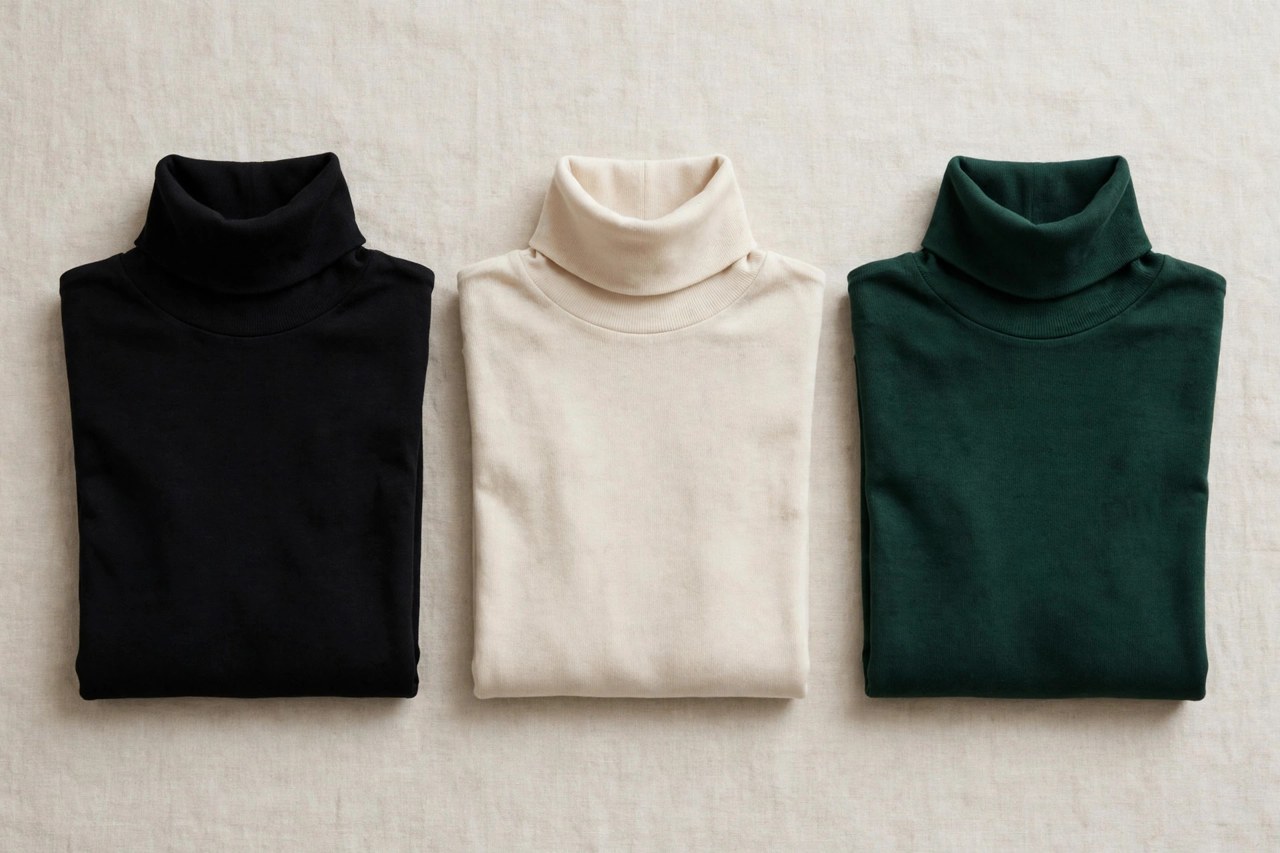
The cotton turtleneck is the quiet achiever of cool-weather dressing: a fine-gauge knitted top with a high neck that folds or stands, worn alone as a sleek minimal top or layered under jackets, dresses, and heavier knits. Cotton gives the style a particular character. It has a cool, smooth hand feel, none of wool's itch, and a matte finish that sits calmly under tailoring, which is why cotton turtlenecks are the layering choice for people whose skin objects to wool against the neck, the most sensitive place a knit touches. The garment looks simple, but its quality lives in two places: the gauge of the knit, which decides smoothness and warmth, and the construction of the neck itself, which decides whether it stands elegantly all day or slumps by noon. This guide covers both, plus honest guidance on when cotton beats wool and when it does not.
Full, Mock, and Funnel Necks Explained
A full turtleneck has a long neck tube designed to fold over once, giving the classic doubled band of fabric at the throat. It is the warmest and most traditional construction, and the fold is the test: good cotton knit folds cleanly and stays, while tired elastic lets it ripple. A mock turtleneck, or mock neck, is a shorter standing band, usually a few centimetres high, that does not fold. It gives most of the visual effect with less fabric at the throat, suits people who find a full fold confining, and layers more discreetly under collars and necklaces. A funnel neck stands taller and looser, away from the throat, in a softer architectural shape that belongs to more relaxed, fashion-led tops. For pure layering under blazers and dresses, the mock and slim full necks disappear best; for wearing alone as the outfit's top half, the full fold and funnel carry more presence.
Fine-Gauge Knits and Cotton Weights
Turtlenecks are knitted, not cut from jersey, and gauge describes the fineness of that knitting: higher gauges use finer yarns and more stitches per inch, producing a smoother, denser, more refined fabric. Fine-gauge cotton turtlenecks have an almost woven neatness, slide under jackets without catching, and hold a clean silhouette alone. Lighter gauges and looser knits feel more casual, show texture, and can turn slightly sheer in pale colours. Cotton weight in a turtleneck is about comfort as much as warmth: cotton insulates less than wool fibre for fibre, so a cotton turtleneck is a cool-to-mild weather garment and a layering piece in true cold, rather than a standalone winter shield. Cotton-elastane blends, commonly around 5 percent elastane, are nearly standard in the neck and body because recovery is everything here; pure cotton necks relax and lose their stand faster. Interlock-style smooth knits pill less than loosely spun yarns, so for a top washed often, a tight, smooth surface is the practical luxury.
Cotton Versus Wool at the Neck
The honest comparison favours each fibre somewhere. Wool is warmer for its weight, naturally elastic, and better in deep cold. Cotton is smoother and cooler against skin, hypoallergenic in practice for most wool-sensitive wearers, easier to wash, and free of any scratch at the throat, which is where sensitivity concentrates. Cotton also takes deep, even dye colour beautifully, so black cotton turtlenecks keep the saturated, matte black that makes the style famous. Where cotton loses is in very cold wind and in long-term neck elasticity, both manageable: layer it under real outerwear, and choose elastane-blend necks. Choose the fibre for the hours you will actually spend in the garment, not the coldest ten minutes of the day.
Layering and Styling the Turtleneck
As a layer, the cotton turtleneck is unmatched for tidiness. Under a blazer it replaces a shirt with a cleaner line and no collar conflicts; black under black tailoring is a perennially sharp combination. Under a sleeveless or short-sleeve dress, it extends the dress into cool weather while adding a deliberate, editorial contrast at the neck and arms. Under a chunky knit or sweatshirt, a fine cotton turtleneck stops roughness at the neck and adds a finished edge at the cuffs if the sleeves are allowed to show slightly. Worn alone, it wants structure elsewhere: tailored trousers, a defined waistband, or a skirt with shape, because the top itself is intentionally plain. Jewellery sits over the neck or not at all; a pendant on a long chain over a full turtleneck is the classic solution.
Fitting and Caring for the Neck
Fit a turtleneck by the neck first. It should contact the throat all the way around without pressure; if you are aware of it while swallowing or turning your head, it is too tight, and if it gaps or folds unevenly, the knit has too little recovery for your size. The body should skim rather than cling when the top will be worn alone, and can fit closer when its destiny is layering. Shoulder seams should sit exactly at the shoulder, since the smooth silhouette exposes any drift. For care, wash cool and inside out, and dry flat: hanging a wet knitted turtleneck stretches both body and neck under their own weight. Fold the neck down smoothly in storage rather than crushing it. A fabric shaver handles the light pilling cotton develops under jacket friction. Looked after this way, a fine-gauge cotton turtleneck keeps its stand and surface for years, remaining the layer that makes the rest of the wardrobe look more expensive.
More to Explore on Apparel Search
Photos


Looking for Women's Clothing Stores?
This guide helps you choose women's cotton turtlenecks by neck style, gauge and colour. To browse where to buy, visit our women's clothing store directory, where you can find retailers that carry them.