Women's Medical Uniform Accessories Guide
The small gear that finishes the uniform — scrub caps, badge reels, compression socks, pen lights, and the tech joining the kit.
Shop Women's Medical Uniform Accessories Now
Shop Women's Medical Uniform Accessories on Amazon Shop Women's Medical Uniform Accessories on eBayThe Amazon and eBay links on this page are affiliate links. If you make a purchase through them, Apparel Search may earn a commission.
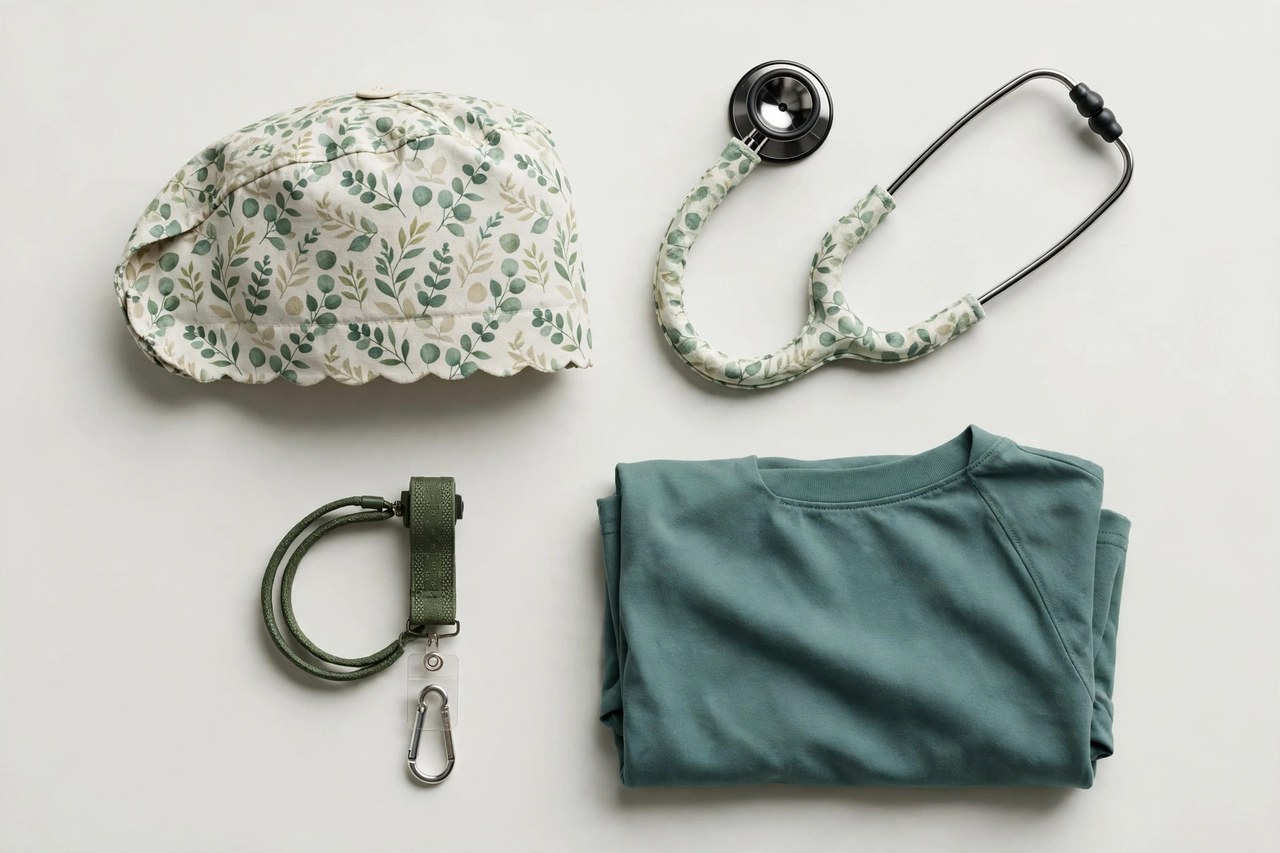
A fashion accessory is an item used in a secondary manner to contribute to the wearer's outfit — chosen to complete a look and express identity and personality, in endless shapes, sizes, and hues. In healthcare, the definition flips: a medical uniform accessory is more about utility than fashion. Every item in the kit earns its place by holding an ID where scanners can read it, keeping hair contained, carrying a light into a darkened room, or keeping legs fresh through hour twelve.
That said, accessories are also where the standardized uniform loosens its grip. Within dress-code limits, a printed scrub cap, a cheerful badge reel, or a favorite pair of compression socks lets a clinician's personality show — a small morale boost patients genuinely enjoy. This guide tours the working kit: caps and hair control, identification gear, comfort layers, bags and stethoscope gear, and the wearable technology quietly joining the team.
Scrub Caps & Hair Control
The modern scrub cap contains hair completely in surgical and procedural areas, where loose strands are a contamination risk. Bouffant caps give long or thick hair full room under a soft, gathered crown; tie-back and ponytail caps route hair through a rear pouch or opening; close-fitting skull caps suit short hair. Sweatbands sewn into the front band tame the forehead drip under hot OR lights, and button tabs save ears from mask-loop fatigue on marathon shifts.
The scrub cap has an ancestor worth knowing: the nurse's cap, part of the classic female nurse's uniform from early in the profession's history. Its purpose was to keep the nurse's hair neatly in place and present a modest appearance — hair control and professional image, the same two jobs today's caps still do. The difference is context: the modern cap is infection-control equipment first, chosen for coverage and launderability, with personality — prints, team colors, holiday patterns — as the welcome bonus.
Badges, Lanyards & Pen Lights
Identification is the accessory category facilities regulate most tightly, because the badge is a security credential. A lanyard is a cord or strap worn around the neck, shoulder, or wrist to carry items such as keys or identification cards — commonly used to display badges, tickets, or ID where security is required. In clinical areas, though, many staff prefer badge reels: retractable cords clipped to a pocket or waistband that keep the badge visible, scannable, and unable to dangle into a wound, a patient, or a machine.
Breakaway clasps are the safety rule for anything worn around the neck — they release under a grab or a snag. Pair the badge with a badge buddy or role tab (“RN,” “MD,” “Student”) so patients can identify you without squinting. The humble pen light rounds out the pocket kit: a slim, often disposable or rechargeable light for pupil checks and throat exams, ideally with a pupil gauge printed on the barrel. Add a reliable pen, a small notebook, and bandage scissors, and the classic clinician's pocket is complete.
Underscrubs, Compression Socks & Warmth
Accessories include the layers nobody sees. Underscrubs — long- or short-sleeve knit tees worn beneath scrub tops — add warmth in over-air-conditioned facilities, modest coverage under V-necks, and a clean barrier between skin and scrub fabric. Moisture-wicking knits keep them comfortable; check your dress code for approved sleeve lengths and colors, since some surgical areas restrict long sleeves.
Compression socks may be the highest-impact accessory in the whole kit. Graduated compression — firmest at the ankle, easing up the calf — supports circulation during hours of standing, reducing leg fatigue, swelling, and end-of-shift aching. Many nurses consider them non-negotiable equipment, and the category has embraced style: colors and patterns that coordinate with scrubs while the medicine stays invisible. Warm-up jackets, fleece layers where permitted, and cushioned insoles complete the comfort system — small items that decide how a twelve-hour shift actually feels.
Bags, Stethoscope Gear & Wearable Tech
The original medical accessory is the medical bag — the doctor's or physician's bag, a portable case for transporting medical supplies and medicine. Traditionally made of leather, it opened at the top with a split-handle design; during the American Civil War, physicians carried medical saddle bags instead. Modern versions use technical fabrics and open into organized interiors of pockets, pouches, and zippered or hook-and-loop compartments — the same organizational logic now found in nurses' tote and belt-bag designs.
Around the neck, the stethoscope gets its own accessories: covers and sleeves that protect tubing and add identification, ID tags that keep an expensive instrument from walking away, and cases for safe transport. The newest category is digital. Wearable devices are becoming an important accessory for the healthcare industry — smartwatches tracking steps, sleep, and hand-washing reminders; badge-integrated duress buttons; even sensor-equipped garments in research settings. Our fashion terms coverage of wearable technology tracks the field as clinical gear and consumer tech continue to merge.
Related Women's Guides
Looking for Women's Clothing Stores?
This guide helps you choose women's medical uniform accessories. To browse where to buy, visit our women's clothing store directory, where you can find retailers that carry them.