Women's Microfleece Full Zip Jackets Guide
A full-zip microfleece jacket zips from stand collar to hem and opens completely — no pulling anything over your head, and full control over warmth and ventilation.
Shop Women's Microfleece Full Zip Jackets Now
Shop Women's Microfleece Full Zip Jackets on Amazon Shop Women's Microfleece Full Zip Jackets on eBayThe Amazon and eBay links on this page are affiliate links. If you make a purchase through them, Apparel Search may earn a commission.
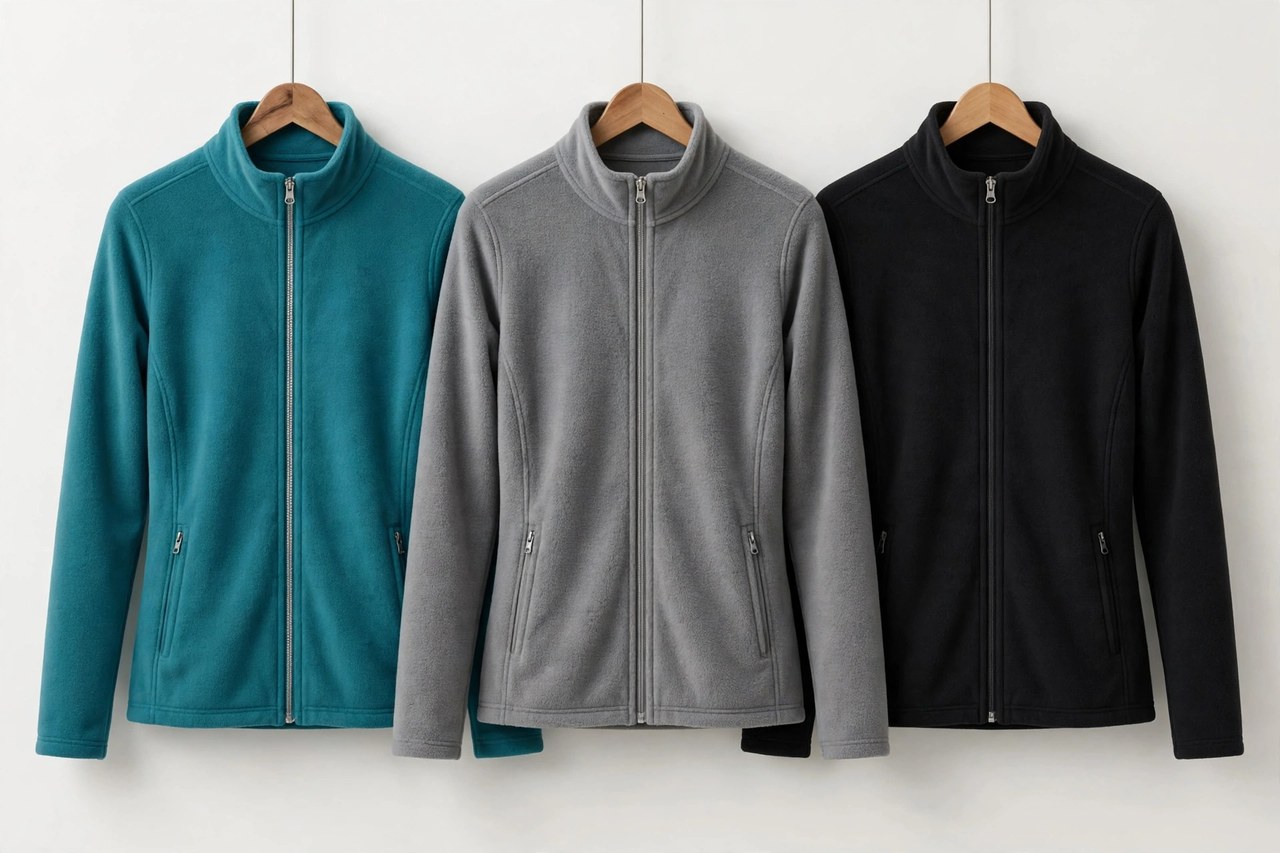
A full-zip jacket is defined by its zipper: when the zip runs the whole front of the garment, from the neckline to the bottom hem, the jacket opens fully flat and closes completely — no part of it needs to pass over your head. In microfleece, that full-length zipper meets the thinnest grade of polar fleece, the soft napped polyester first manufactured in 1979 by Malden Mills, now Polartec LLC. The result is the most versatile member of the jacket family: part outer layer, part cardigan, part mid layer, and the style most women own in more than one color.
The pairing works because each half covers the other's weakness. Microfleece alone is a fixed amount of warmth: a pullover gives you one setting, on or off. Add a full zip and the same thin fabric becomes adjustable, worn open, half-zipped or sealed to the chin as conditions change. And because microfleece is so light and packable, the full-zip jacket keeps that adjustability without the weight of a heavier fleece or a lined coat. Care is easy too: hydrophobic polyester that holds less than 1% of its weight in water, wicks moisture, dries fast and machine washes.
Why the Full-Length Zip Matters
Venting is the practical heart of the full-zip design. On a walk that starts cold and warms up, you can open the zip a few inches at a time, dumping heat gradually instead of tying a pullover around your waist. Two-way zippers add comfort when you sit: unzip the lower few inches in the car or at a desk and the jacket stops bunching at the hips. Getting dressed is easier too — a full-zip goes on over a blouse or bulky sweater without dragging, and comes off in seconds indoors.
The full zip also unlocks cardigan-style wear, something no pullover can do. Worn open over a dress, a tee or a work blouse, a microfleece full-zip reads as a soft, structured layer rather than sportswear, and it stays in place on your shoulders instead of slipping like a shawl. Zip it halfway and it behaves like a deep V-neck layer; zip it fully and add the stand collar and it is a proper jacket. That is why the full-zip is the default recommendation for travel, commuting and office drawers: one garment covers more situations than any other fleece style.
Zipper Quality and Construction
Because the zipper is the garment, its quality matters more here than on any other fleece. Better jackets use smooth-gliding coil or molded-tooth zips sized generously for the fabric, with metal or sturdy resin pulls you can work with cold fingers or light gloves. A zip garage — a small fabric fold at the top of the zip — parks the pull away from your chin and neck. An interior wind flap behind the zipper is worth looking for: fleece itself is not windproof, and the zipper line is where drafts sneak in first, so a flap meaningfully extends the jacket's comfort range.
Construction around the zip needs care because fleece is a stretchy knit that moves more in one direction than the other. On a well-made jacket the zipper is sewn to a stable tape or a reinforced placket so the front hangs straight instead of rippling, and the two sides meet evenly at the hem. Check that hand pockets are placed so their zips do not collide with the main zip's path, and that a drawcord hem can cinch below the zipper's bottom stop. Run the zip up and down in the shop: it should travel without chewing the fleece.
Wearing and Layering Full-Zip Styles
As an outer layer, a microfleece full-zip in the micro or 100 weight handles spring and fall on its own; in the 200 weight it carries into genuinely cold days, especially with the collar up and hem cinched. As a mid layer it slides under a rain shell or winter coat, where its wicking pulls moisture off your base layer and its thin profile adds warmth without shoulder bulk. The stand collar is tall enough on most styles to protect the neck under a coat's open front. For most wardrobes, one mid-weight full-zip does the layering jobs of three lesser garments.
A few habits keep a full-zip jacket at its best. Zip it closed before washing: this protects the teeth and keeps the front from twisting in the drum. Wash cool and dry on low heat or line-dry — high heat from dryers and irons can damage polyester fleece, and cheap fleece pills quickly regardless. Expect the usual fleece traits: some static, a tendency to collect lint and pet hair, and little wind resistance on its own. None of that outweighs the design's usefulness; it just means the full-zip works best as one smart layer in a small system.
Related Women's Guides
More to Explore on Apparel Search
- Women's Fashion
- women's jacket
- Fleece Weights
- women's fleece clothing
- Women's Heavyweight Micro-fleece Quarter Zip Mock
- Women's Microfleece Hats
- Women's Microfleece Long Sleeved Zip Sports Shirt
- Women's Microfleece Pajamas
- Women's Microfleece Pants
- Women's Microfleece PJ
- Women's Microfleece PJ Set
- Women's Microfleece Quarter Zip Pullover
- Women's Microfleece Robes
- Women's Microfleece Shirts
- Women's Microfleece Sweatshirts
Looking for Women's Clothing Stores?
This guide helps you choose women's microfleece full zip jackets. To browse where to buy, visit our women's clothing store directory, where you can find retailers that carry them.