Women's Microfleece Clothing Guide
Microfleece is the thinnest, softest member of the fleece family — a polyester fabric that warms without bulk, and the material behind a whole wardrobe of jackets, pullovers, pants and sleepwear.
Shop Women's Microfleece Clothing Now
Shop Women's Microfleece Clothing on Amazon Shop Women's Microfleece Clothing on eBayThe Amazon and eBay links on this page are affiliate links. If you make a purchase through them, Apparel Search may earn a commission.
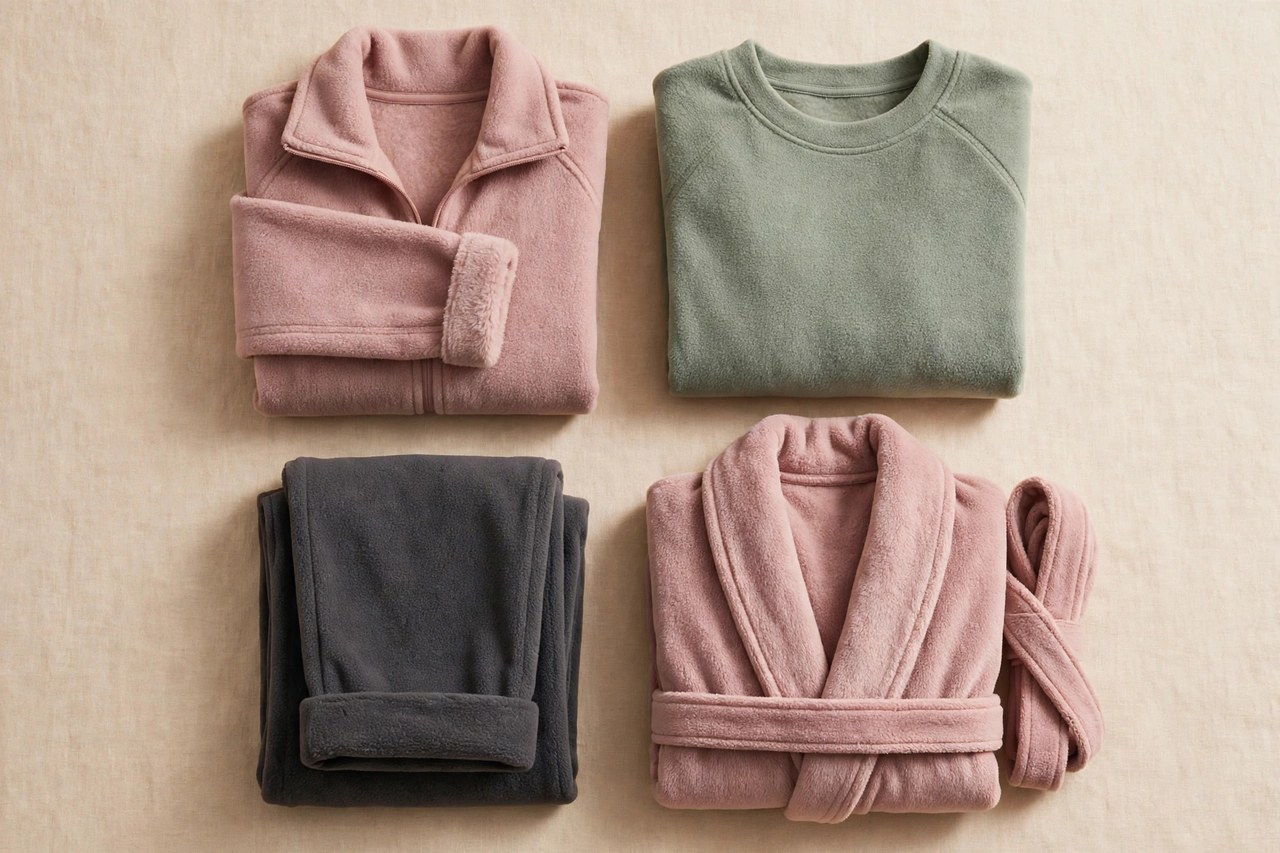
Microfleece clothing is everything made from the lightest grade of polar fleece: a thin, soft, napped polyester fabric first manufactured in 1979 by Malden Mills, the company now known as Polartec LLC. Where regular fleece can be bulky, microfleece is deliberately fine and close-fitting, with a brushed surface on both sides that feels gentle against the skin. That combination — real insulation at very low weight — is why the fabric spread from outdoor jackets into an entire clothing family: pullovers, pants, pajamas, robes and hats, all covered by the guides in this section.
The performance comes from the polyester itself. Microfleece is hydrophobic, holding less than 1% of its weight in water, so it sheds moisture instead of soaking it up and pulls sweat away from the skin to the surface, where it can evaporate. It keeps much of its insulating quality even when damp, dries quickly after washing, and is machine washable — an easy-care alternative to wool for anyone allergic or sensitive to wool fibers. Much of it is made partly from recycled polyethylene terephthalate (PET) plastic bottles, or even from recycled fleece, which gives old plastic a second life as clothing.
Microfleece, Regular Fleece and Microfiber: Sorting the Names
Fleece thickness is described by a traditional weight scale: micro, 100, 200 and 300, with 300 the thickest and least flexible. Microfleece sits at the bottom of that scale — it is simply the thinnest fleece grade, not a different material. A 100-weight garment gives light warmth for cool days and layering, a 200 adds real insulation, and a 300 is a heavy winter layer. Microfleece garments deliver wool's warmth at a fraction of the weight of the lightest woolens, and the knit stretches more easily in one direction than the other, which pattern makers use to shape a comfortable fit.
Microfleece is often confused with microfiber, but the words describe different things. Microfiber is a fiber size: a synthetic fiber finer than one denier, with a diameter under ten micrometres — smaller than a strand of silk, itself about one-fifth the diameter of a human hair. Microfleece is a fabric: a napped, insulating polyester knit, whatever the fineness of its fibers. A microfleece garment may or may not use microfibers; what defines it is the thin, brushed fleece construction. When you shop, judge by the fleece weight and the finish, not by name alone.
How Microfleece Layers
Microfleece earns its place in the classic three-layer system. Worn next to the skin as a base layer, its wicking moves moisture outward so you do not chill in your own sweat. Worn as a mid layer under a coat or shell, it traps warm air in its brushed fibers while the outer layer handles wind and rain. And on mild, dry days it works alone as a light outer layer — a jacket or pullover over a tee is often all spring and fall require. Because the fabric is so thin, a microfleece piece adds warmth without the bulk that makes layering awkward.
The limits are worth knowing too. Regular microfleece is not windproof: moving air passes through the knit and steals its warmth, which is why a shell matters on exposed, windy days. Fleece readily generates static electricity, which attracts lint, dust and pet hair, and lower-quality polyester fleece is prone to pilling — those small bobbles on the surface. Keep microfleece away from high heat in washing, tumble drying and ironing, which can damage the fibers. Wash cool, dry low, and a good microfleece garment will stay soft for years.
A Tour of the Microfleece Family
Start with tops and outer layers, the heart of the family. Microfleece jackets come as full-zip styles that open completely, lightweight versions built for travel and mild weather, and unlined single-layer designs that breathe freely. Pullovers split by zipper depth: the half-zip vents deeply for active use, the quarter-zip keeps a shorter, neater collar, and the heavyweight quarter-zip mock pairs the thickest fleece with a stand-up mock neck for serious cold. Shirts, sweatshirts and a long-sleeved zip sports shirt round out the top half of the wardrobe.
Below the waist and after hours, the same fabric keeps working. Microfleece pants — including solid-color styles cut for everyday wear — bring fleece warmth to legs without sweatpant bulk. Pajamas, PJ sets and robes turn the fabric's softness into sleepwear and lounging layers that stay warm without overheating, since the thin knit breathes better than heavier fleece. Microfleece hats finish the system at the head, where a light, quick-drying layer makes a real difference. Each branch of the family has its own guide below, with the fabric and fit details for that garment.
Related Women's Guides
More to Explore on Apparel Search
- Clothes
- Women's Fleece Clothing
- Women's Heavyweight Micro-fleece Quarter Zip Mock
- Women's Lightweight Microfleece Full Zip Jacket
- Women's Lightweight Microfleece Jackets
- Women's Microfleece Full Zip Jackets
- Women's Microfleece Long Sleeved Zip Sports Shirt
- Women's Microfleece PJ
- Women's Microfleece PJ Set
- Women's Microfleece Quarter Zip Pullover
- Women's Microfleece Unlined Jacket
- Women's Solid Microfleece Pant
- Fashion Industry
- Fashion Job Search
- fashion
Looking for Women's Clothing Stores?
This guide helps you choose women's microfleece clothing. To browse where to buy, visit our women's clothing store directory, where you can find retailers that carry them.