Women's Open Toe Shoes Guide
Open-toe shoes are the whole family of footwear that lets the toes show — flats, sandals, wedges and mules — the everyday, warm-weather branch of open-front dressing.
Shop Women's Open Toe Shoes Now
Shop Women's Open Toe Shoes on Amazon Shop Women's Open Toe Shoes on eBayThe Amazon and eBay links on this page are affiliate links. If you make a purchase through them, Apparel Search may earn a commission.
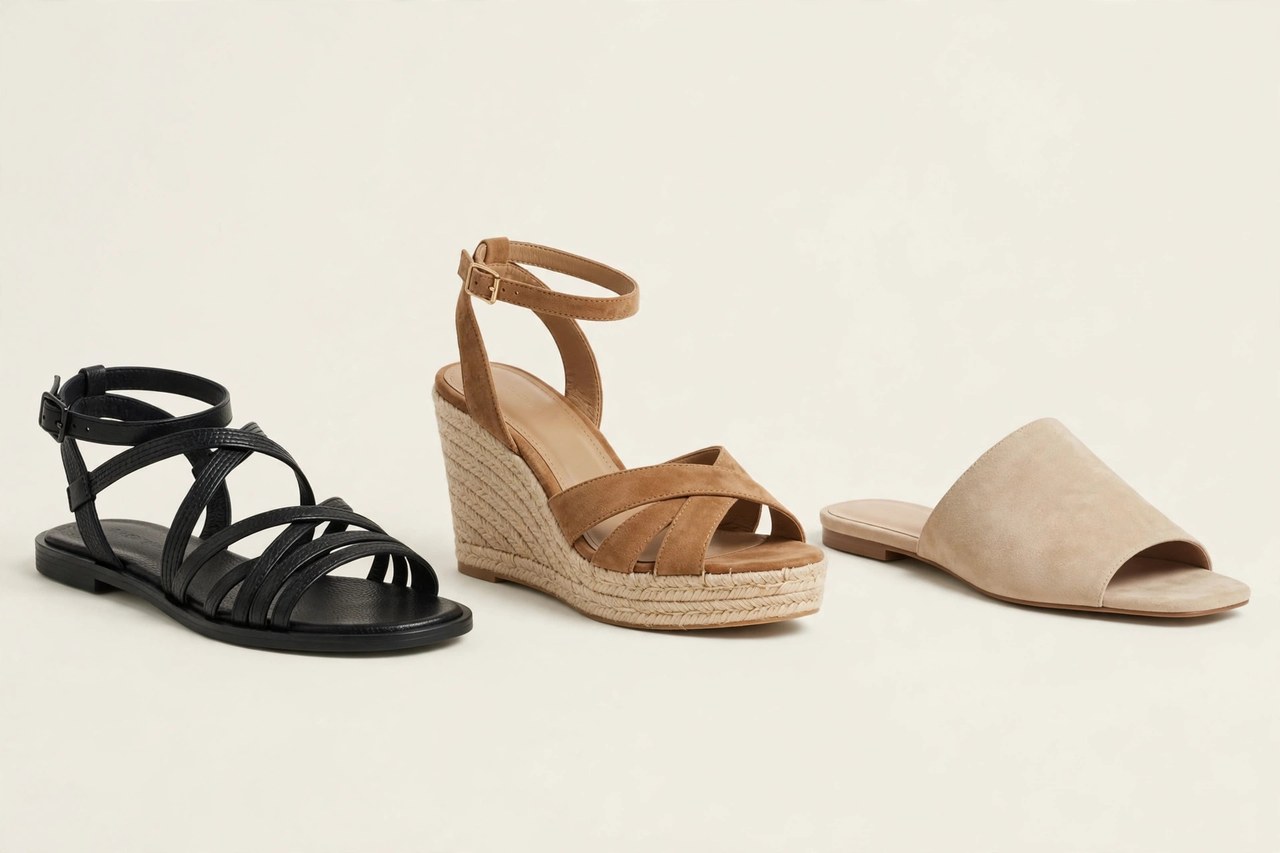
An open-toe shoe is any shoe whose front is cut away to reveal the toes. It is one of the broadest categories in footwear: flat sandals and heeled sandals, ballet flats with a peep, wedges, mules, slides and espadrilles all qualify, in every material from canvas to crocodile-print leather. The category is defined by a single pattern decision — where the vamp ends — and everything else about the shoe, from its support to its formality, is decided by the rest of its construction.
This is the umbrella guide to the family. Its heeled, closed-back member, the open-toe pump, has a specialist guide of its own (linked below); here we cover the everyday range: which open-toe styles exist, how the size of the opening changes the shoe, how to fit an open front properly, and how to judge support in a shoe that shows its working parts.
The Open-Toe Family
Start with the sandal, the family's foundation: an open shoe held by straps, in flat, wedge and heeled forms, ranging from the beach slide to the strappy evening sandal. The peep-toe flat takes the ballet flat and opens a small oval at the front — the most covered member of the family and the one that passes in the most workplaces. Wedges put the whole foot on a continuous sloped sole, open at the toe in most summer versions, and give height with the steadiest walking base in the category. Mules and slides are backless open-toe shoes you step into, from flat pool slides to heeled fashion mules.
Then there are the regional and seasonal specialists: espadrilles with their rope soles for summer, fisherman-style and cage-front shoes whose woven or strapped vamps are technically open throughout, and open-toe boots and booties, the transitional-season hybrid that pairs a boot's shaft with a sandal's front. What unites them is the open front's practical effect: ventilation, room for the toes to spread, and a shoe that adapts to feet that swell in heat — which is why open-toe shoes dominate every warm-climate wardrobe.
Openings, Support and Honest Fitting
Judge an open-toe shoe by three constructions. First, the opening: a small peep holds the foot most securely and suits narrower feet; a wide opening needs straps or a shaped insole to keep the foot from sliding forward. Second, the footbed: in an open shoe the foot rests visibly on the sole, so look for anatomical shaping, arch support in walking styles, and cushioning under the ball of the foot; a board-flat fashion sole is a short-distance shoe whatever its looks. Third, the retention: ankle straps, back straps and higher vamps all substitute for the closed toe box the shoe has given up.
Fitting rules are simple and non-negotiable. The toes must end on the sole: the longest toe just short of the front edge, with no overhang and no clawing grip on the edge. The foot should not slide forward when you walk downhill or stop suddenly — test both. Straps should hold without biting; any strap that leaves a deep mark in ten minutes will be a wound in two hours. And buy for the afternoon foot: feet expand in heat, and open-toe shoes are bought for exactly the weather that swells them. Between sizes, an open shoe usually takes the larger size better than a closed one, since there is no toe box to swim in.
Wearing and Caring for Open-Toe Shoes
Formality in open-toe shoes is read from material and finish more than from shape: a leather flat sandal in a neutral tone passes almost anywhere in summer, a satin heeled sandal is evening wear, and a rubber slide is the beach regardless of its price tag. Workplace rules vary — some offices bar open toes entirely, others accept peep toes but not sandals — so the peep-toe flat is the strategic purchase for a working wardrobe. With dresses, match the shoe's openness to the outfit's lightness: the heavier the fabric, the more covered the shoe should be.
Care focuses on the footbed and the edges. Footbeds absorb what stockings would in a closed shoe, so wipe them after wear and let shoes dry fully between outings; cork and leather footbeds benefit from an occasional conditioning. Clean strap edges and the toe opening's rim, where dust outlines the foot's shape. Store open shoes away from direct sun (straps and colored leathers fade unevenly) and unstacked, since a heel resting on a strap creases it permanently. A summer rotation of three pairs, each rested between wears, outlasts a single pair worn daily by far more than the arithmetic suggests.
Related Women's Guides
Photos

Looking for Women's Clothing Stores?
This guide helps you choose women's open toe shoes. To browse where to buy, visit our women's clothing store directory, where you can find retailers that carry them.