Women's Printed Lab Coats Guide
The printed lab coat keeps the professional white-coat silhouette and adds pattern at the trim, lining or all over — this guide is about the coat itself: lengths, closures, print placement, image and laundering.
Shop Women's Printed Lab Coats Now
Shop Women's Printed Lab Coats on Amazon Shop Women's Printed Lab Coats on eBayThe Amazon and eBay links on this page are affiliate links. If you make a purchase through them, Apparel Search may earn a commission.
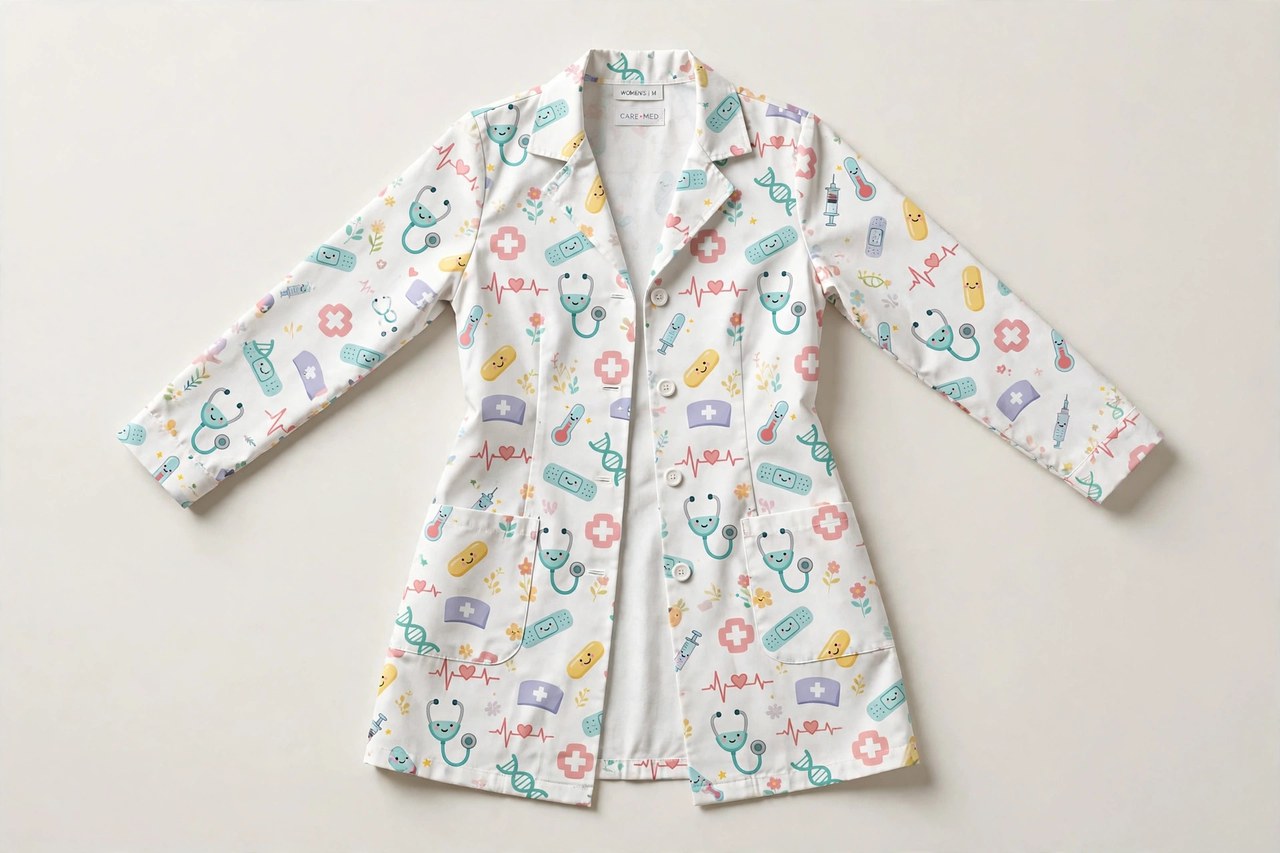
The lab coat is a uniform with a meaning. Its white length, its closed front and its pockets signal training, cleanliness and authority in clinics, laboratories, pharmacies and classrooms — which is precisely why the printed lab coat is a careful invention rather than a novelty. A printed lab coat keeps the coat's professional architecture intact and introduces pattern in controlled doses: a floral trim inside the collar and cuffs, a patterned lining that flashes when the wearer moves, or, in settings where informality is welcome such as pediatrics, veterinary practice and dental offices, a full print across the coat itself.
This guide treats the printed lab coat as a coat, not as a uniform set or a scrub garment. It covers the lengths and closures that define the style, where print is placed and how much print a professional setting absorbs, the pockets and fabrics that make a coat work through a shift, and the laundering reality of a garment that must come clean, completely, wash after wash. If your workplace has a dress code, it governs everything here — the guide's job is to help you choose well inside it.
Lengths, Closures and Coat Construction
Lab coats are sold by length, traditionally described in inches from the back neck. Consultation coats, around 30 inches, end at the hip and suit talking work — rounds, consultations, teaching. Mid-length coats, around 34 inches, are the versatile standard for clinical work. Full-length coats, 38 inches and beyond, give maximum coverage for laboratory and procedure work, protecting clothing and legs from splashes. Women's coats add shaping the unisex original lacks: princess seams or a back belt for waist definition, and cuts that close properly at the bust without pulling, which matters because a lab coat is worn buttoned, not open like a jacket.
Closures divide into buttons, the traditional choice, secure and formal but slower to open, and snaps, which close fast, release fast in an emergency, and survive industrial laundering without cracking or loss. Some coats add a knit or concealed placket for a cleaner front. Construction checks that matter: a collar that stands and lies correctly, since it frames the face in every patient interaction; reinforced pocket corners, because coat pockets carry phones, pens, instruments and handbooks; a back vent or pleats for stride and sitting; and sleeve lengths that end at the wrist bone, clear of cuffs that could trail through a sterile field or a sink.
Print Placement and Professional Image
Print on a lab coat works on a spectrum of discretion. At the most conservative end, trim prints hide the pattern where only movement reveals it: inside the collar, on cuff facings, along the inner placket, or as a printed lining. These coats pass in almost any clinical setting while still feeling personal to the wearer. In the middle sit panel and yoke prints, where a patterned section appears at the shoulders or back. At the open end, all-over prints — florals, hearts, seasonal and pediatric motifs — belong to workplaces whose culture invites them, and where the print does a job: softening a clinician's approach to children and anxious patients.
The professional-image rule is simple: the coat must still read as a lab coat at ten paces. That means the silhouette, the closed front and, in most settings, a predominantly white ground do the signaling, and the print decorates within that frame. Check your facility's policy before buying an all-over print, and consider your patient population: prints that reassure in pediatrics may undercut gravity in oncology or administration. Embroidery — name, credentials, department — is placed on the chest opposite any logo and should be specified when ordering, since embroidering a finished coat at retail rarely matches the original maker's quality.
Fabrics and Laundering
Classic lab coat cloth is a polyester-cotton poplin or twill, weighted for opacity, drape and soil release; premium coats use 100 percent polyester or high-twist cotton for a crisper hand and better stain resistance. Whatever the blend, a white coat's fabric must be opaque over scrubs or clothing, resistant to the disinfectants and reagents of its workplace, and stable through hot washing. Printed coats add one requirement: the print must be applied by a method — quality screen or digital printing with proper fixation, or woven trim fabrics — that survives the same washing as the coat, without fading to a ghost while the white ground stays bright.
Laundering is where lab coats earn or lose their keep. Most wearers wash at home in warm-to-hot water with an oxygen-based booster for organic stains, treating ink, iodine and blood marks promptly and separately. Follow the facility rule first: some workplaces require industrial laundry and prohibit home washing, and that rule overrides any label. Dry on medium heat or line dry, remove promptly to limit wrinkling, and inspect closures and pocket stitching as you fold — a coat worn daily announces its retirement through thinning elbows and failing snaps before it fails anywhere else. A printed coat that is laundered correctly keeps both halves of its promise: the authority of the white coat, and the small, deliberate lift of the print.
Related Women's Guides
More to Explore on Apparel Search
- Women's Medical Clothing Guide
- Medical Uniform Stores
- Wholesale Medical Clothing
- Medical Gowns Factory
- Scrubs Definition
- Hospital Gown Definition
- Wholesale Uniforms
- Fashion
- Clothing Retail Stores
- Fashion News
- Fashion Designers
- Popular Brands
- Apparel
- Women's Clothing Stores
- Women's Clothing Wholesalers
- Women's Fashion
- Fashion Videos
- Fashion Calendar
- Celebrity Fashion
- Fashion Designer Directory
Women’s Clothes Guide by Letter: A · B · C · D · E · F · G · H · I · J · K · L · M · N · O · Q · R · S · T · U · V · W · X · Y · Z
Looking for Women's Clothing Stores?
This guide helps you choose women's printed lab coats. To browse where to buy, visit our women's clothing store directory, where you can find retailers that carry them.