Women's Retro Corsets Guide
A product guide to retro corsets as garments: underbust and overbust construction, steel and spiral boning, coutil fabrics, lacing, sizing by measurement and proper storage and care.
Shop Women's Retro Corsets Now
Shop Women's Retro Corsets on Amazon Shop Women's Retro Corsets on eBayThe Amazon and eBay links on this page are affiliate links. If you make a purchase through them, Apparel Search may earn a commission.
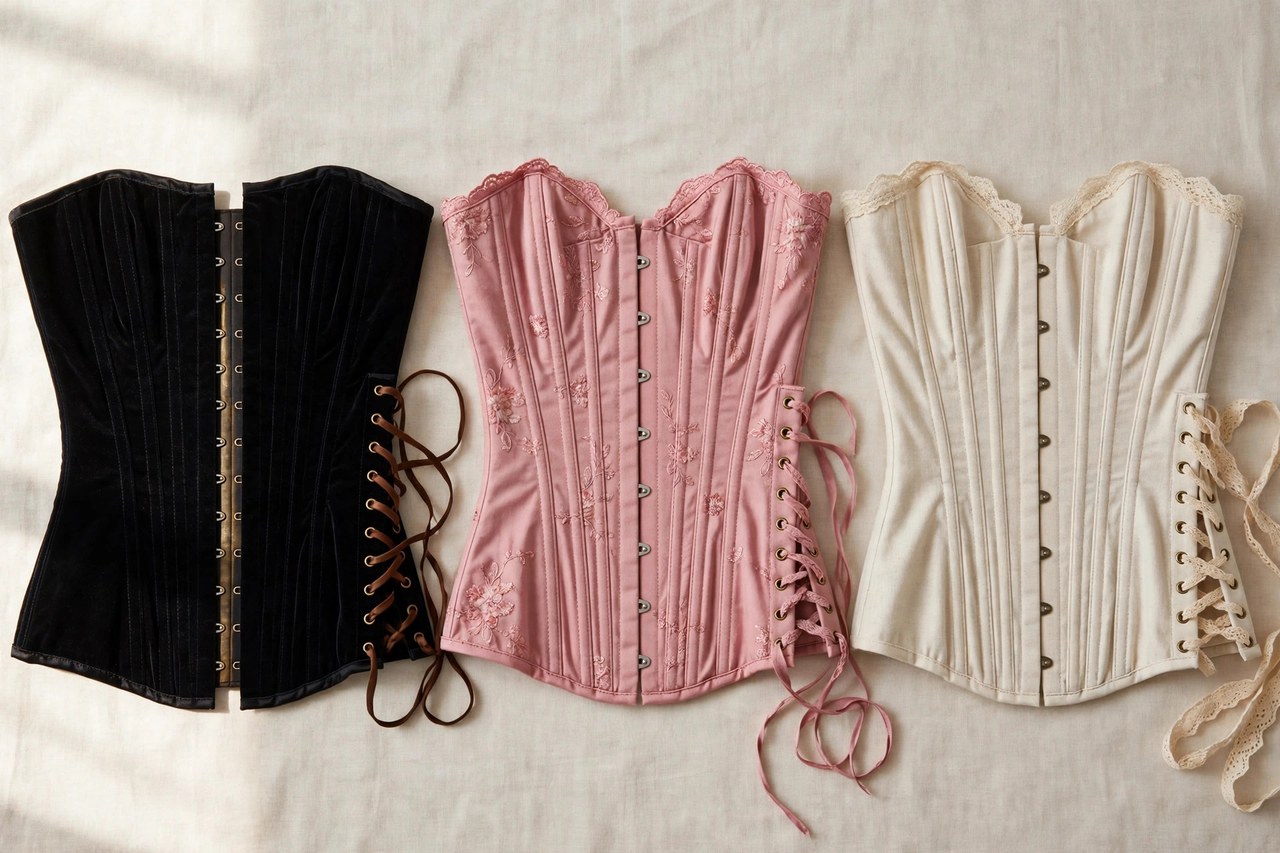
This is a strictly product-focused guide to the retro corset as a garment: how it is constructed, what its parts are called, which fabrics and boning types are used, and how to choose a size from measurements. Corsetry has a long history in women's dress, from the structured bodices of earlier centuries through the wasp-waist silhouettes of the Victorian era and the smoother foundation garments of the twentieth century, and modern retro corsets reproduce those historical patterns for period dress, costume and structured formal wear.
Because a corset works by structure rather than stretch, its quality lives entirely in its construction. Two corsets that look alike in a photograph can differ completely in materials: one built on strong coutil with steel boning and a proper lacing system, the other a fashion garment in stretch fabric with plastic strips that bend permanently at first wear. This guide explains the difference part by part, so you can read a product description and know what you are actually buying.
Construction: Panels, Busk and Boning
A traditional corset is sewn from multiple shaped panels — commonly ten to fourteen — joined by stitched channels that hold the boning. At the front sits the busk, a two-part steel closure of studs and loops that lets the garment open and close without undoing the laces. At the back, metal eyelets carry the lacing, usually in a single long lace with loops at the waist for adjustment. A wide waist tape sewn inside at the waistline takes the strain of tightening so the fabric panels do not have to.
Boning comes in three main types. Spiral steel boning, made from flattened coiled wire, flexes in every direction and is used at the side seams where the body bends. Flat spring steel bends in one plane only and is placed beside the busk and eyelets where stiffness is wanted. Synthetic or plastic boning is the mark of a light fashion garment: inexpensive and comfortable for brief costume wear, but it warps with body heat and cannot provide lasting structure. A serious retro corset lists steel boning in its description; silence on the subject usually means plastic.
Underbust and Overbust Styles, Fabrics
The two families are defined by height. An underbust corset ends below the bust and shapes the waist and torso only; it is worn over or under clothing as a foundation or over a blouse or dress as a wide structured belt in period and steampunk styling. An overbust corset continues up to cover the bust and forms a complete bodice, the form used in Victorian and Edwardian reproductions and in formal gowns with built-in corsetry. Historical patterns also distinguish the mid-Victorian hourglass cut from the straighter Edwardian and 1910s lines that sit lower on the hip.
The strength fabric of corsetry is coutil, a dense herringbone cotton woven specifically to resist stretching under tension; a corset without a coutil strength layer is decoration, whatever its outer fabric. Outer fashion fabrics include silk and polyester satin, brocade, cotton sateen, mesh for summer weight garments, and leather for specialty pieces, usually over a cotton lining for comfort against the skin. Retro-styled fashion corsets and corset tops sold for evening wear typically use stretch panels and plastic boning and should be bought as tops, not as structured garments.
Sizing, Lacing and Care
Corsets are sized by waist measurement in inches, not by dress size. Measure the natural waist snugly, and choose according to the maker's chart: a standard ready-made structured corset is commonly ordered four to five inches below the natural waist measurement for a moderate, comfortable reduction, with the understanding that a new wearer laces down gradually over several wearings as the garment and body settle to each other, a process makers call seasoning. The bust and hip measurements of an overbust style must also be checked against the chart, since panel shaping varies by pattern.
Lace from the top and bottom toward the waist loops, tighten evenly rather than all at the waist, and never force a garment closed on its first wearings. For care: air the corset inside out after wearing, spot clean the lining, and use dry cleaning sparingly on structured pieces since solvents and pressing can damage boning channels and busk finishes. Store flat or rolled loosely with laces loosened, never folded sharply across the boning and never hung by its laces, which distorts the eyelet row. Kept this way, a well-made steel-boned corset remains a serviceable garment for many years.
Related Women's Guides
Photos

Looking for Women's Clothing Stores?
This guide helps you choose women's retro corsets. To browse where to buy, visit our women's clothing store directory, where you can find retailers that carry them.