Women's Retro Dresses Guide
The retro dress is the centerpiece of the vintage wardrobe — fit-and-flare, wiggle, shift, shirtwaist and wrap silhouettes that carry a whole decade in a single garment.
Shop Women's Retro Dresses Now
Shop Women's Retro Dresses on Amazon Shop Women's Retro Dresses on eBayThe Amazon and eBay links on this page are affiliate links. If you make a purchase through them, Apparel Search may earn a commission.
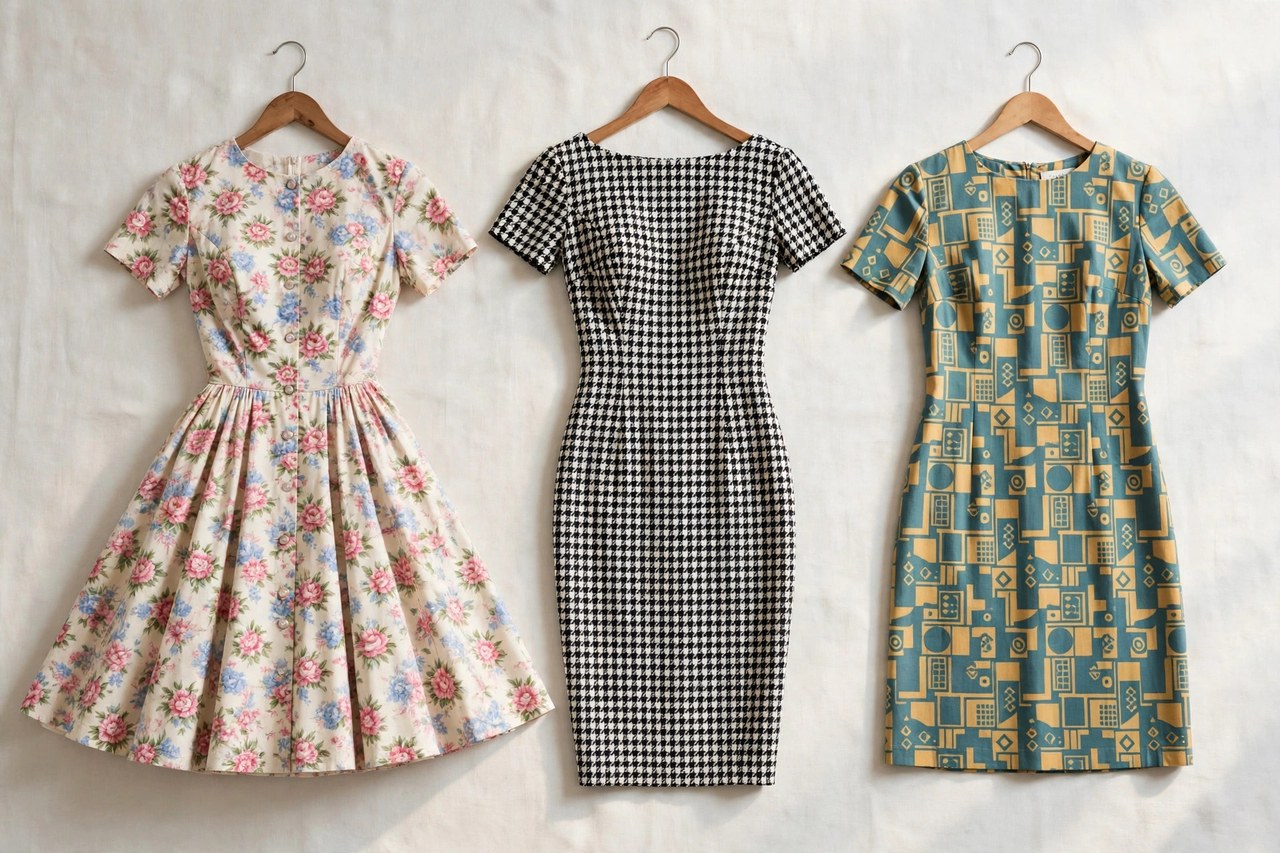
No garment carries a decade as completely as the dress. A retro dress does not need accessories to announce its era: the silhouette does it alone, from the dropped waist of the 1920s to the wrap front of the 1970s. That completeness explains why the dress is where most retro wardrobes begin and why vintage shops arrange their rails by dress style. Buy the right dress and the shoes, bag and hairstyle suggest themselves; buy the wrong one and nothing else in the outfit can rescue the date.
This guide walks through the major retro dress silhouettes and the decades that own them — fit-and-flare and its petticoats, the wiggle dress, the shirtwaist, the shift and the wrap — then covers the necklines, fabrics and prints that fine-tune the date, how vintage dress sizing and fit differ from modern expectations, and how to launder and store dresses that may be older than their wearer.
The Great Silhouettes
The fit-and-flare is the defining 1950s dress: fitted bodice, nipped waist and a skirt that swings out to a full circle, worn with or without a net petticoat to hold the bell shape. Its tailored sister, the wiggle dress, narrows the same bodice into a pencil skirt that restricts the stride to a deliberate walk. The shirtwaist dress, buttoned like a shirt with a collar and often a self belt, was the era's respectable day dress. A decade earlier, the 1940s dress kept a strong shoulder, a knee-length A-line skirt and sleeves, shaped by wartime fabric rules.
The 1960s broke the waist's reign with the shift: a straight, easy dress hanging from the shoulders, in bold prints, color blocking and mini lengths by the decade's end. The 1970s restored the waist in softer form with the wrap dress, a jersey dress that ties at the side and adjusted to the body instead of the other way round, alongside flowing maxi dresses and prairie styles with tiers, ruffles and tiny florals. Earlier still, the 1920s drop-waist dress and the 1930s bias-cut gown-length day dress remain the connoisseur's choices, fluid where the 1950s were architectural.
Necklines, Fabrics and Prints
Necklines fine-tune a dress's date and its mood. Sweetheart and halter necklines belong to the 1950s; boat necks and jewel necks to the late 1950s and 1960s; scoop and square necks recur across decades; the shirt collar and V of the wrap are the 1970s signatures. Sleeves follow the same map: cap and puff sleeves early, three-quarter fitted sleeves in the tailored years, sleeveless shifts in the 1960s, and long bell and bishop sleeves in the 1970s. A dress whose neckline argues with its silhouette usually turns out to be a modern hybrid, which is fine if you know it.
Period fabrics give retro dresses their movement. Cotton sateen and polished cotton hold a full skirt crisply; rayon crepe drapes for 1930s and 1940s styles; silk and chiffon serve evening; synthetic jersey made the wrap dress possible; and polyester double knit powered the easy 1960s and 1970s day dress. Prints carry dates too: conversational novelty prints and polka dots for the 1950s, op-art geometrics and daisies for the 1960s, paisleys, prairie florals and earth-tone stripes for the 1970s. When in doubt, a solid color in a period fabric dates less loudly than a print.
Fit, Petticoats and Dress Care
Fit a retro dress at the waist first: most silhouettes before the 1960s were built around a defined, often high waist, and a dress that sits at the wrong waist point will never hang correctly. Vintage sizes run several numbers smaller than modern ones, so buy by measured bust, waist and hip. Structured dresses were worn over foundation garments, and a modern smooth slip or light shaping layer can make the difference between a dress that pulls and one that floats. Check vintage zippers by working them fully, twice, before buying.
The petticoat question applies only to full-skirted styles: a soft net petticoat restores the intended 1950s bell, while a stiff crinoline pushes toward costume. Choose the softest volume that holds the skirt off the legs. For care, wash cotton day dresses gently in cool water, keep rayon and silk dresses to careful hand washing or a trusted cleaner, and store all vintage dresses clean, on padded hangers or flat if beaded or bias-cut, since bias fabric grows under its own hanging weight. A dress that survived sixty years deserves the next sixty started properly.
Related Women's Guides
Photos

More to Explore on Apparel Search
Looking for Women's Clothing Stores?
This guide helps you choose women's retro dresses. To browse where to buy, visit our women's clothing store directory, where you can find retailers that carry them.