Women's Retro Hats Guide
Retro hats are whole decades worn on the head: the cloche, the fedora, the pillbox, the wide picture hat and the cocktail fascinator, in felt, straw and veiling.
Shop Women's Retro Hats Now
Shop Women's Retro Hats on Amazon Shop Women's Retro Hats on eBayThe Amazon and eBay links on this page are affiliate links. If you make a purchase through them, Apparel Search may earn a commission.
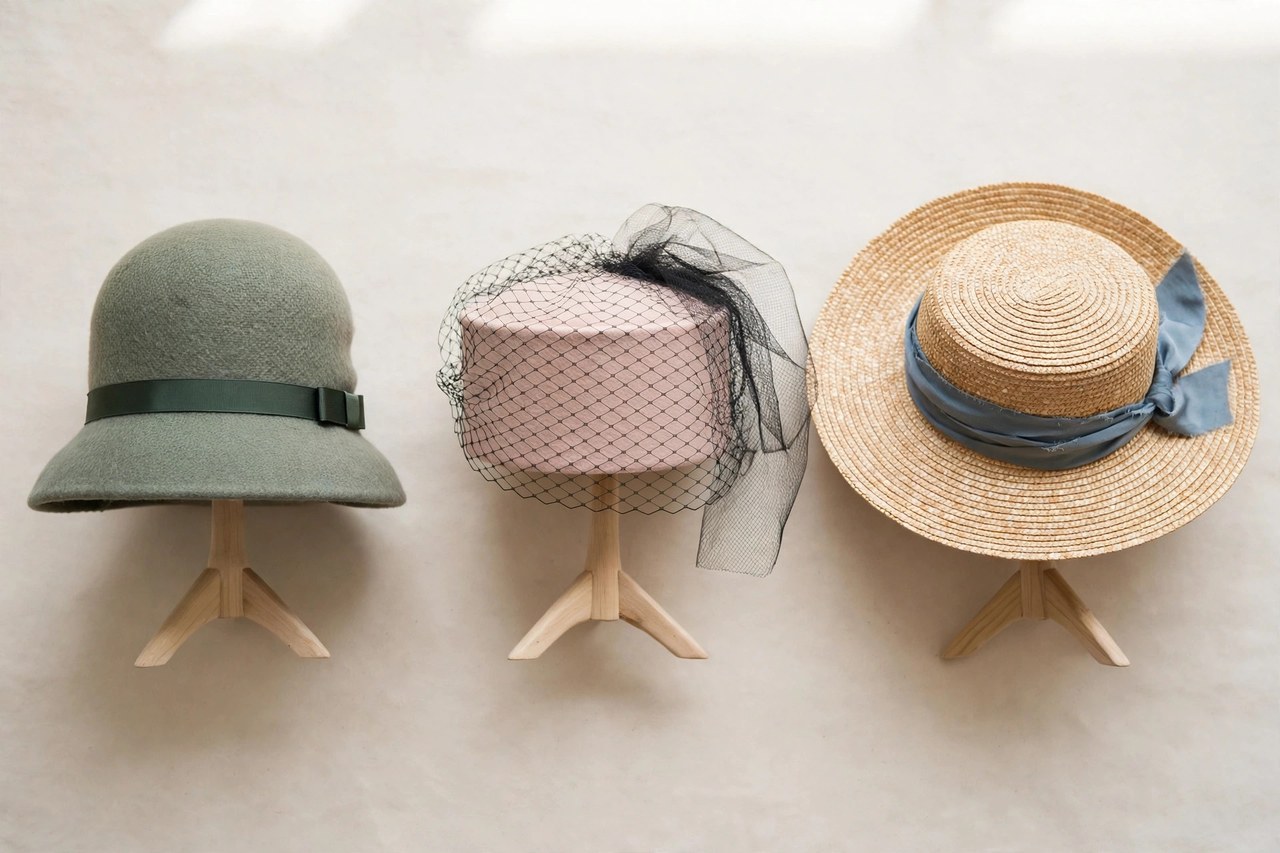
Until the 1960s, a dressed woman outdoors wore a hat as a matter of course, and hat styles changed as fast as dress silhouettes — which makes the retro hat the most dateable accessory in fashion. A cloche places an outfit in the 1920s as surely as a dropped waist does; a pillbox says early 1960s at twenty paces; a wide picture hat with a ribbon band is pure summer 1950s. Retro hats therefore reward study out of proportion to their size and price.
This guide covers the major women's hat styles and their decades, from cloches and turbans through fedoras, berets, pillboxes and cocktail hats, in their period materials of felt, straw, velvet and veiling. It explains hat sizing and the wearing angles that make a style read correctly, what to check in vintage hats — where moths, crushed crowns and tired veiling tell the truth about storage — and how to store and revive hats at home.
Styles by Decade
The cloche, a close bell of felt pulled low over short hair, owns the 1920s, often with a ribbon cockade or jeweled pin at the side. The 1930s tilted everything: small hats worn at an angle, berets, turbans and the slouch and fedora shapes borrowed from menswear and made feminine. The 1940s worked under fabric restrictions with tilt hats, snoods' companions and the neat New Look precursors. Then the 1950s opened the floodgates: wide picture hats and cartwheels for summer, flowered and veiled cocktail hats, and small perched hats that sat on the hair like punctuation.
The pillbox, a small brimless oval perched straight or tilted, became the early 1960s emblem in felt, velvet and leopard-printed fabric, usually with a short veil. Later 1960s hats went soft and floppy or tall and dramatic; the 1970s favored wide floppy felt and straw hats, berets and crocheted caps, echoing the decade's romantic lines. Earlier revivals reach for Victorian and Edwardian shapes — feathered, flowered and veiled constructions on small bases — which survive in the modern fascinator, the cocktail hat's direct descendant. Each style also has a correct angle, and the angle is not a suggestion: period photographs are the pattern card.
Materials, Veiling and Trims
Winter hats were blocked in felt — wool felt for everyday, fur felt for quality — and shaped over wooden blocks into crowns and brims; summer hats were woven in straw, from fine leghorn and panama to coarse raffia and sisal. Velvet, silk and satin covered evening and cocktail bases, and fabric hats in linen, pique and the dress's own material matched summer outfits exactly. A quality vintage hat shows its making inside: a grosgrain ribbon sweatband, a lining in better pieces, and milliner's stitching invisible from outside.
Trim carries the fashion: grosgrain and velvet ribbon bands and bows, feather sprays and whole small birds on early pieces, silk flowers, fruit and leaves on summer hats, and above all veiling, the fine net dotted or plain that covered the eyes on cocktail hats and added mystery to everything from pillboxes to picture hats. Veiling is also the most fragile element and the first to tear, which is why replacement veiling is sold by the yard and why a vintage hat with perfect original veiling commands its premium. When trims are original and right, leave them; re-trimming is for damaged pieces.
Sizing, Buying and Hat Care
Women's hat sizes run by head circumference in inches or centimeters, measured around the forehead and the widest part of the back of the head; many vintage hats, however, were made in a single standard size and adjusted by their inner drawstring ribbon, so fit by trying or by the seller's inside measurement, and note that perched styles like pillboxes fit nearly everyone because they pin rather than settle. Check vintage hats for moth grazing on felt — small shallow tracks and holes, worst in dark storage — crushed or cracked crowns, and sweatband staining that telegraphs through light straw.
Store hats on heads, stands or stuffed with tissue in boxes, never stacked under weight, and keep felt away from the moths that regard it as a pantry: clean storage, cedar nearby and periodic airing are the defenses. Brush felt with the nap using a soft hat brush, steam gently over a kettle to revive shape and let a milliner do real reblocking. Straw wants dry storage and no crushing; veiling smooths under the lightest steam and a patient hand. A hat asks little — a box, a brush, respect for its shape — and returns the most period character per dollar in the retro wardrobe.
Related Women's Guides
Photos

Looking for Women's Clothing Stores?
This guide helps you choose women's retro hats. To browse where to buy, visit our women's clothing store directory, where you can find retailers that carry them.