Women's Retro Headwear Guide
Retro headwear is everything worn on the head beyond the hat: turbans, headscarves, snoods, headbands, veils and fascinators — the soft, tied and pinned side of the category.
Shop Women's Retro Headwear Now
Shop Women's Retro Headwear on Amazon Shop Women's Retro Headwear on eBayThe Amazon and eBay links on this page are affiliate links. If you make a purchase through them, Apparel Search may earn a commission.
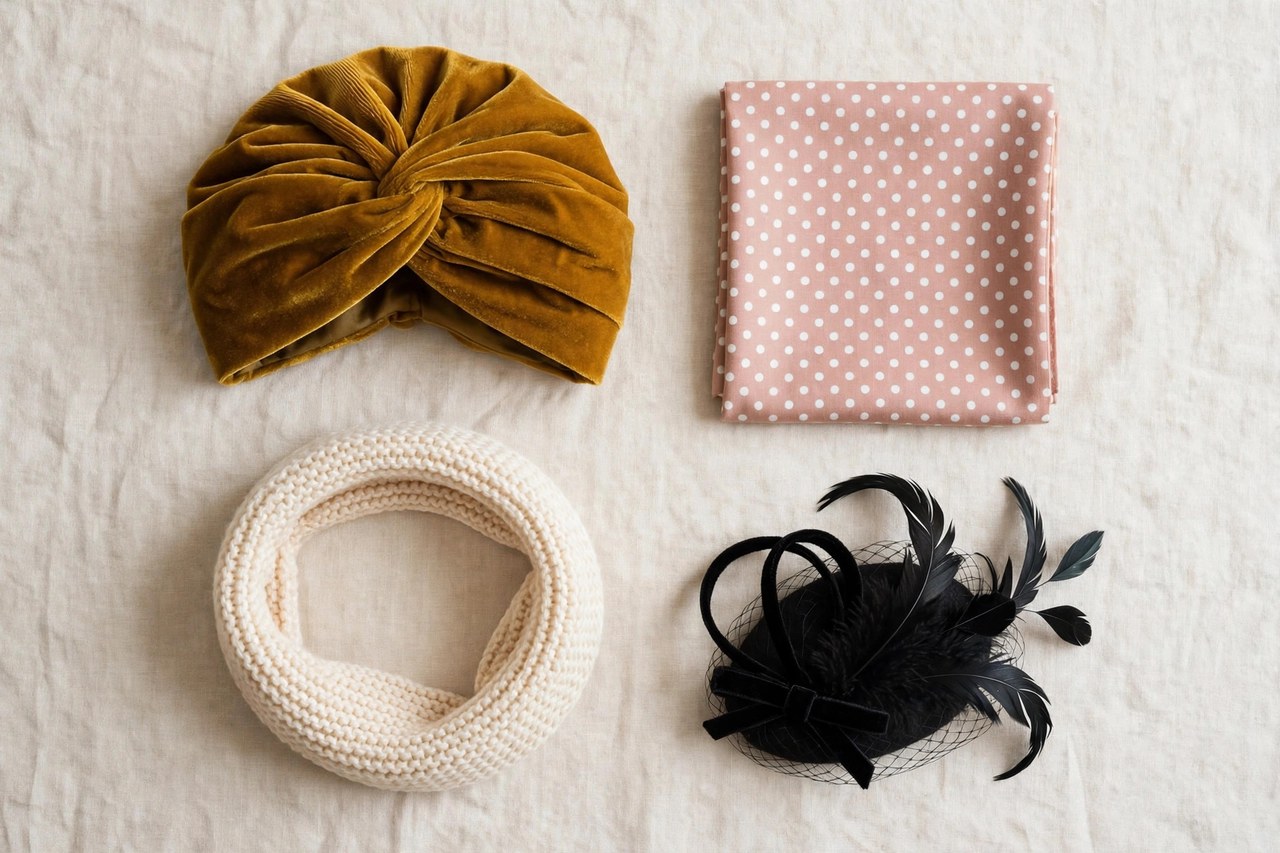
Headwear is the wider category of which hats are only the structured half. This guide covers the rest: everything soft, tied, wrapped, pinned or netted that women have worn on their heads across the retro decades — turbans and headscarves, snoods and headbands, fascinators, veils and decorative combs. Where the companion hats guide deals in blocked felt and straw, this one deals in fabric and ingenuity, and its pieces share a virtue: most of them fold flat, travel anywhere and cost little, which is how several of them became wartime and working staples in the first place.
Retro headwear solves practical problems in period style. It covers hair on a bad day or in a factory, protects a set hairstyle from weather, adds the finishing ornament to an evening outfit, and provides the modesty or formality a setting requires. This guide walks the main forms decade by decade, explains how to tie, pin and wear the important ones, and closes with styling notes and care for the silk, net, feathers and beads these small pieces are made from.
Turbans, Scarves and Snoods
The turban arrived in Western fashion in the 1910s, returned in the 1930s and 1940s as both glamour and utility — draped in silk or jersey for evening, tied from a plain scarf by factory and farm workers to keep hair safely covered — and revived again in the 1970s with evening dresses. Ready-made turbans, sewn to shape and simply pulled on, sit beside the wrap-it-yourself kind in every era. The headscarf is its simpler cousin: a square folded to a triangle, tied under the chin for 1950s and 1960s convertible-and-sunglasses glamour, or knotted at the nape or crown for work and weather.
The snood is a bag of netting, crochet or fabric that gathers long hair at the back of the head, worn from Victorian times through a major 1940s revival when it kept hair tidy for war work and added a period softness to evening hair. Headbands run from the jeweled bandeau of the 1920s, worn low across the forehead, through 1950s and 1960s wide fabric bands to the padded and knotted bands of later revivals. Each of these pieces protects or presents the hair rather than replacing it, which is the working definition that separates headwear from the hat.
Fascinators, Veils and Hair Ornaments
The fascinator is a small, decorative construction — feathers, flowers, net and beads on a comb, clip or small base — worn tilted at the front or side of the head for weddings, races and formal days. It descends from the cocktail hat and the Victorian evening ornament, and it flourishes whenever formality wants decoration without a full hat. Quality fascinators are built on sinamay or buckram bases with hand-rolled petals and wired feathers; cheap ones collapse visually because the base is wrong, so buy this category by construction, not by photograph.
Veils as headwear run from the short dotted net of a cocktail hat to bridal and mourning veiling with its own long etiquette, while hair ornaments fill the smallest end of the category: jeweled and tortoiseshell combs from the 1920s and earlier, decorative slides and grips, ribbon bows worn at a ponytail or chignon in the 1940s and 1960s, and fresh or silk flowers pinned above the ear, a wartime and tropical staple that became a signature of 1940s evening style. Together these pieces let a wearer scale headwear from a whisper to a statement without changing the outfit at all.
Wearing It Well, and Care
Successful headwear is a matter of placement and security. Turbans and scarves sit best with the knot or twist placed deliberately — center front for drama, side for softness — and with earrings chosen to balance the covered hair. Fascinators tilt forward over one eye's line, not straight up like a flag, and are anchored with their comb pushed against the hair's direction plus a grip or two for insurance. Snoods need the hair arranged first, since the net shows everything inside it. Practice a new piece at home before its event; every one of these items is easy the third time and treacherous the first.
Care matches the materials. Wash silk scarves by hand in cool water, dry flat and iron on the reverse; net snoods and veils rinse gently and dry over a towel, since tangled net tears before it untangles. Feather pieces are never washed: dust them, store them in a box where nothing presses on them, and keep them from damp, which curls feathers and spots sinamay. Combs and jeweled ornaments wipe clean and live in pouches so their stones do not snag net and scarves stored beside them. Small pieces, kept with small attentions, last indefinitely — which is why grandmothers' headwear drawers are still supplying the retro wardrobe today.
Related Women's Guides
Photos


Looking for Women's Clothing Stores?
This guide helps you choose women's retro headwear. To browse where to buy, visit our women's clothing store directory, where you can find retailers that carry them.