Women's Retro Veils Guide
Retro veils are bridal veils in the styles of past eras — blushers, birdcage veils, Juliet caps, mantillas and the long cathedral veils of vintage weddings.
Shop Women's Retro Veils Now
Shop Women's Retro Veils on Amazon Shop Women's Retro Veils on eBayThe Amazon and eBay links on this page are affiliate links. If you make a purchase through them, Apparel Search may earn a commission.
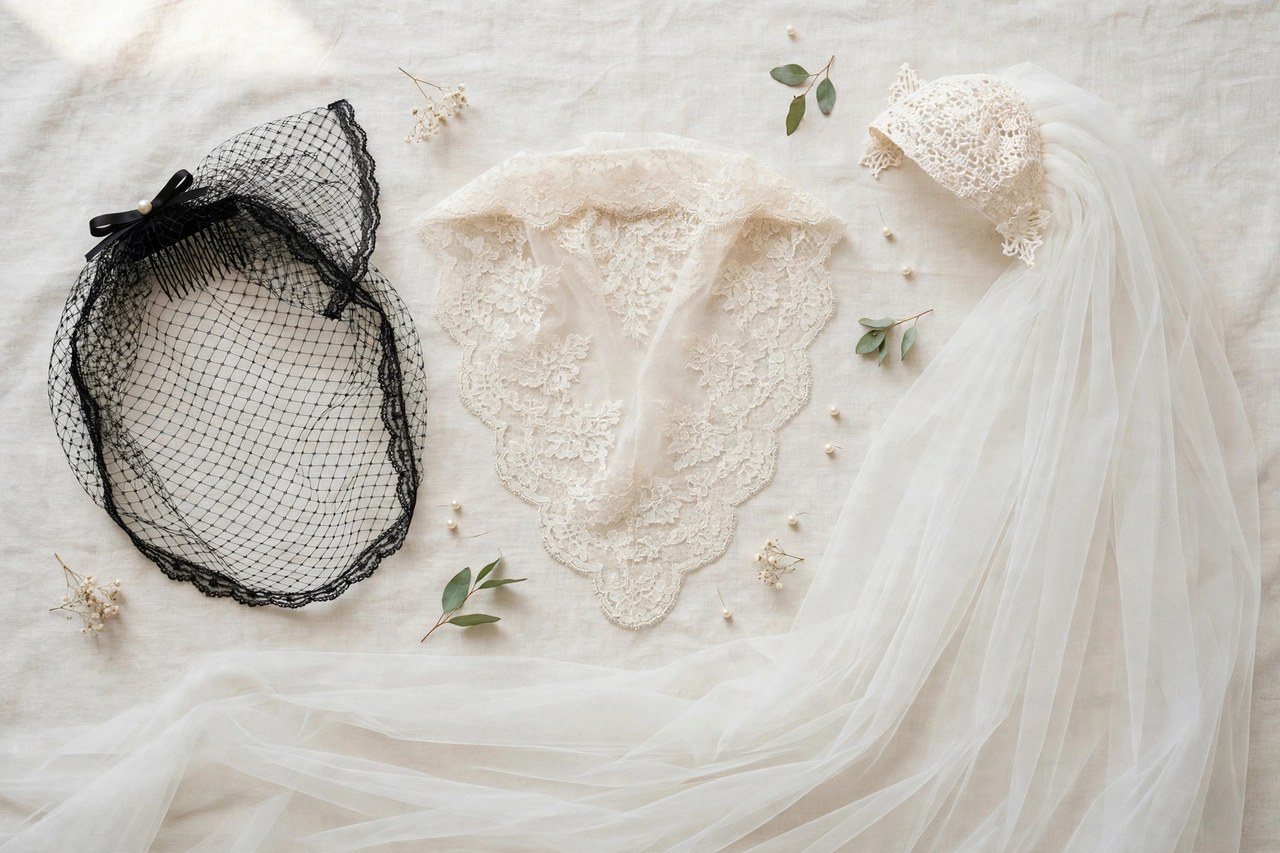
The veil is the oldest continuously worn bridal garment, and its shape changed with every era's silhouette: long lace mantillas, the cloche-hugging veils of the 1920s, the short face veils of the 1940s, the frothy blushers of the 1950s and the flower-crowned veils of the 1970s. This guide is about the headpiece itself — lengths, fabrics, edgings and attachments, era by era. Our companion guides cover retro wedding dresses and retro wedding gowns as garments; here, the dress is only background and the veil takes the whole stage.
A veil is measured and chosen differently from every other part of the outfit. Its vocabulary is its own: blusher for the short layer worn over the face, birdcage for the brief net veil of the forties and fifties, Juliet cap for the close cap that anchors a long veil, mantilla for the lace-edged veil draped over a comb, and a ladder of lengths from shoulder and elbow to fingertip, chapel and floor-sweeping cathedral. Learn those terms and any vintage or reproduction veil listing becomes easy to read.
Veils by Era: Twenties Caps to Fifties Birdcages
The 1920s veil clung to the era's cloche silhouette: tulle or lace gathered to a cap, headband or coronet, falling close around the face and shoulders, often with wax-flower or pearl trim. The Juliet cap — a small, close cap of lace, net or embellished fabric from which a longer veil falls — belongs to this period and returned in the 1970s. The 1930s lengthened the veil with the bias gown: fine tulle or lace veils falling to fingertip or beyond, worn over a coronet or simple comb, deliberately plain against slinky dresses.
Wartime 1940s veils shortened with everything else: shoulder and elbow lengths, simple tulle on a comb or small hat, and the first popularity of the short face veil. The 1950s made the veil a cloud — short, full layers of stiff nylon net in blusher and flyaway lengths, worn with pillbox and Juliet-cap bases, plus the chic birdcage veil: a diamond of wide French netting falling just to the nose or chin, attached to a comb or small hat. The birdcage is the most revived retro veil of all, because it suits short dresses, suits and registry-office weddings as well as full gowns.
Fabrics, Edges and Attachments
Veiling fabrics decide how a veil behaves. Traditional silk tulle drapes fluidly and photographs soft, but tears easily and costs accordingly; nylon illusion net, the post-war standard, is springier, cheaper and far more durable, which is why most surviving vintage veils are nylon. French net, with its larger diamond mesh, makes birdcage veils. Edges carry the decoration: cut edges vanish, pencil and satin edges define, and lace edges — from narrow Chantilly borders to the deep scalloped lace of a mantilla — turn a veil into an heirloom piece that families re-wear across generations.
Attachments are practical history. Older veils sit on combs, coronets, caps and headbands; mantillas drape over a tall or low comb in the Spanish tradition; Juliet caps are pinned or sit on an elastic or band. When buying vintage, inspect the attachment first — combs lose teeth, cap elastic perishes, and tulle tears where it is gathered to its base. A veil whose netting is sound can be re-mounted by a milliner onto a fresh comb or cap inexpensively, which rescues many otherwise unwearable family pieces for another wedding.
Choosing a Retro Veil and Keeping It
Match veil to dress by era and by weight of decoration, not by whiteness alone: a lace mantilla wants a simpler gown, a birdcage suits a short or tailored retro dress, a Juliet cap and long tulle belong with thirties and seventies slinky silhouettes, and a frothy fifties blusher needs the full skirt it was designed over. Check color in daylight — vintage whites age toward ivory and cream, and a veil one shade warmer than the dress is far less noticeable than one shade cooler or brighter.
Store a veil flat or gently rolled in acid-free tissue, never crushed in a drawer and never hung by its comb, and keep it dark, since nylon yellows with light and age. Steam — never a direct hot iron — relaxes storage creases; hold the steamer at a distance and let the veil cool hanging before use. Stains on heirloom lace call for a textile conservator rather than home bleach. A veil is often the one wedding garment that survives intact when dresses are altered or lost, so a retro veil, chosen and kept well, is both a style decision and a small act of preservation.
Related Women's Retro Guides
Looking for Women's Clothing Stores?
This guide helps you choose women's retro veils. To browse where to buy, visit our women's clothing store directory, where you can find retailers that carry them.