Women's Strapless Swimsuit Guide
A strapless swimsuit has no shoulder straps — support comes from the band, boning and gripper trim, giving a clean neckline for sun and an unbroken line under cover-ups.
Shop Women's Strapless Swimsuits Now
Shop Women's Strapless Swimsuits on Amazon Shop Women's Strapless Swimsuits on eBayThe Amazon and eBay links on this page are affiliate links. If you make a purchase through them, Apparel Search may earn a commission.
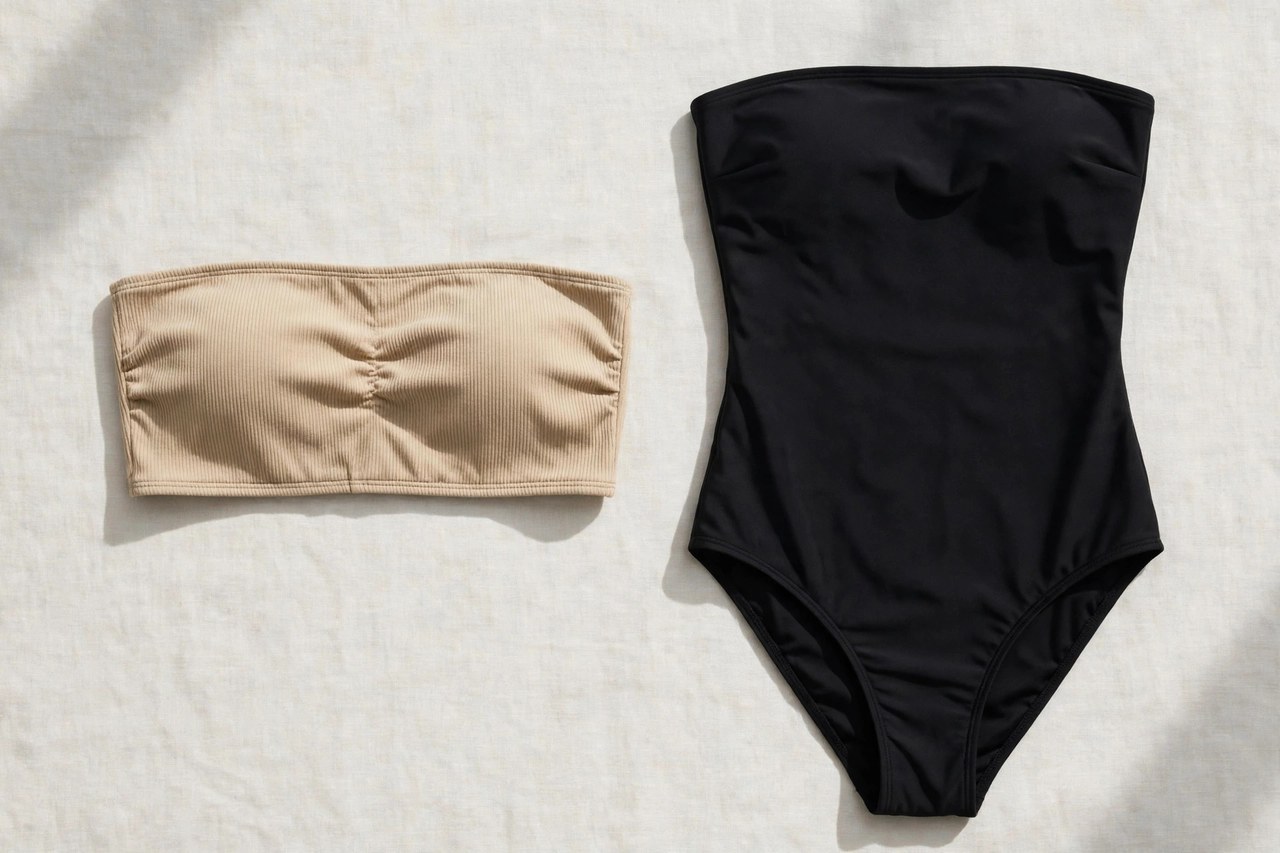
A strapless swimsuit is swimwear designed without shoulder straps, so the neckline runs straight or gently curved across the top edge and nothing crosses the shoulders. The style appears most often as the bandeau — a band-like top worn as part of a two-piece suit or as the top of a one-piece — and its appeal is straightforward and purely practical: no strap marks from sun, no straps showing under strapless cover-ups and dresses, and a clean, simple line at the neckline.
This guide treats the strapless suit as a product category: how a suit with no straps is engineered to stay in place, which support features matter by size, how to fit the band correctly, and which details separate a suit suited to swimming from one suited mainly to the lounger. Everything here is construction and buying guidance, because with no straps to adjust, construction is the entire product.
How a Strapless Suit Stays Up: The Engineering
Support in a strapless suit comes from four features working together. A wide, firm underband or top-edge band anchors the suit around the torso. Gripper elastic — a silicone or rubberized strip along the inside top edge — holds the fabric against the skin. Side boning, short flexible stays sewn at the sides of the bodice, keeps the top edge from rolling or folding down. And structured cups — molded foam, sewn-in pads or an internal shelf band — shape and support from inside rather than relying on strap lift.
Many strapless suits also include a removable or convertible strap in the package: a single strap that clips on as a halter or a pair that restores conventional support for active swimming. Treat that included strap as a genuine feature, not an afterthought — it lets one suit serve the sun deck and the swim properly. Suits lacking any of these elements, a plain tube of stretch fabric with no band, boning or grip, are beachwear for lying still, and should be priced and expected accordingly.
Styles: Bandeau Tops, One-Pieces and Variations
The bandeau two-piece pairs the band top with separate bottoms in a range of rises and coverage levels, and often adds a center twist, ring or knot detail that helps the top keep its shape. The strapless one-piece distributes the anchoring job over the whole torso, which many wearers find more secure, and it takes ruching and shirred panels well, since the fabric interest replaces the missing straps as the design focus. Bandeau-style tankini tops offer a third structure, with a longer top worn over separate bottoms.
Neckline variations are subtle but real: a straight band is the most secure and the most minimal, a sweetheart edge adds shaping seams that can improve fit, and a slight dip or center notch changes how the top edge grips. Underwire strapless styles exist for larger cup sizes and move the support job to a proper bra structure inside the suit. Choose among them by the support features first and the neckline second — in this category the prettiest edge is worthless if the band cannot hold it.
Fitting the Band: Sizes and Support Levels
Fit a strapless suit by the band, not by hope. The top edge should sit level and firm around the torso, snug enough that the gripper strip stays in contact through a stretch and a bend in the fitting room. If you can pull the top edge easily away from the body, or if it feels comfortable in the way a loose T-shirt is comfortable, it will migrate in the water. Many wearers size by cup as well as dress size in this category, and suits sold in cup sizes generally support better than a single stretch size.
Match support to honest use. For sunbathing, reading and wading, a soft bandeau with gripper trim is adequate. For swimming lengths, playing with children, beach games or any water with waves, look for boning, structured cups, a substantial band and the option of the clip-on strap — and use it. Trying the suit with a few jumps and arm raises at home, tags still on, is a fair test of what the sea will ask of it within the first minute.
Fabrics, Care and Getting Full Value
Strapless suits are made from the standard swim fabric family — nylon or polyester blended with elastane — and the elastane does double duty here, providing both the fit and much of the holding power. That makes care unusually important: chlorine, heat and sunscreen oils degrade elastane, and a strapless suit whose stretch has tired loses its one support system. Polyester blends resist chlorine longer and suit frequent pool use; nylon blends feel softer and suit occasional wear.
Rinse the suit in clean water after every use, hand wash gently, and dry it flat in shade rather than hanging it by the top edge, which stretches exactly the band that must stay firm. Rotate two suits if you swim daily so each recovers its elasticity between wears. Stored clean, dry and unstretched, the grip and band stay true, and a well-built strapless suit keeps its clean neckline and its composure for several seasons.
Related Women's Guides
More to Explore on Apparel Search
- Fashion
- Clothing Retail Stores
- Fashion News
- Fashion Designers
- Popular Brands
- Apparel
- Women's Clothing Stores
- Women's Clothing Wholesalers
- Women's Fashion
- Women's Swimwear Stores
- Women's Wholesale Swimwear
- Women's Swimwear Guide
- Swimwear News
- Women's Swimwear Store
- Fashion Videos
- Fashion Calendar
- Celebrity Fashion
- Fashion Designer Directory
Women’s Clothes Guide by Letter: Women's Apparel Directory N · Women's Clothes Directory O · Women's Clothing Directory P · Women's Apparel Directory Q · Women's Fashion Directory R · Women's Clothes Directory T
Looking for Women's Clothing Stores?
This guide helps you choose women's strapless swimsuits. To browse where to buy, visit our women's clothing store directory, where you can find retailers that carry them.