Women's String Bikini Guide
A string bikini is a two-piece style defined by its ties — small triangle cups and brief panels joined and held by thin cords at the neck, back and hips.
Shop Women's String Bikinis Now
Shop Women's String Bikinis on Amazon Shop Women's String Bikinis on eBayThe Amazon and eBay links on this page are affiliate links. If you make a purchase through them, Apparel Search may earn a commission.
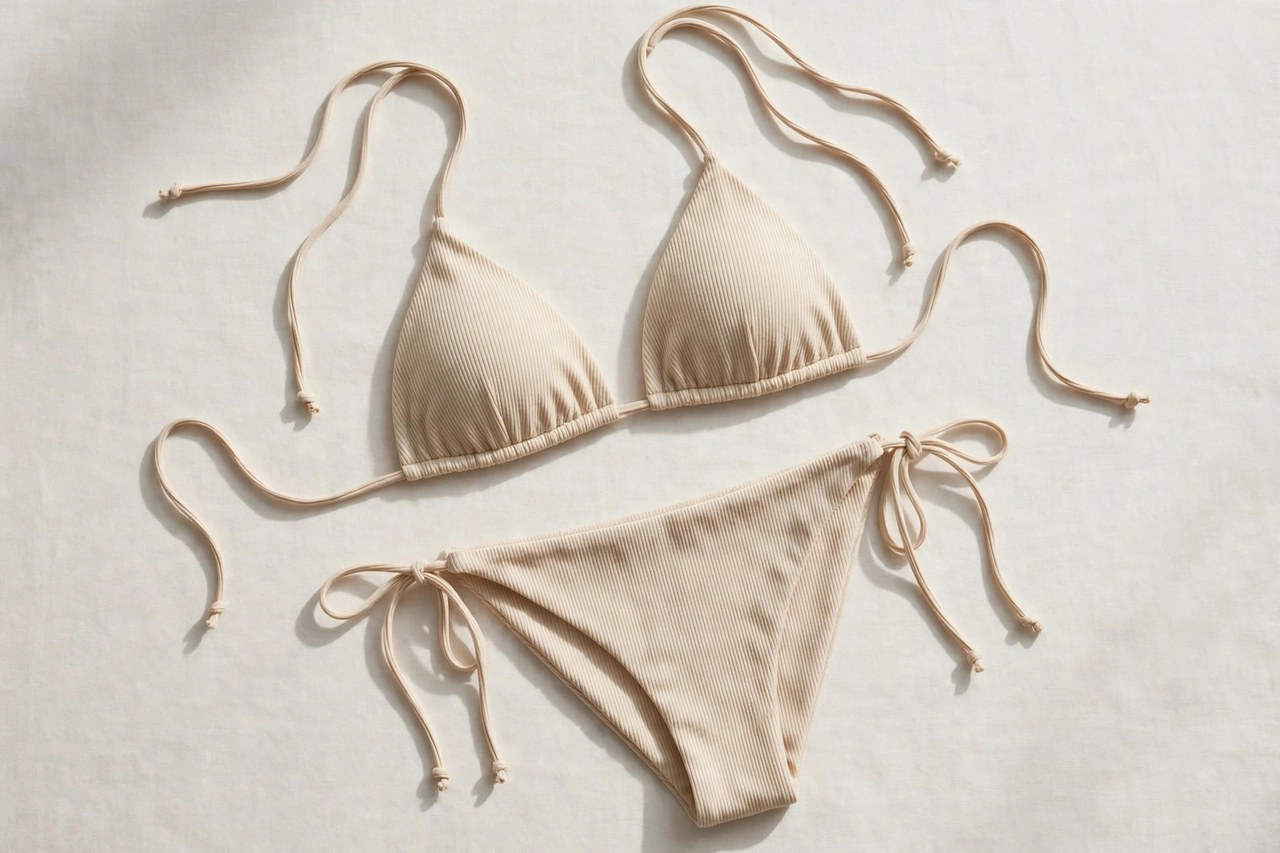
A string bikini is a two-piece swimsuit style whose pieces are connected and secured by thin cords — the 'strings' of the name. The classic form pairs triangle cups that slide along a cord tied at the neck and back, with a brief bottom whose front and back panels are joined at the hips by tie sides rather than by sewn side seams. In plain terms, the bottom consists of two triangular pieces connected at the front but not at the sides, where a thin string wraps around the waist connecting the parts, and the top is tied in place the same way.
This guide is about the style itself, as a design: how the tie construction works, where the style came from, and what its adjustable fit does well and poorly. Companion pages cover the swimwear shopping angle and the separate underwear version; this page stays with design and history.
Anatomy: Sliding Triangles and Tie Sides
The top's defining mechanism is the sliding triangle: each cup is a triangle of fabric with a casing along its base through which the underbust cord runs, so the cups can be positioned and gathered by sliding them along the string. The same cords extend to tie at the back, and a second pair ties behind the neck in the halter fashion. Because every closure is a knot, the top has no fixed band size; fit is created by the wearer each time it is put on.
The bottom mirrors the logic. Front and back panels, often triangular or softly curved, are joined by side ties that knot or bow at the hips, with cord ends sometimes finished with beads or small charms. Some versions replace one or both ties with fixed string sides — narrow cord sides without knots — which keep the minimal side line but surrender the adjustability. Knowing which version you are buying matters, because the tie-side original and the fixed-string variant fit, and fail, in completely different ways.
A Brief History of the Style
The bikini itself dates to 1946, and through its first decades the standard form used sewn, structured pieces. The string bikini emerged in the early 1970s, when designers reduced the bikini toward its minimum — fabric where required, cord everywhere else — and the tie-side style became a fixture of 1970s beach fashion, helped by the era's taste for natural, unstructured clothing. Its construction had a practical logic for makers, too: a tie garment fits many bodies from few sizes, so early string bikinis were sold with minimal size runs.
The style has cycled with fashion ever since — prominent in the 1970s, the late 1990s and the 2010s revival of 1990s minimalism — while its construction has barely changed, because there is little left to change. Modern versions refine the details that the originals handled casually: wider, softer cords that do not dig, lined cups, removable padding, and recycled stretch fabrics. The silhouette a shopper meets today is the 1970s design with better materials and more honest sizing.
Fit: The Strength and Limit of Adjustability
Ties make the string bikini the most adjustable swimsuit style and, at the same time, one of the least supportive. The sliding cups accommodate a wide range of sizes and let the wearer set coverage and spacing, and tie sides forgive hip variation that defeats fixed sizes. The limits are structural: thin cords concentrate all hold at three or four knots, support for larger cup sizes is minimal, and the style's security depends entirely on knots staying tied, which movement and water test constantly.
Fit one by dressing as you would swim. Tie the back cord firmly first, position the cups by sliding rather than stretching the fabric, then tie the neck cord so the weight is shared rather than hung on the neck alone — neck strain is the style's most common complaint and usually means the back tie was left too loose. Choose cup size by coverage, sizing up if between, because an undersized triangle on a cord does not compress into place the way a molded cup does. Double-knot for swimming; a bow is for the beach chair.
Fabrics, Coverage Levels and Quality Signs
String bikinis are made from standard swim stretch fabric — nylon or polyester with elastane — and in this style the fabric's recovery matters at the cord casings and panel edges, where tired elastic lets edges curl. Lining is the clearest quality sign: a fully lined top and front panel keep shape and opacity, while an unlined set is a budget garment and will behave like one. Cord quality is the second sign — flat, woven cords tie securely and sit comfortably, while round, slippery cords loosen and saw at the neck.
Coverage within the style varies more than newcomers expect: cups range from minimal triangles to fuller cuts with wider bases, and bottoms from narrow Brazilian-influenced panels to moderate brief panels, all sharing the same tie construction. Shop by the panel measurements and size charts rather than by photographs, which are styled to minimize. However it is cut, the string bikini remains what its design says it is — the minimal, adjustable end of the bikini family — and choosing it knowingly, for the right beach days, is the whole of shopping for it well.
Related Women's Guides
More to Explore on Apparel Search
- Women's Swimwear Store
- Fashion
- Clothing Retail Stores
- Fashion News
- Fashion Designers
- Popular Brands
- Apparel
- Women's Clothing Stores
- Women's Clothing Wholesalers
- Women's Fashion
- Women's Swimwear Stores
- Women's Wholesale Swimwear
- Women's Swimwear Guide
- Swimwear News
- Fashion Videos
- Fashion Calendar
- Celebrity Fashion
- Fashion Designer Directory
Women’s Clothes Guide by Letter: Women's Apparel Directory N · Women's Clothes Directory O · Women's Clothing Directory P · Women's Apparel Directory Q · Women's Fashion Directory R · Women's Clothes Directory T
Looking for Women's Clothing Stores?
This guide helps you choose women's string bikinis. To browse where to buy, visit our women's clothing store directory, where you can find retailers that carry them.