Women's Skirted Swimwear Guide
Skirted swimwear adds a fabric skirt panel to a swimsuit for extra hip and thigh coverage — available as one-piece suits and as skirted bottoms paired with separate tops.
Shop Women's Skirted Swimwear Now
Shop Women's Skirted Swimwear on Amazon Shop Women's Skirted Swimwear on eBayThe Amazon and eBay links on this page are affiliate links. If you make a purchase through them, Apparel Search may earn a commission.
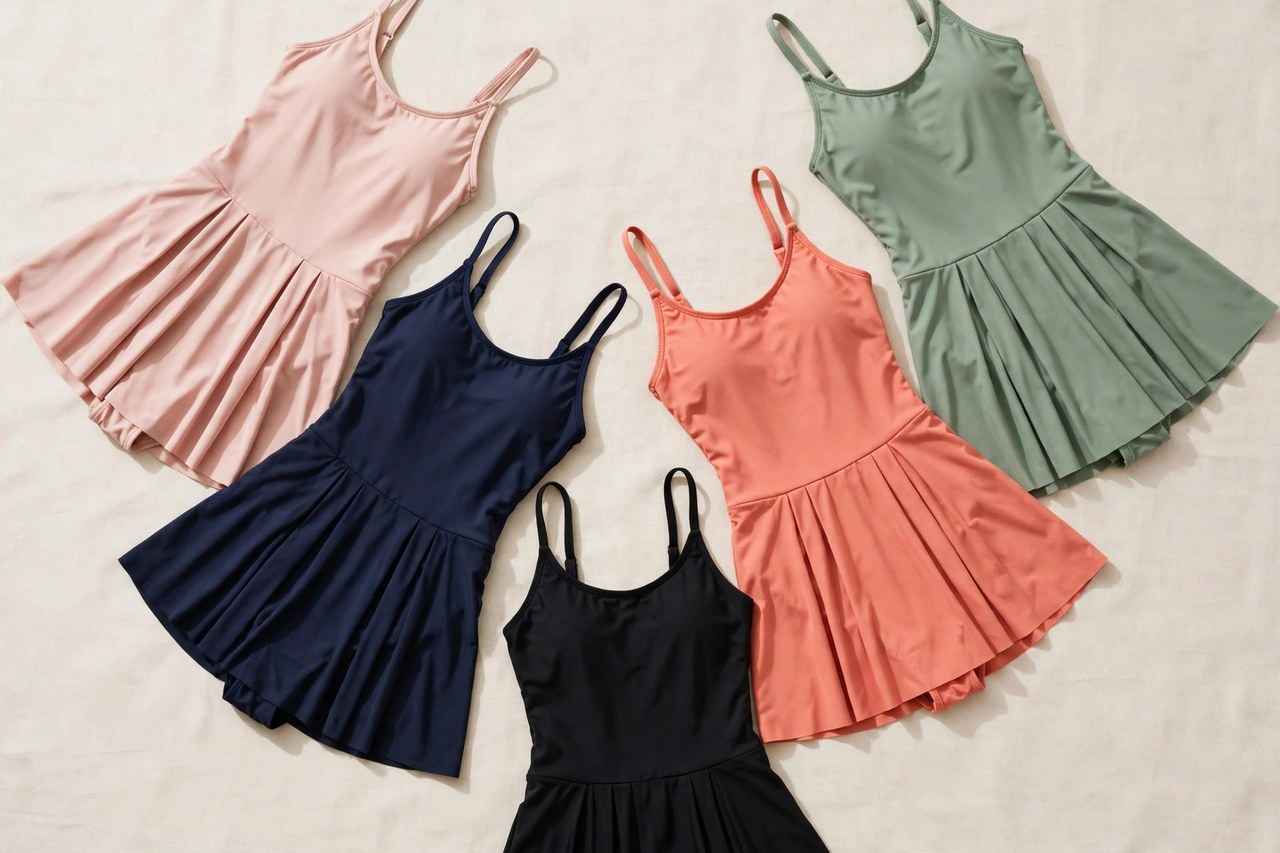
Skirted swimwear is the family of swimsuits that incorporates a skirt: a panel of swim fabric attached at the waist or hip of the suit, falling over the top of the thigh. The skirt is a coverage and styling feature, not a separate garment — underneath it there is always an attached brief or short that does the actual work of a swimsuit bottom. Shoppers choose the style for the smoother line it gives at the hip, for modest coverage in and out of the water, and for a silhouette that reads more like a short dress than a conventional suit.
This page is the umbrella guide to the category: the constructions available, how skirt lengths and cuts differ, the fabrics and support features to compare, and how to size a suit with two layers at the hip. Two close relatives have their own pages with narrower definitions — the skirted tankini, a two-piece with a tank-style top, and the skirtini, a two-piece with a bikini-style top — and the boundaries are summarized in the last section here.
Constructions: One-Piece Suits and Skirted Bottoms
The one-piece skirted suit, closely related to the swimdress, attaches the skirt to a full torso suit; many have a flared, dress-like skirt over a brief, with the shaping and support built into the bodice. It is the simplest construction to wear — one garment, nothing to match — and the most common form of skirted swimwear. The separate skirted bottom is a skirt-over-brief or skirt-over-short piece sold on its own, paired by the shopper with any top: tankini top, bikini top, rash guard or swim tee. Separates allow different sizes for top and bottom and let one skirted bottom serve several tops.
Under the skirt, check what is actually attached. A brief base gives the lightest, quickest-drying underlayer. A short or boy-short base adds thigh coverage and reduces chafing on long beach walks, at the cost of more wet fabric. Some skirts are full circles that flare from the waist; others are straight or A-line panels, and some are a short front panel only, ruffled or tiered. In the water, fuller skirts float and swirl upward; closer panels stay nearer the leg. Trying the skirt's behavior in a pool, not just a mirror, is the honest test.
Fabrics, Linings and Support Features
Skirted swimwear is made from standard swim fabrics: nylon or polyester blended with elastane, with polyester blends offering the best chlorine and fade resistance for frequent pool use. The skirt panel itself may be solid fabric or mesh; mesh skirts dry fastest and add the least drag and weight when wet. Look for a fully lined brief base at minimum, and front torso lining or power-mesh panels on one-piece styles where shaping is claimed. A skirt adds a second layer everywhere it overlaps, so breathability and drying time depend heavily on these fabric choices.
Support features live in the top half and follow ordinary swimwear practice: molded or removable cups, underwire or banded support on one-piece suits, adjustable straps, and racerback or halter constructions that change how weight is carried. Because the skirt gives visual emphasis at the hip, many skirted suits balance it with detail at the neckline — a practical construction point to check in photographs and product descriptions. UPF-rated fabrics appear in this category for sun coverage and should state their rating numerically rather than as a vague claim.
Sizing and Fit Checks
Size skirted swimwear by your torso length and hip measurement together, not by dress size alone. On a one-piece, a short torso makes the skirt sit high and short; a long torso pulls the skirt up and flattens its flare. The skirt's hem should fall where you want the coverage — typically mid-thigh at the longest for swimming practicality — and the under-brief should fit like any swim brief: secure at the leg openings without digging, because it, not the skirt, keeps the suit in place in the water.
For separates, size the skirted bottom by hip and the top independently; mismatched proportions are the main reason separates exist. When between sizes, swimsuit elastane relaxes in water, so the snugger dry fit is usually the safer one. Walk and sit in the fitting room: the skirt should settle back into place without being tugged, and straps should stay where they were adjusted.
Care, and the Category Boundaries
Care is standard swimwear care, applied to two layers. Rinse in cool fresh water after every swim to remove chlorine, salt and sunscreen; wash gently by hand with mild detergent; roll in a towel to press out water rather than wringing, which twists the skirt's attachment seams; and dry in shade, since heat and sun degrade elastane. Give skirted suits extra drying time and hang or lay them so air reaches between skirt and brief — mildew starts in exactly that damp fold if a suit is balled into a bag.
Finally, the boundaries this site keeps: skirted swimwear is the whole family. A skirted tankini is the two-piece version whose top is a tank top. A skirtini is the two-piece version whose top is a bikini top, with a small skirted bottom. A swimdress leans furthest toward a dress silhouette in one piece. Knowing which name a retailer is using tells you the construction before you open the product photos — and the next two guides take each of the two-piece forms in turn.
Related Women's Guides
More to Explore on Apparel Search
- Fashion
- Clothing Retail Stores
- Fashion News
- Fashion Designers
- Popular Brands
- Apparel
- Women's Clothing Stores
- Women's Clothing Wholesalers
- Women's Fashion
- Women's Swimwear Stores
- Women's Wholesale Swimwear
- Swimwear News
- Women's Swimwear Guide
- Fashion Videos
- Fashion Calendar
- Celebrity Fashion
- Fashion Designer Directory
Women’s Clothes Guide by Letter: Women's Apparel Directory N · Women's Clothes Directory O · Women's Clothing Directory P · Women's Apparel Directory Q · Women's Fashion Directory R · Women's Clothes Directory T
Looking for Women's Clothing Stores?
This guide helps you choose women's skirted swimwear. To browse where to buy, visit our women's clothing store directory, where you can find retailers that carry them.