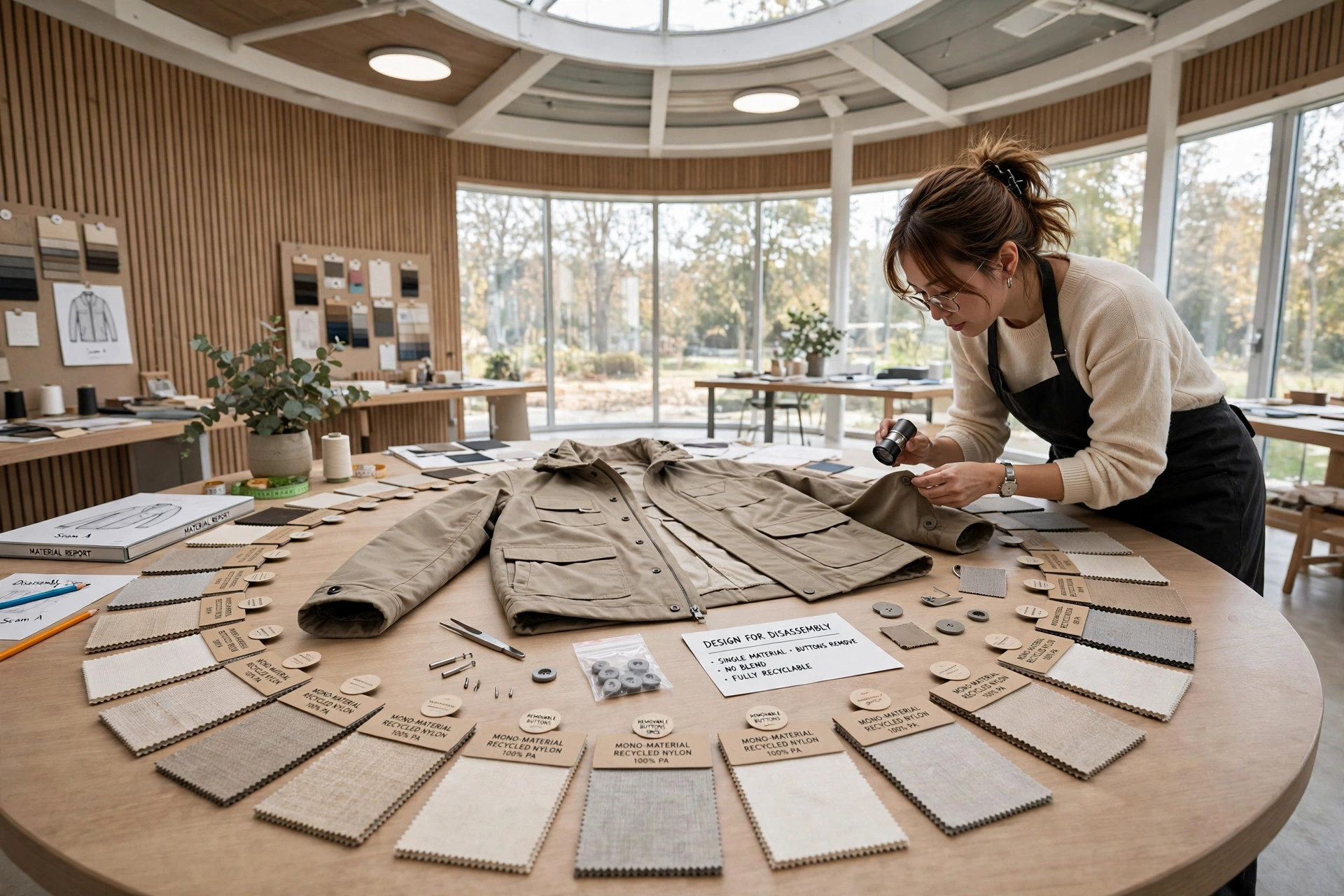
Cradle to Cradle Certified is a product certification administered by the Cradle to Cradle Products Innovation Institute. It assesses products across five categories — material health, product circularity, clean air and climate protection, water and soil stewardship, and social fairness — and awards achievement levels that rise as a product’s design and production improve. In apparel it is used for garments and textiles designed from the start for safe materials and repeated cycling.
The Five Categories
Material health asks what a product is made of and whether its ingredients are safe for people and the environment, using chemical inventory and assessment down to the formulation level. Product circularity assesses whether the product is designed for its next use — reuse, repair, recycling, or safe return — and whether the systems to recover it exist. Clean air and climate protection addresses energy and emissions in production; water and soil stewardship covers how manufacturing treats water and ecosystems; and social fairness examines the maker’s responsibility toward the people in its supply chain.
A product is scored in each category and receives its overall certification level from its lowest category result. That structure is deliberate: a garment cannot offset unsafe chemistry with excellent carbon accounting. It makes the certification demanding, and it is why certified apparel products are still a minority of the market.
How Certification Works
Products are assessed by accredited assessment bodies working with the Institute’s requirements. The process involves documenting materials and suppliers in depth, laboratory and documentary assessment of material health, and verification of the production claims behind each category. Certification is time-limited, and renewal expects continued progress — the program is built around continuous improvement rather than a permanent badge earned once.
For apparel, the deepest practical challenge is information: brands must obtain formulation-level detail from fabric mills and chemical suppliers that historically treated recipes as trade secrets shared with no one. Programs such as Eco Passport for textile chemicals, and the bluesign system, can support parts of that documentation, but gathering it remains the main cost of pursuing certification.
Who Uses It and Why
Certified apparel and textile products include denim, basics, workwear, and interior textiles, from both dedicated circular-economy brands and large companies certifying selected lines. Retailers and institutional buyers use the certification as a screened shortlist when their purchasing policies require verified circular design rather than marketing language.
Cradle to Cradle thinking also influences designers who never certify: mono-material construction, detachable trims, and chemistry chosen for recyclability are its design habits, and they align closely with where regulation is heading under measures such as the Digital Product Passport. Brands comparing frameworks should note that this certification evaluates the whole product across all five categories, unlike single-attribute standards such as recycled content certification.
FAQs
- What does Cradle to Cradle Certified assess?
- Five categories: material health, product circularity, clean air and climate protection, water and soil stewardship, and social fairness. The overall level reflects the lowest category, so strengths cannot hide weaknesses.
- Is a certified product necessarily recyclable?
- Circularity is one assessed category, covering design for recovery and the systems around it, but certification is broader than recyclability — it also covers chemistry, energy, water, and social fairness.
- Why do relatively few garments carry the certification?
- It requires deep material and supplier documentation and verified performance across five categories at once, which takes time and supply-chain cooperation that many brands have not yet built.
Sustainability Certifications & Standards
This guide is part of the Apparel Search sustainability certifications series. Browse the full series below, or start from the manufacturing guides hub.
- Global Recycled Standard (GRS) Certification
- Recycled Claim Standard (RCS) Certification
- Organic Content Standard (OCS) Certification
- Responsible Wool Standard (RWS) Certification
- Responsible Down Standard (RDS) Certification
- Responsible Mohair Standard (RMS) Certification
- OEKO-TEX Made in Green
- OEKO-TEX STeP Certification
- OEKO-TEX Eco Passport
- Digital Product Passport for Textiles
- Extended Producer Responsibility for Textiles
- France’s Repair Bonus for Clothing and Shoes
- B Corp Certification
- Leather Working Group Auditing
- Bio-Based Leather Alternatives
Apparel Search: explore the manufacturing guides hub and production & sourcing resources for the fashion industry.
Please note: Cradle to Cradle Certified is maintained by the Cradle to Cradle Products Innovation Institute, and its requirements are revised over time. This page is a general overview provided for information only — it is not legal or compliance advice, and it may not reflect the most current version. Always confirm the current requirements directly with the Cradle to Cradle Products Innovation Institute or an accredited certification body before making certification or sourcing decisions, rather than relying on this website.