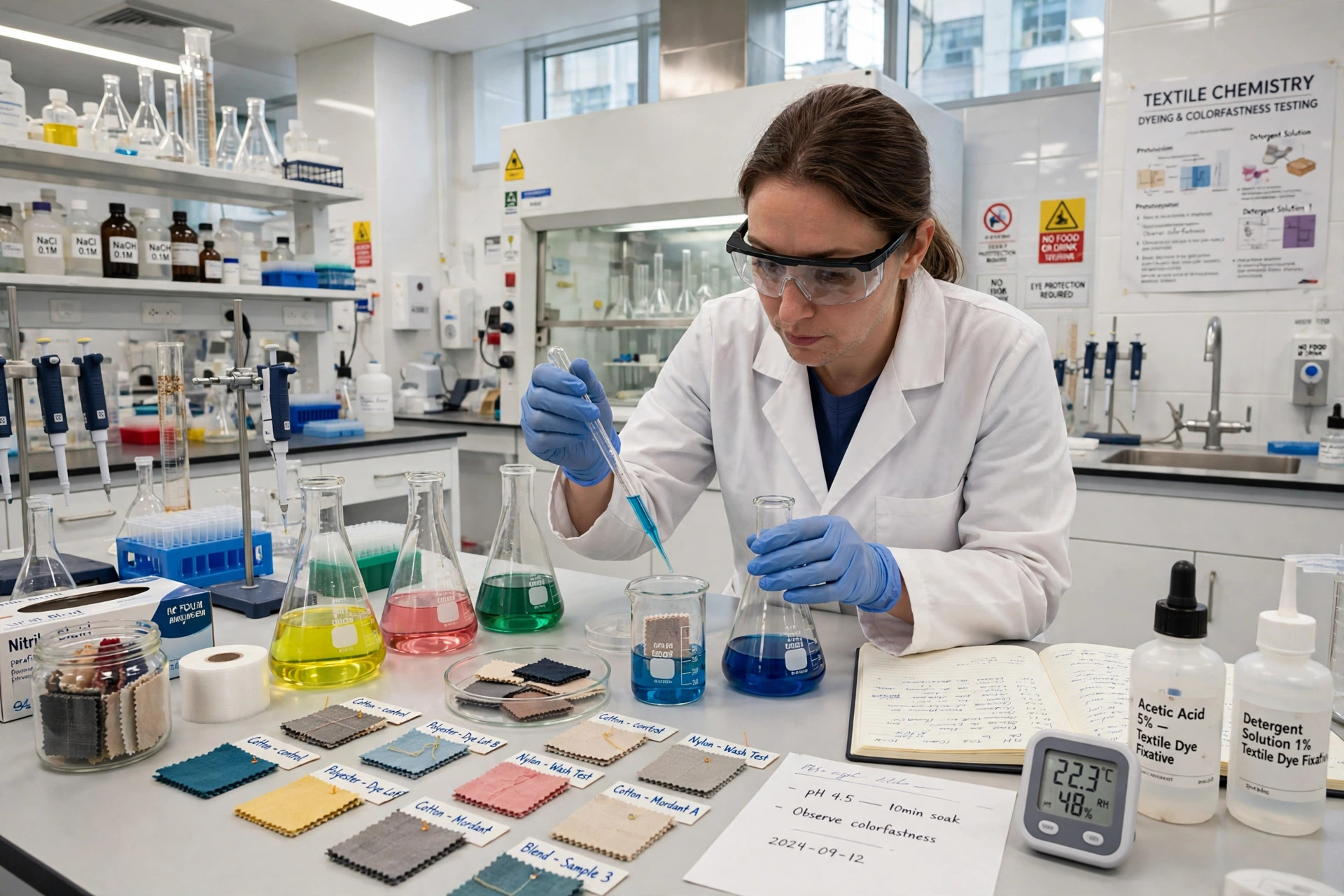
OEKO-TEX Eco Passport is a certification from the OEKO-TEX Association for chemicals, colorants, and auxiliaries used in textile and leather production — the dyes, pigments, softeners, and processing agents that determine much of a fabric’s chemical footprint. Certified chemicals have been screened against restricted-substance criteria and verified by laboratory analysis, so mills can choose inputs that support safer finished products.
What Eco Passport Covers
Almost every textile passes through chemistry: scouring agents prepare the fiber, dyes and pigments color it, and finishes give it softness, water resistance, or wrinkle performance. Eco Passport addresses that input side of the industry. Chemical manufacturers submit their products for assessment, which includes screening the formulation against restricted substance lists and manufacturing restricted substances list (MRSL) criteria used in the industry, together with laboratory verification that the product matches its declared composition.
The certification gives chemical suppliers a credible way to document the safety profile of their products and gives mills a shortcut: choosing Eco Passport-certified inputs reduces the risk that a finished fabric will fail harmful-substance testing or a brand’s chemical restrictions.
How Certification Works
Certification is handled by OEKO-TEX institutes and combines documentary review with analytical testing of the chemical product. Certificates are issued for specific products — not as a blanket approval of a supplier’s whole catalog — and they are time-limited, with renewal requiring the product to be reassessed against the criteria then in force. Certified products can be looked up in OEKO-TEX’s buying guide, which is how mills and brands typically verify a claim.
Eco Passport fits into the wider OEKO-TEX system: facilities certified under STeP are assessed on their chemical management, and using certified inputs is one practical way they improve that performance, while product labels such as Standard 100 test the outcome on the finished article.
Who Uses Eco Passport
Dye and chemical manufacturers use Eco Passport to sell into global supply chains where brands publish strict chemical policies. Mills and dyehouses use certified inputs to protect their own product certifications and to answer brand questionnaires with documentation instead of declarations. Sourcing and compliance teams increasingly ask about input certification because it is far cheaper to keep a problematic chemical out of a factory than to fail a finished-goods test after production.
For readers comparing chemical-management systems, Eco Passport’s closest relative on this site is bluesign, which also works from the input stream outward. The two systems differ in structure and criteria, and many suppliers participate in both to serve different customer bases.
FAQs
- What kinds of products does Eco Passport certify?
- Chemicals used in textile and leather production: dyes, pigments, and auxiliaries such as softeners, washing agents, and finishing products, each certified individually by product.
- Does Eco Passport guarantee a finished fabric is safe?
- No single input certification can guarantee the finished article, which is why finished products are still tested under systems such as Standard 100. Certified inputs substantially reduce the risk of failures.
- How can a mill check whether a chemical is certified?
- Certified products are listed in OEKO-TEX’s official buying guide, and buyers can ask the supplier for the product’s current certificate and confirm its scope and validity.
Sustainability Certifications & Standards
This guide is part of the Apparel Search sustainability certifications series. Browse the full series below, or start from the manufacturing guides hub.
- Global Recycled Standard (GRS) Certification
- Recycled Claim Standard (RCS) Certification
- Organic Content Standard (OCS) Certification
- Responsible Wool Standard (RWS) Certification
- Responsible Down Standard (RDS) Certification
- Responsible Mohair Standard (RMS) Certification
- OEKO-TEX Made in Green
- OEKO-TEX STeP Certification
- Digital Product Passport for Textiles
- Extended Producer Responsibility for Textiles
- France’s Repair Bonus for Clothing and Shoes
- Cradle to Cradle Certified® Products
- B Corp Certification
- Leather Working Group Auditing
- Bio-Based Leather Alternatives
Apparel Search: explore the manufacturing guides hub and production & sourcing resources for the fashion industry.
Please note: OEKO-TEX Eco Passport is maintained by the OEKO-TEX Association, and its requirements are revised over time. This page is a general overview provided for information only — it is not legal or compliance advice, and it may not reflect the most current version. Always confirm the current requirements directly with the OEKO-TEX Association or an accredited certification body before making certification or sourcing decisions, rather than relying on this website.