Mao Suit
Clothing Definitions — definitions of garments and clothing terms from Apparel Search
Search Apparel Search
At a Glance
Definition: The Mao suit, also known as the Chinese tunic suit, is the Western name for the style of male attire known in China as the Zhongshan suit — a tunic suit with a turndown collar and four symmetrically placed pockets, introduced by Sun Zhongshan after the founding of the Republic of China and popularised by Mao Zedong.
Also known as: Zhongshan suit; Chinese tunic suit
Category: Clothing Definitions
Word Origin
The two names record the suit's two histories. In China it is the Zhongshan suit (Zhōngshān zhuāng), named after Sun Zhongshan — Sun Yat-sen — who introduced it shortly after the founding of the Republic of China. The Western name, Mao suit, comes from its popularisation by Mao Zedong, under whom it became the standard dress of the People's Republic.
The Mao suit, also known as the Chinese tunic suit, is the Western name for the style of male attire known in China as the Zhongshan suit, named after Sun Zhongshan, who introduced it shortly after the founding of the Republic of China. In accordance with the Chinese tradition of changing the style of dress for different dynasties, Sun instructed that a new form of clothing be designed for the new republic. The Western name comes from its popularisation by Mao Zedong. The suit incorporates elements of German military dress, including a turndown collar and four symmetrically placed pockets, and is based on a form of attire popular with contemporary Chinese men in Japan and Southeast Asia. It is the one suit in this section designed as a political statement first and a garment second.
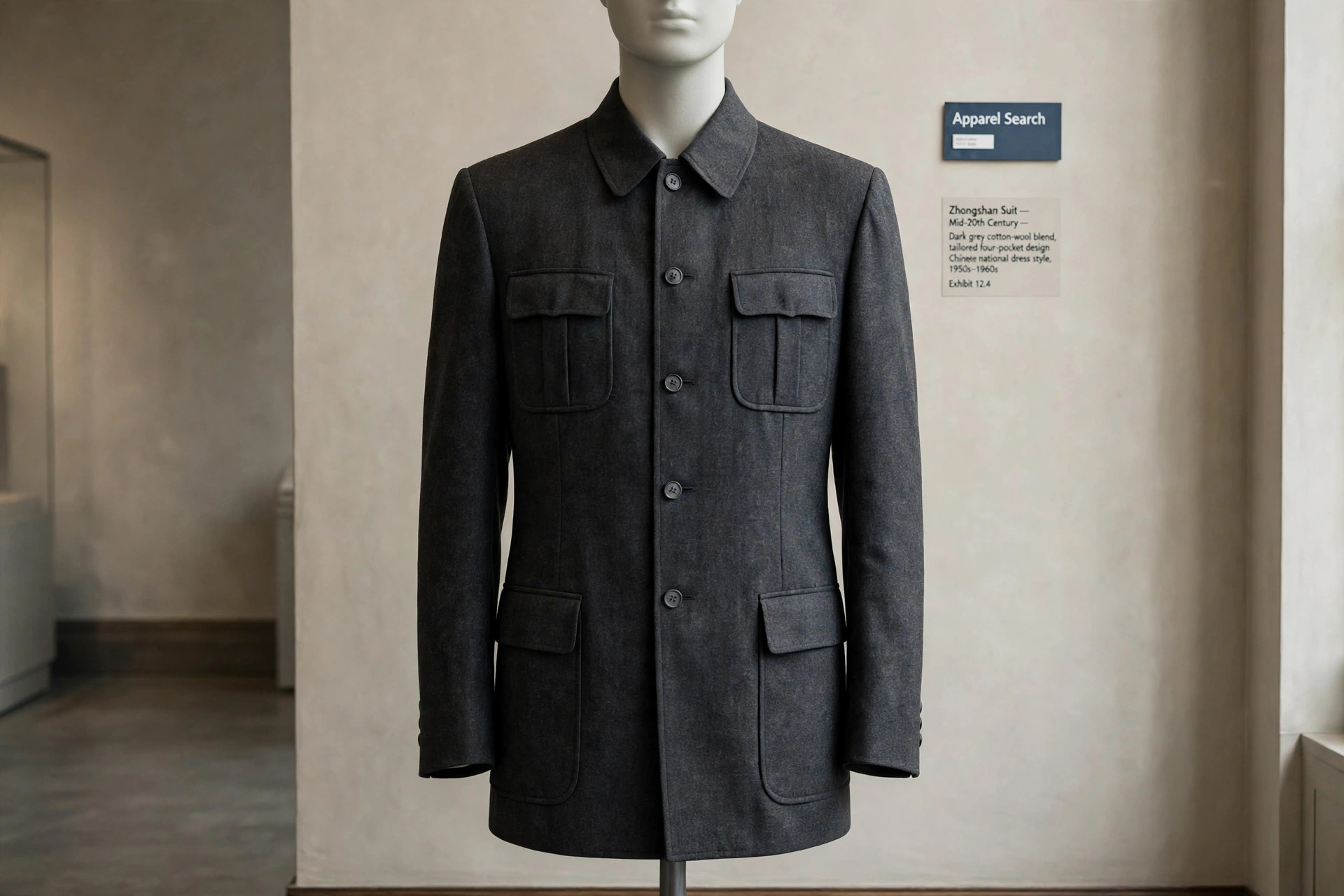
A New Suit for a New Republic
The Zhongshan suit was an attempt to cater to "modern" sensibilities without completely adopting Western styles wholesale. Incorporating elements of German military dress, including a turndown collar and four symmetrically placed pockets, and based on a form of attire popular with contemporary Chinese men in Japan and Southeast Asia, it looked disciplined and Chinese at once — a deliberate alternative both to the dress of the fallen Qing and to the imported business suit.
The details were designed, not inherited. Instead of the three hidden pockets in Western suits, the Zhongshan suit had four outside pockets, to adhere to Chinese concepts of balance and symmetry. Over time, minor stylistic changes developed: the suit originally had seven buttons, later reduced to five. Few garments have carried as much political meaning in their cut alone.
The commission itself followed an old pattern. In accordance with the Chinese tradition of changing the style of dress for different dynasties, a new regime marked itself with new clothing, and Sun instructed that a new form of dress be designed for the new republic. What was new in this case was the direction of the borrowing: the form of attire popular with contemporary Chinese men in Japan and Southeast Asia, and elements of German military dress, were taken up and made Chinese, rather than the Western business suit being adopted as it stood. The turndown collar — neither the high collar of the old dress nor the lapel of the Western jacket — is the visible sign of that middle course.
The Meanings Assigned to It
After Sun Yat-sen's death in 1925, popular mythology assigned a revolutionary and patriotic significance to the Zhongshan suit. The four pockets were said to represent the Four Cardinal Principles cited in the classic Book of Changes. The five centre-front buttons were said to represent the five Yuans — the branches of government — cited in the constitution of the Republic of China. And the three cuff buttons were said to symbolise Sun Yat-sen's Three Principles of the People.
Whether or not the symbolism was designed in from the start, it fitted the suit's role. A garment whose every countable feature could be read as a principle turned daily dress into a statement of allegiance, and the reading stuck because the suit itself was everywhere the new state was.
Note what the mythology fastened on: not the cloth, the colour or the collar, but the numbers — four pockets, five buttons, three cuff buttons. The Zhongshan suit is a plain, symmetrical, almost severe garment, and its plainness is what made it available for meaning. A decorated uniform says what its wearer has done; this suit's undecorated regularity said what its wearer belonged to, which is why both the Republic and, later, the People's Republic could make it state dress.
From State Dress to Rare Sight
In the 1920s, civil servants of the Chinese government were required to wear the Zhongshan suit. A designed version of the suit, adapted for combat, formed the basis for army uniforms during the Second Sino-Japanese War and the Chinese Civil War. After the establishment of the People's Republic of China, the suit became a symbol of proletarian unity, and was regularly worn by Communist Party cadres until the 1990s, when it was largely replaced by the Western business suit. The Zhongshan or Mao suit remained the standard formal dress for the first and second generation of PRC leaders, such as Deng Xiaoping.
During the 1990s it began to be worn with decreasing frequency by leaders of Jiang Zemin's generation; on informal occasions, most older cadres wore panama shirts and most younger cadres polo shirts. By the early part of the twenty-first century, the Mao or Zhongshan suit was rarely worn even on formal occasions, and the infrequent occasions on which it is worn usually involve situations in which civilian party officials wish to demonstrate control over the military. On Taiwan, the Zhongshan suit was seldom seen after the 1970s. Today, among the Chinese people, the suit has been entirely abandoned by the younger generation in urban areas, but is still regarded as formal attire by many older people, and it is also prevalent among Chinese peasants as casual dress. Its retirement in favour of the Western suit was itself widely read as a statement about China's direction — the suit designed as a statement ended as one.
Common Questions
Why does the Zhongshan suit have four pockets and five buttons?
By design first: instead of the three hidden pockets of Western suits, the Zhongshan suit has four outside pockets, adhering to Chinese concepts of balance and symmetry. After Sun Yat-sen's death in 1925, popular mythology assigned meanings to the numbers: the four pockets represent the Four Cardinal Principles of the classic Book of Changes, the five centre-front buttons represent the five Yuans, or branches of government, in the constitution of the Republic of China, and the three cuff buttons symbolise Sun's Three Principles of the People.
How did the suit change over time?
Minor stylistic changes developed over the decades. The suit originally had seven buttons, later reduced to five. A version adapted for combat formed the basis for army uniforms during the Second Sino-Japanese War and the Chinese Civil War, and after the founding of the People's Republic of China the civilian suit became a symbol of proletarian unity, worn regularly by Communist party cadres until the 1990s.
Is the Mao suit still worn?
Rarely. During the 1990s it was worn with decreasing frequency by leaders of Jiang Zemin's generation and was largely replaced by the Western business suit. By the early 21st century it appeared mainly when civilian party officials wished to demonstrate control over the military. On Taiwan it was seldom seen after the 1970s. Among the general public the younger urban generation has abandoned it, though it is still regarded as formal attire by many older people and remains common among peasants as casual dress.