Couching and Laid Work
Embroidery Definitions — embroidery and needlework definitions from Apparel Search
Search Apparel Search
At a Glance
Definition: Couching and laid work are embroidery techniques in which yarn or other material is laid across the surface of a ground fabric and fastened in place with small stitches.
Also known as: Laid work is also called Bayeux stitch
Category: Embroidery Definitions
In embroidery, couching and laid work take the opposite approach to ordinary stitching: instead of passing the decorative thread through the fabric again and again, the worker lays yarn or another material across the surface of the ground and ties it down where it lies, using small stitches of the same yarn or a different one. The tying stitches may match the laid threads in colour or stand out against them, and when they contrast, the couching itself can be patterned, so that the fastening becomes a second layer of design.
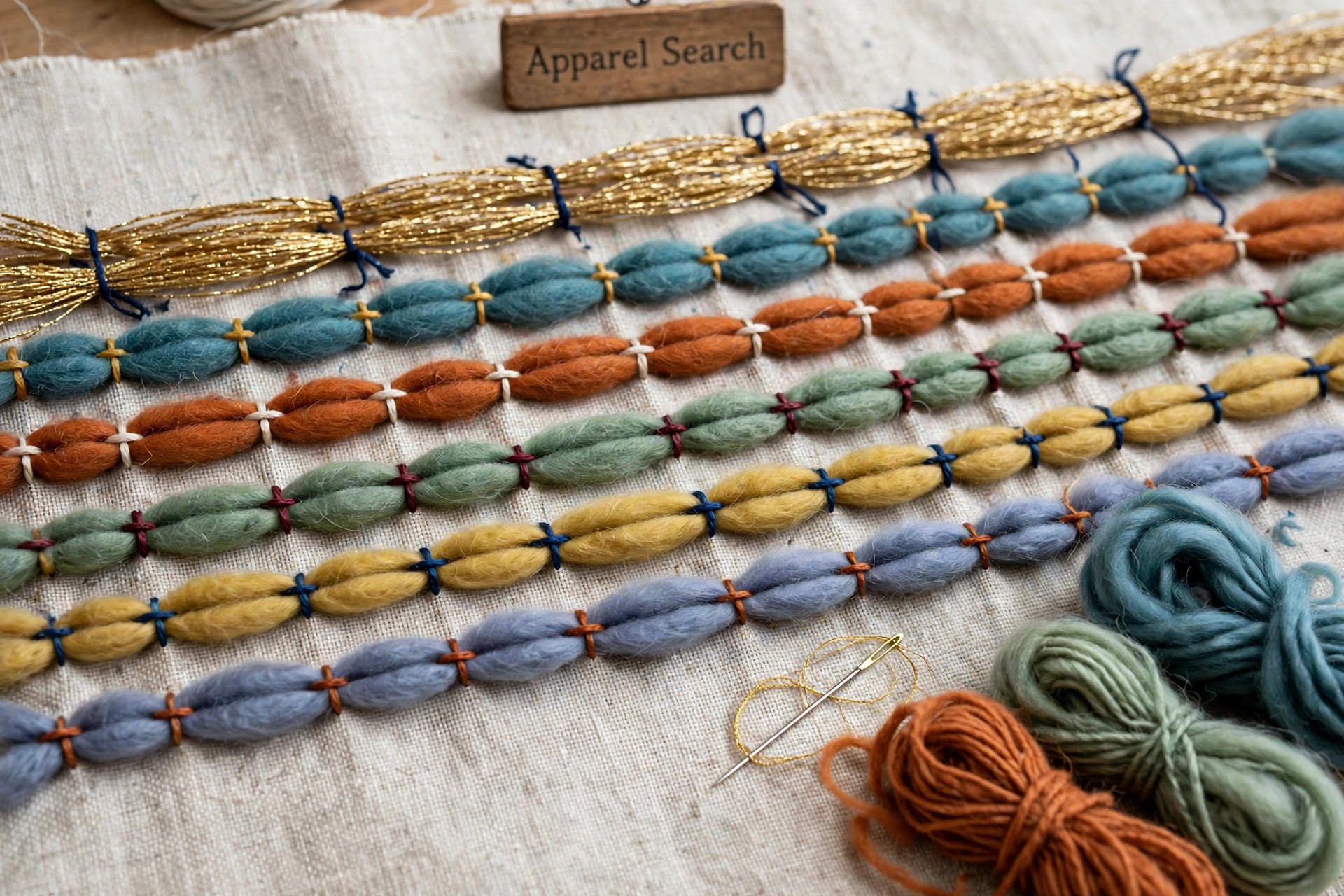
Why Precious Threads Are Laid, Not Stitched Through
Couching exists because some threads should never be pushed through a ground fabric. Gold and other metal threads are stiff and costly, and every pass through the cloth bends and wears them; laid on the surface and tied down, nothing is wasted on the back of the work, the metal stays unbent, and parallel laid threads can cover a broad area quickly. The same reasoning serves thick cords, braids and bundles of yarn that no needle eye could carry through the fabric at all. The couching stitch is therefore structural first and decorative second — until the stitcher chooses a contrasting tying thread, at which point the tie-downs turn into pattern in their own right, worked as trellis, chequer or the aligned rows of tiny crossing stitches seen in Bokhara couching.
The Main Variants
In plain couching, one or more threads rest on the surface and are sewn to the fabric at regular intervals. In couched filling, the laid threads are arranged as a trellis and secured where they cross. In laid work — the Bayeux tapestry stitch — threads are placed side by side until they fill a shape, a further thread is laid across them at right angles, and that crossing thread is itself couched down, pinning the whole filling in place. Bokhara couching holds its laid threads with many tiny crossing stitches, which can be aligned from row to row to build patterns. Roumanian stitch takes a different scale: each long satin stitch is held by a small diagonal stitch at its centre, and in Roumanian couching, bundles of laid threads are secured with Roumanian stitches.

Surface Couching and Underside Couching
Surface couching and underside couching solve the same problem from opposite sides of the cloth. In surface couching the tying thread remains visible on the front, so its colour, spacing and regularity are part of the design and the measure of the workmanship. In underside couching a heavy couching thread — historically a stout linen — is brought up from the wrong side, looped over the laid thread and taken back down, then given a sharp pull that draws a small loop of the laid thread through to the back. The tying thread is then completely hidden from the front, and because it never sits on the surface it escapes wear. Spacing is the other great design decision: ties set close together hold a laid thread rigid and give a smooth, enamel-like surface, while wider spacing lets a soft yarn move slightly and reads as texture, and aligning or staggering the ties from row to row builds trellis, brick and chequer effects across a filled area.
Where Couching Has Been Used
Laid work is one of only two techniques used in the Bayeux tapestry, an embroidered cloth probably dating to the later 1070s, the other being stem stitch; its workers covered the large shapes of horses and ships with long laid threads and held the whole surface with a sparse grid of couching, at a fraction of the stitch count solid satin work would have needed. Underside couching of metal thread was characteristic of the earlier Opus Anglicanum of medieval England, and was also used historically in Sicily and, rarely, in other parts of Italy and France. Couching is likewise characteristic of Japanese metal-thread embroidery and of Central Asian suzani work. See the embroidery stitch definitions for the individual stitches that do the tying down.
Common Questions
How does couching work?
One or more threads are laid on the fabric surface and sewn to the fabric at regular intervals with small stitches. In couched filling the laid threads form a trellis pattern sewn down at the intersections; in laid work, or Bayeux stitch, threads lie side by side to fill a shape, a thread crosses them at right angles, and that crossing thread is couched down to hold them.
What is underside couching?
In underside couching a heavy couching thread, historically a stout linen, comes up from the wrong side, loops over the laid metal thread and returns to the wrong side, where a sharp pull draws a small loop of the laid thread through. The couching thread is completely concealed from the front and is not subject to wear — the technique characteristic of Opus Anglicanum in medieval England.
Where has couching been used historically?
Underside couching of metal thread was characteristic of Opus Anglicanum in medieval England and was also used in Sicily and rarely elsewhere in Italy and France. Couching is also characteristic of Japanese metal-thread embroidery and Central Asian suzani work, and laid work fills large areas of the Bayeux tapestry.