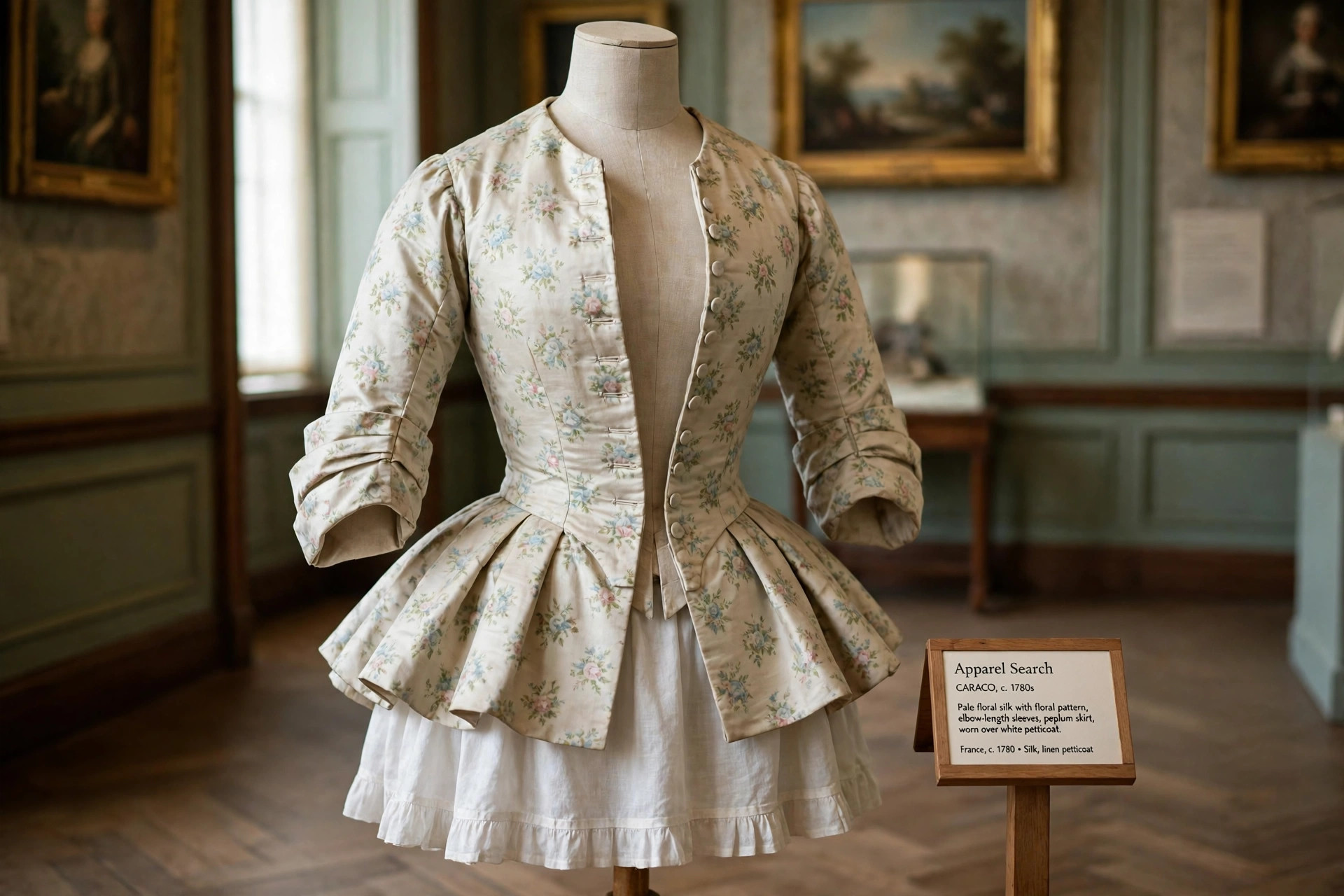
The caraco was a short, closely fitted jacket worn by women in the 1770s, 1780s, and 1790s, paired with a separate petticoat skirt rather than a one-piece gown. It fastened down the front, ended at the hip or just below the waist with a short peplum-like skirt of its own, and gave its wearer a neat, tailored outline that contemporaries considered both practical and smart. In the decades covered by 1750–1795 fashion, the caraco became one of the most useful garments in a woman's wardrobe.
Its name came from French fashion vocabulary, and the style was known across France, Britain, and America. At a time when fashionable dress could mean a wide sacque gown or a formal robe, the caraco offered something simpler: a jacket and skirt that could be mixed, matched, cleaned separately, and worn for ordinary days as readily as for visits.
From Working Dress to Fashion
The caraco began in working and informal dress. Market women, servants, and country women had long worn short jackets over skirts because the combination was economical, easy to move in, and easy to launder. Fashionable women adopted the form in the later 18th century, part of a wider taste for simpler, more 'natural' dress that also produced the robe à l'anglaise, the fitted gown that became the caraco's closest fashionable relative.
In silk, the caraco was anything but humble. Surviving examples use striped, sprigged, and brocaded silks, quilted linings, and carefully shaped fronts that close with hooks, pins, or a stomacher-like panel. In cotton and linen prints, the same cut served middling and working wearers. The jacket's short skirt flared slightly over the hips, echoing the peplum of a riding habit, another tailored influence on women's dress in this period.
Construction and Fit
A caraco was cut with a fitted back, often with seams curving to a point at the waist, and sleeves that reached the elbow or the wrist. Necklines were usually modest and could be filled with a kerchief. The front might meet edge to edge over stays, or overlap and pin across the chest. Because jacket and skirt were separate, a woman could wear one caraco with several petticoats — plain wool for work, quilted satin or silk for company — stretching a wardrobe much further than a single gown allowed.
As the 1790s approached, waistlines rose and the caraco shortened with them, foreshadowing the brief spencer jacket of the next decade. When high-waisted white muslin gowns replaced structured dress after about 1795, the caraco in its classic form faded, its role taken by shorter jackets and outer garments.
Legacy
The caraco matters because it marks the moment the separate jacket became respectable fashionable dress for women, not just workwear. Every later suit jacket, tailored separate, and jacket-and-skirt ensemble descends in part from this 18th-century solution. Museum collections preserve caracos in silk and in humble printed cotton alike, a reminder that the garment crossed class lines more freely than almost any other fashionable form of its century.
Common Questions
- What is a caraco?
- A caraco was a short, fitted women's jacket of the 1770s to 1790s, worn over a separate petticoat skirt instead of a full gown. It fastened at the front and ended at the hip or just below the waist.
- How was a caraco different from a gown?
- A gown such as the robe à l'anglaise was a single garment with bodice and skirt joined. A caraco was a separate jacket that could be mixed with different skirts, making it more flexible and economical.
- Who wore caracos?
- Women across society wore caracos — working women in cotton and linen versions, and fashionable women in silk examples worn for informal visits, country dress, and everyday wear.
Historic Garments & Accessories
- Fashion History Guide
- Pelisse
- Polonaise
- Robe à la Française
- Robe à l'Anglaise
- Robe en Chemise (Chemise à la Reine)
- Justacorps
- Inverness Cape
- Kirtle
- Bliaut
- Houppelande
- Poulaine
- Pomander
- Caraco
- Banyan
- Pagoda Sleeve
- Paned Sleeve
- Kokoshnik
- Hennin
- Bergère Hat
- Capeline
- Cartwheel Hat
- Cocktail Hat
- Gainsborough Hat
- Halo Hat
- Shako