Backstitch
Sewing Definitions — the line stitch worked backward to go forward, and its stem, outline and split stitch family, from Apparel Search
Search Apparel Search
At a Glance
Definition: Backstitch is a class of embroidery and sewing stitches in which individual stitches are made backward to the general direction of sewing, forming continuous lines used to outline shapes and add fine detail.
Also known as: Back stitch
Category: Sewing Definitions
Backstitch, or back stitch, and its variants stem stitch, outline stitch and split stitch form a class of embroidery and sewing stitches in which individual stitches are made backward to the general direction of sewing. Because the stitches form lines, they are used most often to outline shapes and to add fine detail to an embroidered picture. Basic backstitch outlines shapes in modern cross-stitch, in Assisi embroidery and occasionally in blackwork; it follows smooth and complicated outlines equally well, and it serves as a foundation row for more complex stitches. Worked as a utility stitch, the same backward movement makes it the strongest of the common hand stitches for joining two pieces of fabric. This page covers how backstitch is worked, the family of variants built on it, and the history carried by stem and split stitch.
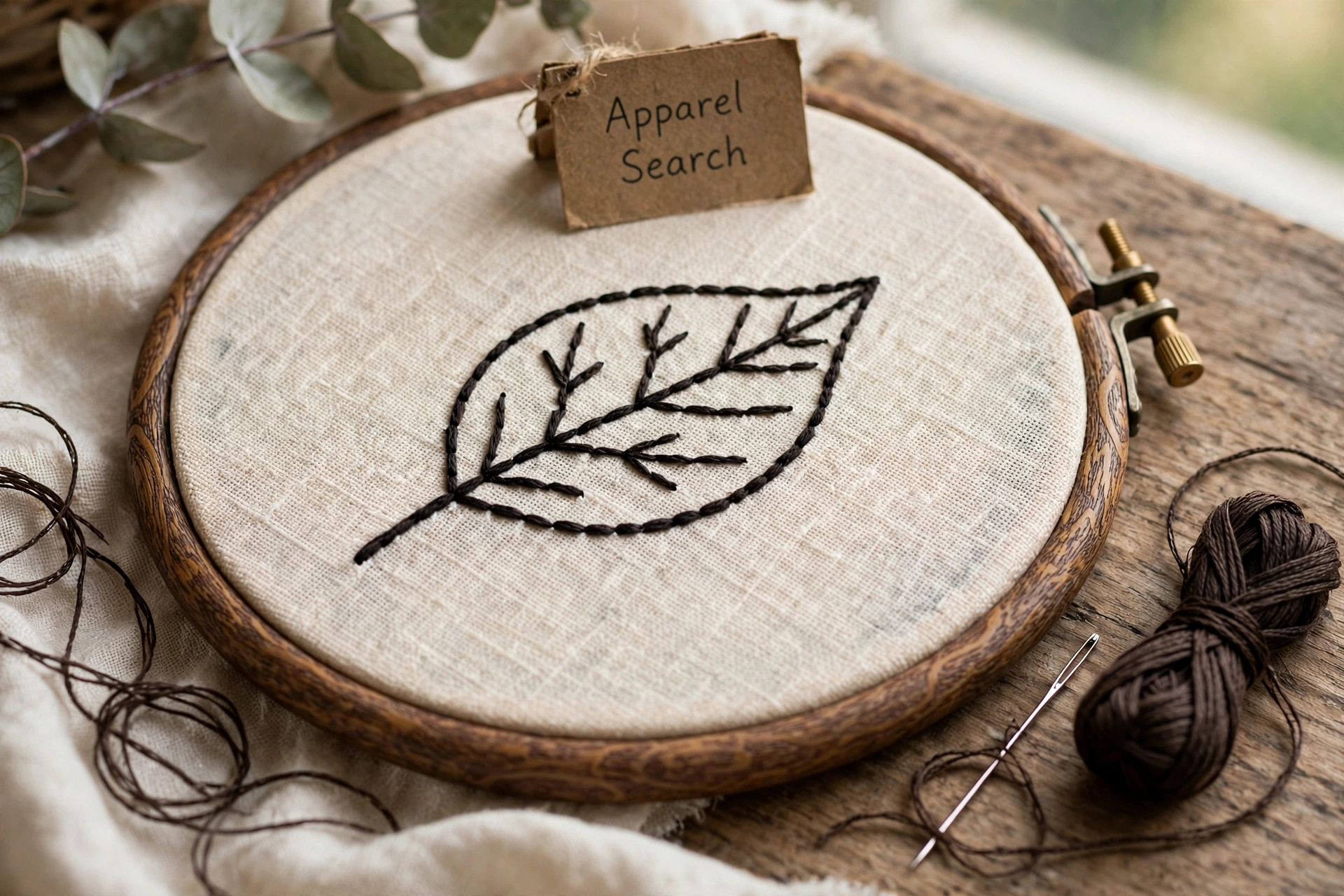
A Line Stitch That Goes Back to Go Forward
Backstitch earns its name from its movement. The needle comes up ahead of the previous stitch and goes back down into the end of it, so each new stitch overlaps backward before the thread travels forward again. The result on the surface is a continuous, unbroken line with no gaps — quite different from the dashed line of a running stitch. That continuity is why backstitch is the default outlining stitch in so many embroidery traditions: lettering, stems, facial features and the edges of motifs all need a line that reads as solid at normal viewing distance.
Worked by hand as a utility sewing stitch, the same backward movement makes backstitch the strongest of the common hand stitches. Each stitch locks against the one before it, so a hand-sewn seam in backstitch resists pulling apart far better than a seam in running stitch. Before sewing machines, backstitch was the stitch of strong seams, and it is still the hand stitch chosen for small repairs, for sewing where a machine cannot reach, and for attaching two pieces of fabric together firmly by hand.
How Backstitch Is Worked
Backstitch is most easily worked on an even-weave fabric, where the threads can be counted to ensure regularity, and it is generally executed from right to left. The stitches are worked in a ‘two steps forward, one step back’ fashion along the line to be filled, as shown in the diagram: the needle travels forward under the fabric for two stitch lengths, comes up, and returns to the end of the stitch before it. Neatly worked in a straight line, the stitch resembles machine stitching.
Regularity is a counting discipline. In modern cross-stitch, backstitch is added last, over the completed crosses, to define edges and details, and its evenness depends on counting the even-weave fabric so that every stitch covers the same number of threads. The wider family of stitches it belongs to is surveyed in our embroidery stitches guide.

Stem, Outline and Split: One Family, Three Lines
The variants differ in how the thread is handled, and each produces a visibly different line. In stem stitch, each stitch overlaps the previous stitch to one side, forming a twisted line of stitching, with the thread passing below the needle; it is generally used for outlining shapes and for stitching flower stems and tendrils. Whipped stem stitch works a second thread over that foundation. Outline stitch is sometimes distinguished from stem stitch in that the thread passes above rather than below the needle — a small change that reverses the direction of the twist.
In split stitch, the needle pierces the thread of the previous stitch rather than returning to one side of it, splitting the fibres and giving a fine, slightly textured line that suits smooth shading. Split stitch in silk is characteristic of Opus Anglicanum, the embroidery style of medieval England. Threaded backstitch and Pekinese stitch extend the family further: Pekinese stitch is a looped, interlaced backstitch, and threading or lacing a second thread through a foundation row of plain backstitch builds a heavier, decorative line without a single new hole in the fabric. Basic backstitch itself carries a French name, point de sable.
An Ancient Family: Paracas, Bayeux and Opus Anglicanum
The family's age is considerable. Stem stitch is an ancient technique: surviving mantles embroidered with stem stitch by the Paracas people of Peru are dated to the first century BCE. Stem stitch is used in the Bayeux Tapestry, an embroidered cloth probably dating to the later 1070s, for lettering and to outline areas filled with couching or laid-work.
A versatile and easy stitch to work, backstitch is ideal for following both smooth and complicated outlines, and as a foundation row for more complex embroidery stitches such as herringbone ladder filling stitch, where the backstitch row gives the lacing something to hold to. The standard references behind this page's account — among them Mary Thomas's Dictionary of Embroidery Stitches and The Dictionary of Needlework (1885) — treat backstitch and its variants as a single family, which is how working embroiderers still learn them: one backward movement, varied by where the needle returns and how the thread is carried.
Not to Be Confused With
Not to be confused with Holbein stitch. Backstitch is superficially similar to Holbein stitch, commonly used in blackwork embroidery, but the two differ in the way they are worked: backstitch completes its line in a single journey, each stitch returning into the end of the one before, while Holbein stitch requires a return journey to fill the gaps left by the first pass. For the embroiderer the practical difference is speed and thread path; for the viewer, a well-worked line of either is a clean outline.
Common Questions
What is backstitch?
Backstitch is a class of embroidery and sewing stitch in which individual stitches are made backward to the general direction of sewing. It forms lines used to outline shapes and add fine detail.
How is backstitch worked?
Backstitch is worked in a two steps forward, one step back fashion along the line to be filled, most easily on even-weave fabric where threads can be counted. Neatly worked in a straight line it resembles machine stitching.
What are the main variants of backstitch?
Variants include basic backstitch, threaded backstitch, Pekinese stitch, stem stitch, whipped stem stitch, outline stitch and split stitch, in which the needle pierces the thread rather than returning to one side.
Is backstitch strong enough for a seam?
Yes. Worked by hand as a utility stitch, backstitch is the strongest of the common hand stitches, because each stitch locks against the one before it. It is still used for small repairs and for attaching two pieces of fabric together where a machine cannot reach.