Even-Weave Fabric
Fabric Definitions — definitions of fabrics, cloths, laces and textile materials from Apparel Search
Even-weave fabric, or canvas, is any woven textile where the warp and weft threads are of the same size. Even-weave fabrics are typically required as foundations for counted-thread embroidery styles such as cross-stitch, needlepoint and blackwork, so that a stitch of the same count will be the same length whether it crosses warp or weft threads. Even-weave fabrics include even-weave linen, Aida cloth and needlepoint canvas.
Even-weave fabric or canvas is any woven textile where the warp and weft threads are of the same size.
Even-weave fabrics are typically required as foundations for counted-thread embroidery styles such as cross-stitch, needlepoint, and blackwork so that a stitch of the same "count" (that is, crossing the same number of fabric threads) will be the same length whether it crosses warp or weft threads.
Even-weave fabrics include even-weave linen, aida cloth, and needlepoint canvas.
Learn more about fabric.
Learn about knit fabrics.
Learn about woven fabrics.
|
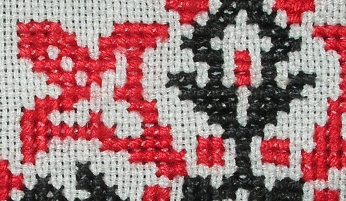
The Grid Under the PictureEven-weave is best understood as graph paper made of thread. Every counted technique in embroidery — cross-stitch laying its X over a set square, blackwork building symmetrical filling patterns, Hardanger cutting and weaving counted blocks, Assisi work reserving a counted silhouette — assumes that the fabric's grid is regular enough to serve as the design's coordinate system. The photograph that accompanies this definition, a close-up of cross-stitch on even-weave, shows the system working: black and red cotton floss in folk patterns characteristic of the embroidery of eastern and central Europe sit stitch by stitch on a ground whose threads can be counted at a glance. Remove the regularity and the same chart produces a distorted picture; the fabric, not the chart, is where proportion lives. Choosing Among Even-WeavesThe even-weave shelf is a graded set of compromises between ease and refinement. Aida cloth groups its threads into obvious blocks and is the most forgiving to count. Woven even-weaves such as jobelan present single threads in a smooth, regular grid at counts from the low 20s to the 30s. Linen even-weave offers the finest counts, the best drape and the most traditional surface, at the price of occasional slubs and slightly irregular threads that experienced stitchers read as character and beginners read as errors. Needlepoint canvas is the stiff, open member of the family, its mesh sized for wool and tent stitch rather than floss. All satisfy the same definition — warp and weft of the same size — and the choice among them is about how visible the grid should be while the work is in progress, and how invisible it should be when the work is done. Common QuestionsWhy does counted-thread embroidery need even-weave?A charted design assumes a square grid. If warp and weft threads differ in size or spacing, a motif counted square on the chart comes out stretched taller or wider on the cloth. On true even-weave, crossing ten threads horizontally and ten vertically gives the same measurement both ways, so the stitched design keeps the chart's proportions. What does fabric count mean for even-weave?The count is the number of threads per inch. Cross-stitch on linen even-weave is commonly worked over two threads, so a 28-count linen gives 14 stitches per inch — the same working scale as 14-count Aida, whose count is given directly in woven squares per inch. How can a fabric be tested for even weave?Count the threads in a measured inch in both directions and compare, and stitch or draw a counted square: if a square of, for example, 20 by 20 threads measures the same on both sides with a ruler, the weave is even enough for counted work. Slightly uneven natural linens may need the stitcher to compensate. More to ExploreMore from Apparel Search: Fabric Definitions | Clothing Industry Glossary | Fashion Terms | Apparel Search Home
|