Assistant Buyer Job Description
The junior professional role that supports a buyer — and learns buying from the inside
An assistant buyer is a junior professional on a retail buying team who supports a buyer while learning the trade on live ranges. The distinction matters: this is not a clerical post. An assistant buyer attends vendor appointments, helps build assortments, analyses sales, manages samples with growing independence, and is being deliberately developed toward running a department of their own. Most fashion buyers in senior positions started here, because buying judgement — what to back, how deep to buy it, when to walk away — is learned by watching real decisions and their consequences season after season. This page explains the assistant buyer's duties, the skills employers look for, the qualifications that help, and how the role progresses.
More Buying Job Descriptions by Letter:
What an Assistant Buyer Does
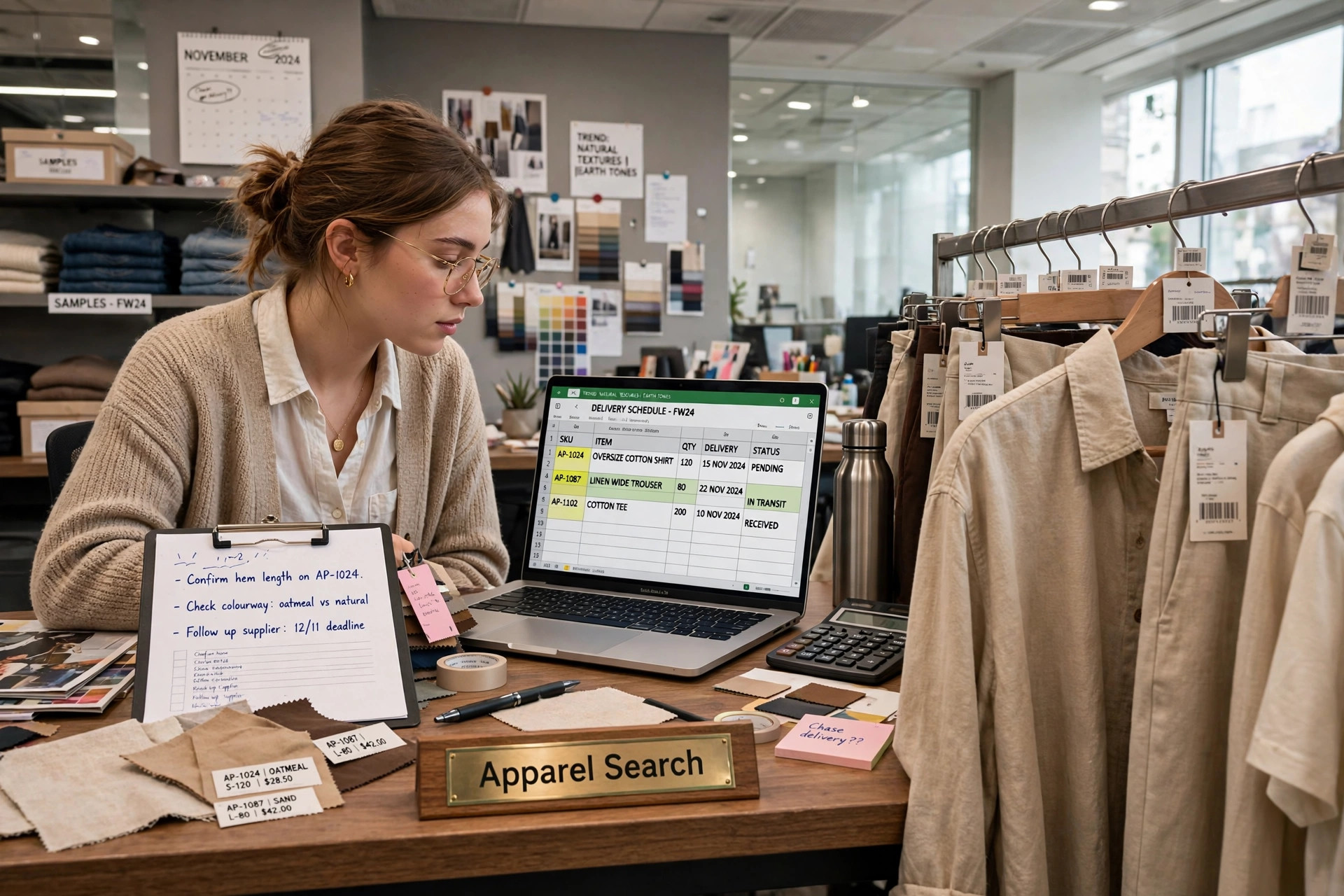
The assistant buyer works as the buyer's right hand across the whole buying cycle. Before a season, that means preparing sales history and competitor research for range reviews, organising samples as they arrive from vendors, and sitting in on appointments to take notes, record costs and follow up agreed actions. During range building, the assistant buyer helps assemble the assortment plan — checking that styles, colours and price points balance across the department — and raises the purchase orders the buyer has approved, confirming quantities, sizes, costs and delivery dates in writing.
In season, the assistant buyer becomes the team's early-warning system. They produce and circulate weekly sales reports, flag styles that are selling faster or slower than planned, track deliveries against the critical path, and chase vendors when shipments slip. They manage the sample library and fit sessions, coordinate with merchandising and allocation colleagues so stock flows to the right stores, and handle the competitor shops and price checks that keep the buyer informed about the market. As experience grows, the buyer delegates real pieces of the range — a small category, a rebuy decision, a vendor relationship — for the assistant buyer to own.
How the Role Differs From Pure Administration
Assistant buyers handle paperwork, but paperwork is not the purpose of the role. The defining feature is development: employers expect an assistant buyer to form opinions about product, to question a quantity or a price with evidence, and to present analysis that changes decisions. In appointments, a good assistant buyer is learning to read a vendor's range critically — comparing quality, spotting the item that fits a gap in the assortment, noticing when a cost does not match the construction in hand. Those judgements, practised under supervision, are exactly what a buyer is paid for.
The role also teaches the commercial disciplines that separate buying from shopping. Assistant buyers learn open-to-buy control, margin and markdown maths, size-ratio and depth decisions, and the cost of mistakes: stock that arrives late, a style bought too deep, a winner repeated too slowly. Seeing a department's results land each week, and connecting them back to decisions made months earlier, builds the cause-and-effect understanding that no classroom replicates as well.
Skills and Abilities the Role Requires
Employers look first for numeracy and analytical confidence. The assistant buyer lives in spreadsheets and sales reports, so accurate, fast work with figures — sell-through, margin, stock cover, size performance — is the foundation everything else rests on. Product sense comes next: a genuine interest in clothing, fabric and fit, and the ability to explain why one garment is right for the customer and another is not. Neither alone is enough; the role exists precisely at the junction of the two.
Organisation and communication complete the picture. Sample rooms, delivery schedules and order deadlines all fail quietly if nobody chases them, and the assistant buyer is usually the person who chases them. Clear written confirmations to vendors, calm handling of several competing deadlines, and the confidence to speak up in a range review with data in hand are the habits that mark out an assistant buyer ready for promotion.
Qualifications, Training and Career Path
Many assistant buyers hold degrees or diplomas in fashion buying, fashion business, merchandising or marketing, and courses with a retail placement year are particularly effective preparation because graduates arrive already familiar with buying-office routines. Formal qualifications are not the only route: strong retail experience — especially department or store roles involving stock, sales analysis or supervisory responsibility — plus evidence of numerical ability can also win these posts, and internal moves from merchandising or allocation teams are common.
The career path from assistant buyer is the buying ladder itself. A capable assistant buyer is promoted to buyer on a smaller department or category, takes ownership of its assortment and budget, and can then progress to senior buyer and divisional merchandise manager. The assistant years are therefore best treated as an apprenticeship with a syllabus: range planning, vendor negotiation, financial control and in-season trading. Assistant buyers who deliberately learn all four, rather than only the tasks they are given, move fastest.
Common Questions
Is an assistant buyer the same as a buyer's assistant?
No. An assistant buyer is a junior professional being trained to become a buyer, with analytical and range-planning duties. A buyer's assistant is an administrative support role focused on orders, samples and office organisation. The two roles work together but are hired and paid differently.
What qualifications do assistant buyers need?
Many hold a degree or diploma in fashion buying, fashion business or merchandising, ideally with a placement year. Employers also hire from retail and merchandising backgrounds when a candidate shows strong numeracy and real product knowledge.
How long does it take to go from assistant buyer to buyer?
It varies by employer and department size, but assistant buyers who master sales analysis, range planning and vendor work are commonly promoted after a few seasons of strong performance, usually first to a small category of their own.