Couture Designer Job Description
Designing haute couture — one-off, hand-finished garments made for individual clients in the atelier
A couture designer creates garments at fashion's highest level of making: individually designed, fitted to one client's body, and constructed largely by hand in an atelier. The original Apparel Search description made the entry requirement plain — a couture designer must know far more than the difference between haute couture, ready-to-wear and pret-a-porter. Behind those terms sits a whole system: protected designations, ateliers of specialist craftspeople, multiple fittings per garment, and hand techniques — draping, embroidery, feather and flower work — that industrial production cannot reproduce. This page explains how couture designers work within that system.
More Design Job Descriptions by Letter:
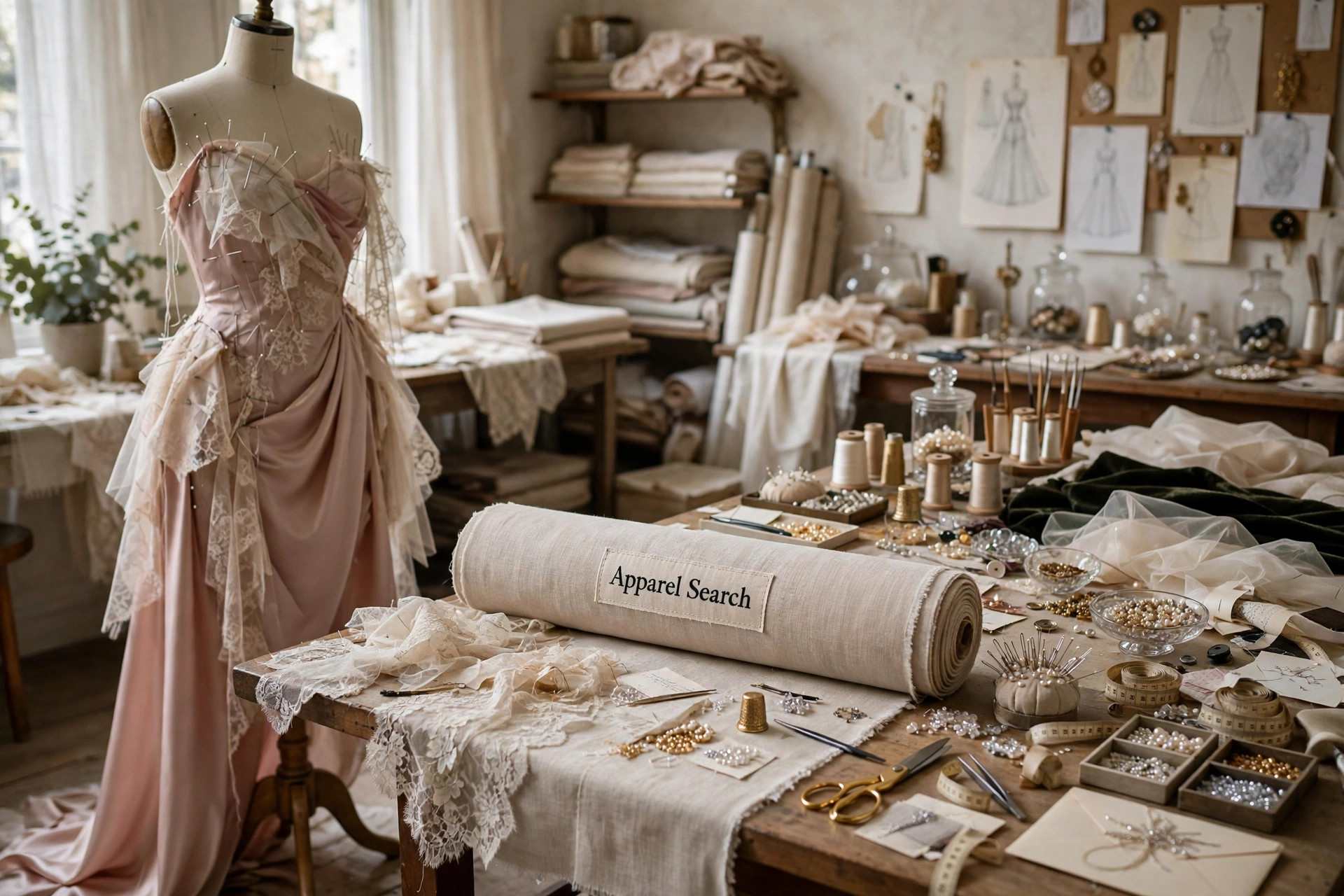
What a Couture Designer Does
The couture designer's work begins in two places: the seasonal collection, which presents the house's vision in shows and salons, and the individual client, whose commissions adapt that vision to one person's body, life and taste. For a client garment, the designer consults on occasion, silhouette and fabric, sketches proposals, and has a toile — a trial version in plain cloth — made and fitted, often through several fittings, before the real fabric is cut. Every proportion is adjusted on the client: the garment is not graded from a standard size but built around an individual.
Inside the atelier, the designer directs specialist hands: pattern cutters who drape and draft to the client's measurements, tailors and dressmakers who construct and hand-finish, and embellishment specialists who execute embroidery, beading and other surface work to the designer's samples. The designer reviews work at each stage, resolves how a sketch's intention survives contact with gravity, cloth and a moving body, and signs off the finished garment. Show collections add creative direction duties — casting, styling and the narrative of the presentation — on top of the making.
Haute Couture, Craft and the Atelier System
Haute couture is a legally protected designation in France, awarded to houses meeting strict criteria on made-to-order work, fittings and atelier size, and governed by the industry's official body; elsewhere, couture describes the same level of individual, hand-finished making without the formal title. Either way, the designer's medium is craft capacity: what the atelier's hands can do sets what can be designed. Feathers, hand-rolled hems, internal corsetry, hand-set zips and embroidery that takes hundreds of hours are design resources here, and the designer composes with them as other designers compose with prints.
That is why couture design knowledge is unusually deep in construction. The designer must understand draping on the stand, pattern geometry, fabric behaviour at the level of individual bolts of cloth, and the sequence in which a complex garment is assembled, in order to design pieces the atelier can realise beautifully rather than approximately. Time is the other material: a single gown may carry weeks of handwork, and the designer plans collections around atelier capacity and client deadlines such as weddings and major events, where the delivery date cannot move.
Skills and Abilities the Role Requires
Exceptional design judgement comes first — an instinct for proportion, line and embellishment exercised at the level of a single garment for a single wearer. Draping skill is central, because couture silhouettes are discovered on the stand more than on paper, supported by strong drawing for client presentation. The designer also needs the client skills the made-to-order system demands: discretion, patience through fittings, and the ability to interpret what a client wants — including when the client's words and the garment's needs point in different directions — into design decisions she will love wearing.
Leadership of craftspeople completes the role. Atelier teams are small, senior and proud of their skills; the designer directs them through samples, fittings and corrections, and earns cooperation by demonstrating genuine respect for the crafts — ideally including hands-on ability in some of them. Commercial sense exists here too, in a particular form: couture economics run on a small number of high-value commissions and the brand value collections generate, and the designer balances creative ambition against what clients will actually commission and what the atelier can deliver superbly.
Qualifications, Training and Career Path
Couture designers typically combine high-level fashion design training with atelier craft experience: degrees from leading fashion schools, followed by internships and assistant posts inside couture or luxury houses, where draping, fitting and hand-finishing standards are absorbed over years. Many strengthen their craft with pattern cutting, tailoring or embroidery study. There is no shortcut around the making knowledge — a designer who has never fitted a toile or supervised hand construction cannot direct those who do, and houses test for exactly that depth.
Careers develop within a small, international world: assistant to the atelier or studio, designer responsible for part of a collection, head of atelier or studio, and for a few, creative direction of a couture house. Others build private client practices and bridal and occasion ateliers, where couture methods serve individual commissions outside the official calendar. It is the smallest employment field in this directory and the most craft-saturated: success is measured garment by garment, in work intended to be kept and worn for decades.
Common Questions
What is the difference between haute couture and ready-to-wear?
Haute couture garments are made to order for individual clients, fitted through multiple fittings and largely hand-constructed in an atelier; in France the term is legally protected for houses meeting official criteria. Ready-to-wear (pret-a-porter) is designed and produced in standard sizes for sale off the rail, however luxurious the brand.
What skills does a couture designer need most?
Draping and construction knowledge deep enough to direct an atelier, refined design judgement for one-off garments, and client skills — discretion and patience through consultations and fittings. Craft experience in pattern cutting, tailoring or embellishment strongly supports the role.
How do you become a couture designer?
Through leading fashion design training plus sustained atelier experience: internships and assistant posts in couture or luxury houses, building draping, fitting and hand-finishing knowledge over years. The field is small and appointment is based on demonstrated craft and design depth.