Teacher of Fashion & Textiles Job Description
Teaching the subject itself — fibres, fabrics, design and making, taught as a classroom discipline in schools and colleges
A teacher of fashion and textiles teaches the subject: how fibres become fabrics, how fabrics behave, how garments are designed, patterned and made, and how the fashion industry around those skills works. The setting is a classroom and workshop in a secondary school, sixth-form or further-education college, and the pupils are students following a syllabus toward coursework deadlines and examinations. It is a teaching post first and a fashion post second, and its craft is turning specialist knowledge into lessons a fourteen-year-old can succeed at.
More Miscellaneous Job Descriptions by Letter:
Planning and Teaching the Subject
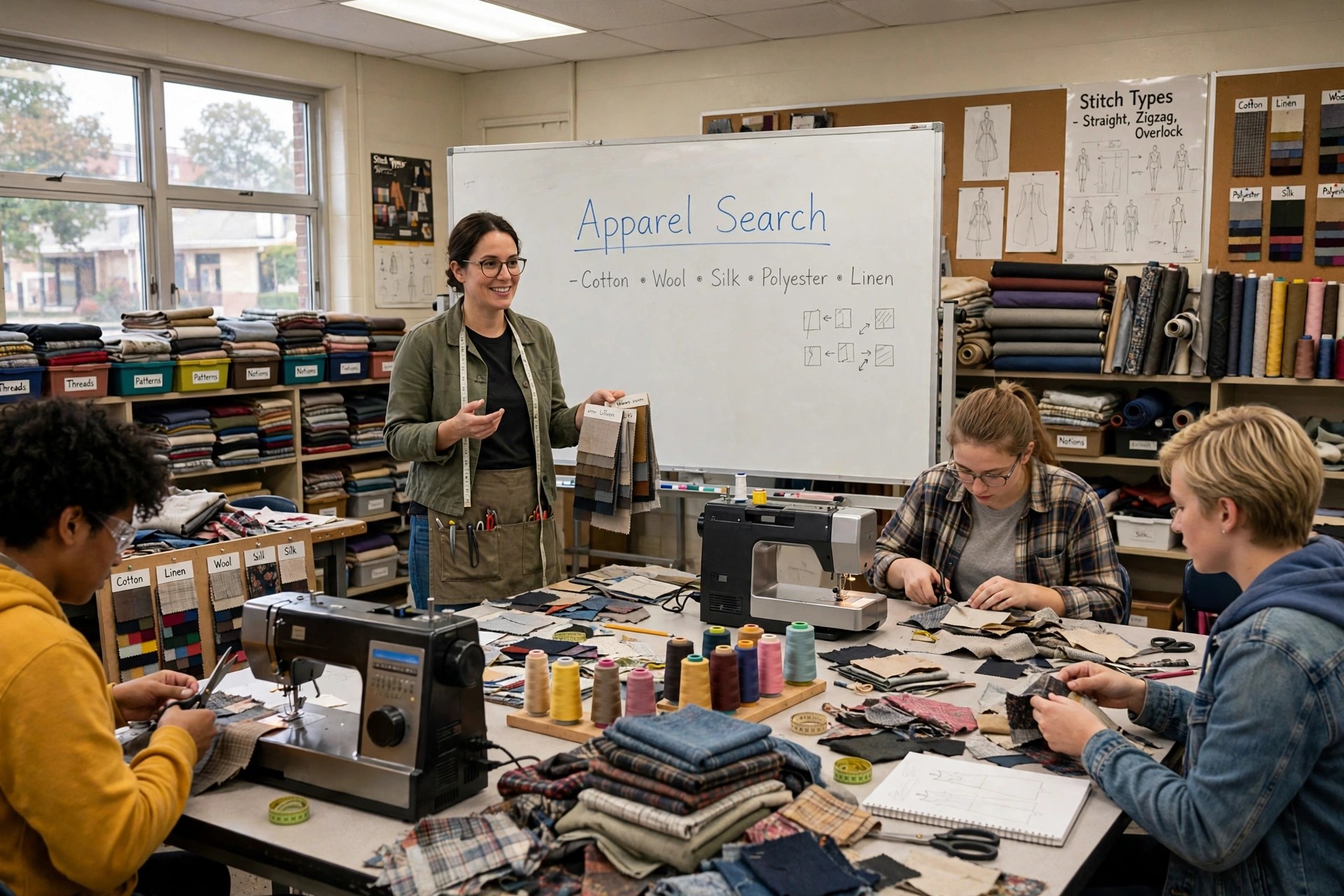
The teacher's year is built from schemes of work: the syllabus broken into sequenced lessons that move students from fibre and fabric knowledge — natural and manufactured fibres, yarns, weaves and knits, finishes and their properties — through design work, pattern drafting and garment construction, to evaluation of finished pieces against a design brief. Lessons mix demonstration, theory and long stretches of supervised practical work, and the teacher plans each one for the actual class in front of them: adapting tasks for different abilities, stretching the strongest toward complex construction, and keeping thirty adolescents with needles, irons and sewing machines safe and progressing at once.
Practical teaching is the subject's heart and its hardest management problem. The teacher demonstrates techniques — seams, fastenings, decorative methods, pattern adaptation — then circulates, diagnosing a jammed machine here, an unpicked seam there, a toile that reveals a drafting error worth a whole class's attention. Materials and equipment are budgeted, ordered, stored and maintained through the teacher's planning: fabrics, threads, patterns, machine servicing and the small consumables without which a practical lesson collapses.
Assessment, Coursework and Student Progress
Fashion and textiles courses are assessed through a demanding mix of controlled coursework — design folders and a made product, documented from first research to final evaluation — and written examinations on materials, processes and industry knowledge. The teacher is assessor as well as instructor: setting interim deadlines across months of project work, marking and moderating coursework to the awarding body's criteria, keeping the evidence trails examiners require, and preparing students for the written papers with the same rigour as the practical ones. A missed coursework deadline is a grade lost, so project management of thirty individual design projects is a real and constant part of the job.
Around the subject sits the ordinary, essential machinery of teaching: tracking each student's progress against targets, reporting to parents, contributing to the department's results analysis, supporting students choosing GCSE, A-level or college pathways, and running the enrichment that keeps a subject alive — fashion clubs, competitions, industry visits, links with local colleges and employers. Pastoral duties and whole-school responsibilities come with the post, and in a workshop subject the teacher writes and follows the risk assessments personally.
Skills and Abilities the Role Requires
Two kinds of expertise must meet in one person. The subject expertise is genuine and practical: fibres and fabric science, garment construction to a standard worth teaching, pattern work, design communication, and enough industry knowledge — production methods, sustainability, consumer and market issues — to teach the syllabus's theory with authority. The teaching expertise is the larger half: explaining clearly, questioning well, managing a practical classroom's behaviour and energy, differentiating for the full ability range, and assessing accurately enough that predicted grades can be trusted.
Personal qualities decide who thrives. Patience with processes that cannot be hurried — a student's first zip takes as long as it takes — enthusiasm for other people's making rather than your own, and meticulous organisation, because coursework systems punish drift. Stamina matters too: practical subjects are physically busy, evenings carry marking and folder reviews, and the teacher who loves both the subject and the students is the one still improving in year ten.
Qualifications, Training and Career Path
School teaching requires qualified teacher status: typically a degree — in textiles, fashion, design technology or a closely related subject — plus a postgraduate teaching qualification or a school-based training route, followed by an induction period as an early-career teacher. Further-education colleges ask for a teaching qualification such as a PGCE or certificate in education alongside strong subject and industry experience, and value recent practice in fashion or textiles work. Subject knowledge enhancement is available for graduates whose degrees sit adjacent to the syllabus, because schools need teachers who can actually sew, draft and explain a fibre diagram with equal confidence.
Careers progress within education: to head of department or head of faculty, where the textiles teacher leads curriculum, budgets and other staff; to advanced practitioner and lead-teacher roles supporting other schools; into initial teacher training and examining for awarding bodies, where experienced teachers set and mark the very papers they once taught toward. Some teachers move between sectors — school to college, college to university technical instruction, or into education publishing and resource design. The role suits makers who discovered that explaining how a garment comes together is as satisfying as making it, and who want that satisfaction multiplied by a classroom.
Common Questions
What does a teacher of fashion and textiles teach?
The subject itself, to a syllabus: fibres, yarns and fabric construction and properties, design and pattern work, garment making, and the fashion industry's production, consumer and sustainability issues — taught through lessons, practical workshop work, coursework projects and examination preparation.
How is this different from a general fashion educator role?
This page covers the school and college classroom teacher of fashion and textiles as a named subject, with its syllabus, coursework and examinations. Broader educator roles can also include lecturers, demonstrators and trainers working outside examined school courses.
What qualifications does a fashion and textiles teacher need?
Qualified teacher status for schools — usually a relevant degree plus a teaching qualification, or a school-based training route — and for further-education colleges a teaching qualification with strong subject and industry experience. Practical making skill is essential, not optional.